LMU Perovskite-Silicon Tandems Reach 34% Lab Efficiency as Robotic Synthesis Targets Space and Building Deployment Within Three to Five Years
Researchers at Ludwig Maximilian University of Munich are developing perovskite thin films and quantum dots backed by €3.7 million in funding, with commercial deployment in orbital and building-integrated photovoltaics projected within a three-to-five-year horizon contingent on stability validation.
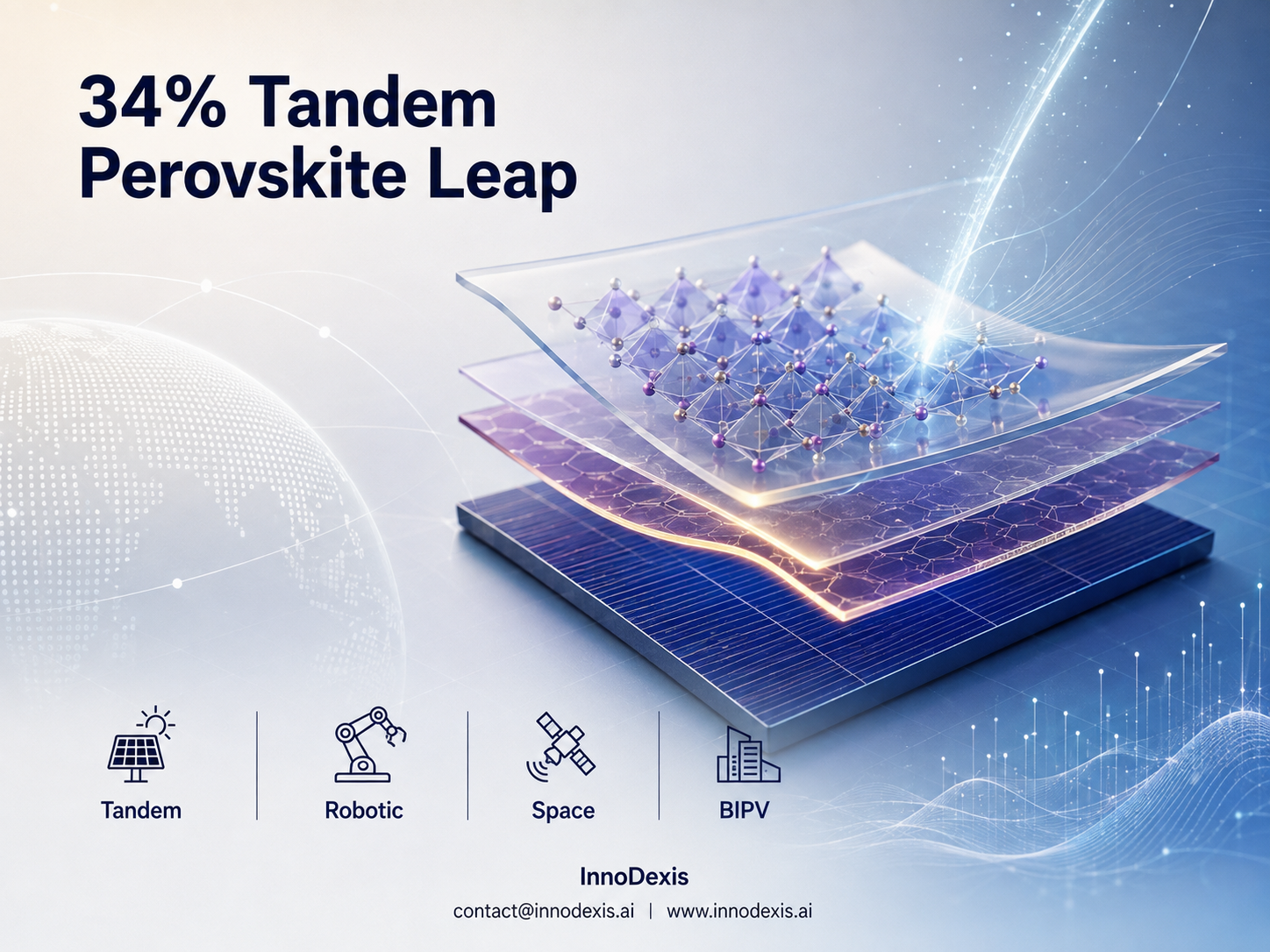
InnoDexis has published its latest Innovation Intelligence Report covering advanced photovoltaic materials and perovskite technology, analyzing a high-significance innovation from Germany in its latest report. The report reveals that researchers at Ludwig Maximilian University of Munich have developed perovskite thin films and quantum dots that achieve 34% efficiency in perovskite-silicon tandem configurations under laboratory conditions, supported by €3.7 million in European Research Council and Emmy Noether funding, with robotic synthesis at the core of the discovery approach and commercial deployment across space and building-integrated photovoltaics targeted within a three-to-five-year horizon.
Key Findings
Single-junction perovskite cells have exceeded 27% laboratory efficiency, while perovskite-silicon tandem configurations have reached 34% — a performance level that surpasses what single-material silicon cells can achieve due to perovskite's capacity to absorb a broader light spectrum. This efficiency ceiling distinction is structurally significant: the gains available through tandem architecture are not accessible to silicon alone, establishing perovskites as a necessary component of next-generation high-efficiency photovoltaic systems.
The thin film components developed at LMU measure under two micrometers in thickness and are solution-processable via low-cost printing or coating methods. This cost structure is fundamentally different from rigid silicon wafer production, removing a core manufacturing barrier that has historically constrained photovoltaic deployment in weight-sensitive and form-factor-sensitive applications including satellites and building facades.
Molecular interlayers have been introduced into the perovskite architecture specifically to absorb thermal stress and prevent delamination under orbital conditions. This represents a targeted engineering response to the primary barrier preventing perovskite deployment in space environments — thermal and environmental stability — and directly addresses the stability validation requirement that determines the three-to-five-year commercial deployment timeline.
Robotic synthesis has been positioned as the central discovery methodology for accelerating progress on the stability challenge. By automating the materials synthesis and screening process, LMU's approach compresses the experimental timeline for identifying stable perovskite formulations, moving the stability certification question toward a near-term commercial decision point rather than an open-ended research horizon.
The research targets deployment across three distinct application domains from a single material platform: space photovoltaics, building-integrated photovoltaics, and quantum communication. This convergence across multiple industries from one material base is a distinctive structural feature of perovskite technology that differentiates it from single-application photovoltaic development programmes.
Strategic Insight and Trend Analysis
The dominant trend emerging from this dataset is a deliberate shift in perovskite research focus — from efficiency record-setting toward manufacturable deployment across multiple industries simultaneously. The 34% tandem efficiency figure is significant not because it represents the absolute limit of perovskite performance but because it was achieved alongside a solution-processable, sub-two-micrometer thin film architecture that is compatible with real-world manufacturing processes. Efficiency and manufacturability are advancing together rather than in sequence.
This convergence matters strategically because the historical pattern in photovoltaic research has been a long lag between laboratory efficiency records and commercially deployable products. LMU's robotic synthesis approach is explicitly designed to compress that lag by accelerating the stability screening process — the specific bottleneck that has prevented perovskite photovoltaics from reaching the certification standards required for satellite and facade markets.
The three-to-five-year commercial deployment projection for space photovoltaics is contingent on stability validation, which is an honest framing of the remaining technical risk. However, the molecular interlayer engineering work targeting thermal stress and delamination in orbital conditions indicates that the stability problem is being approached with specific, testable solutions rather than remaining an abstract research challenge.
The multi-domain convergence across space, buildings, and quantum communication from a single material platform also has strategic implications for how organisations should evaluate perovskite investment. A material system that simultaneously addresses orbital energy generation, architectural integration, and quantum communication components creates cross-sector value that single-domain photovoltaic programmes do not replicate. This positions LMU's perovskite programme as a platform-level innovation rather than a domain-specific efficiency improvement.
Global and Industry Implications
For corporates and R&D teams in energy, aerospace, and construction, the LMU findings identify perovskite thin films as a near-term evaluation priority for applications where silicon's weight, rigidity, and cost structure are limiting factors. The solution-processable manufacturing pathway and sub-two-micrometer thickness directly address the engineering constraints that have prevented photovoltaic integration in satellites and building facades, making the stability certification timeline the primary variable to monitor.
For investors and capital allocators, the €3.7 million ERC and Emmy Noether funding base signals strong institutional validation of LMU's research programme. The three-to-five-year commercial deployment horizon for space photovoltaics provides a defined timeframe for tracking progress against stability milestones, while the multi-domain application potential across space, buildings, and quantum communication reduces single-market concentration risk relative to conventional photovoltaic investments.
For policymakers and national innovation bodies, the LMU programme demonstrates the compounding return available from funding platform-level materials research. European Research Council investment in a single perovskite research programme is generating advances simultaneously relevant to energy security, space infrastructure, and quantum technology — three separate areas of strategic national and regional policy priority.
InnoDexis Statement
"LMU's perovskite programme signals a structural transition in photovoltaic research — from laboratory efficiency records toward manufacturable, multi-domain deployment — with robotic synthesis compressing the stability certification timeline that separates the 34% laboratory result from commercial reality," noted InnoDexis in its latest intelligence report.
Conclusion
Perovskite photovoltaics are approaching a commercial inflection point across multiple application domains simultaneously. As stability validation progresses and robotic synthesis accelerates the materials screening process, the three-to-five-year deployment horizon for space and building-integrated photovoltaics will become a defined milestone rather than a projected estimate. InnoDexis will continue to monitor perovskite stability certification progress, tandem efficiency advances, and deployment timelines across orbital, architectural, and quantum communication applications. The complete Perovskite Photovoltaics Innovation Intelligence Report is available to InnoDexis subscribers and enterprise clients.
About InnoDexis
InnoDexis is a global Innovation Intelligence platform that tracks, analyzes, and interprets breakthrough innovations, prototypes, and emerging technologies across industries and countries. Its intelligence helps corporates, investors, and policymakers understand the true structure and direction of global innovation. Learn more at innodexis.ai.