Laser Shock Compression Converts PET Plastic Into 10 Trillion Nanodiamonds Per Shot, Outperforming Explosive Detonation Purity
Researchers at HZDR and the University of Rostock have developed a laser shock compression method that converts plastic film into high-purity, uniform nanodiamonds, potentially displacing explosive detonation as the standard synthesis route for quantum sensing and medical imaging.
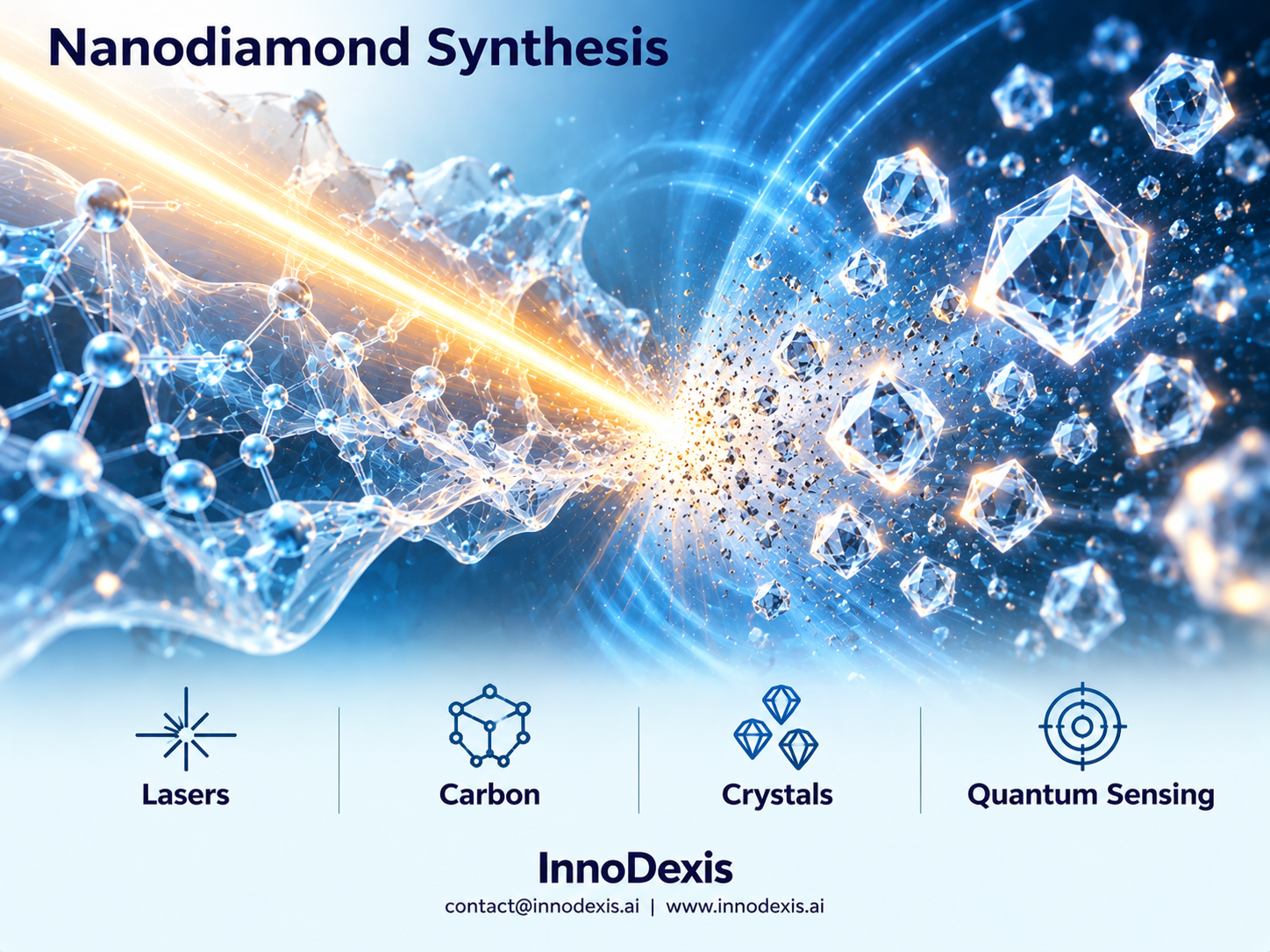
InnoDexis has published its latest Innovation Intelligence Report covering advanced nanomaterials synthesis, analyzing a high-significance innovation developed by researchers at HZDR and the University of Rostock in Germany. The report reveals that a laser shock compression method has been developed that converts 100-micrometre PET plastic film into approximately 10 trillion high-purity nanodiamonds per single laser shot, addressing the impurity and particle-size inconsistency limitations associated with conventional explosive detonation synthesis.
Key Findings
A single laser shot yields approximately 10 trillion nanodiamonds from a 100-micrometre PET plastic film target. This output scale from a single shock event demonstrates that laser shock compression can generate nanodiamond quantities at a level directly relevant to the throughput requirements of downstream applications such as quantum sensing and medical imaging.
The resulting nanodiamonds have an average diameter of 3 nanometres, each containing approximately 3,000 carbon atoms. This narrow, consistent particle size directly addresses the irregular particle sizing that has historically limited explosive-detonation-produced nanodiamonds in precision applications.
Shock compression in this method achieves pressures of approximately 100 GPa, with ejection speeds exceeding 10 kilometres per second — comparable to the velocity of a meteorite impact. These extreme but controlled physical conditions are what enable the conversion of plastic film into nanodiamond structures within a single laser shot event.
The nanodiamonds are captured intact in a soft, water-soluble ionic gel that prevents destruction on impact. This capture mechanism is a critical enabling step, as it preserves the structural integrity of the nanodiamonds despite the extreme velocities and pressures involved in their formation.
Several hundred micrograms of nanodiamonds were recovered from 100 shots performed at a rate of three shots per minute. This recovery rate provides an initial quantitative benchmark for the method's near-term production throughput, ahead of any further scaling using higher-repetition-rate laser systems.
Strategic Insight and Trend Analysis
The dominant trend emerging from this dataset is the replacement of an uncontrolled chemical synthesis process with a controlled physical one. Conventional nanodiamond production has relied on explosive detonation, a method that introduces carbon contamination and produces irregular particle sizes as an inherent consequence of the chemical detonation process itself. Laser shock compression instead applies a precisely controlled physical mechanism — shock pressure and velocity — to achieve the same carbon-to-diamond transformation without those contamination pathways.
This shift from chemical to physical control carries structural significance for any application where nanodiamond purity and size uniformity are prerequisites rather than preferences. Quantum sensing and medical imaging both require narrow size distributions and minimal impurities to function reliably, which is precisely what explosive detonation synthesis has struggled to consistently deliver. A method capable of producing high-purity, uniform nanodiamonds at scale directly addresses the bottleneck that has constrained broader adoption of nanodiamonds in these precision-dependent fields.
The dependency identified for commercial viability — high-repetition-rate lasers — is notable because such laser systems are already under active development for fusion research, meaning the laser hardware requirement is not a standalone technical risk unique to nanodiamond synthesis but is being advanced in parallel by a separate, well-resourced research domain. This reduces the technical uncertainty associated with scaling this method compared with an approach that required entirely novel hardware development.
If this method scales successfully, the strategic implication is a potential displacement of explosive detonation as the standard synthesis route for nanodiamonds used in quantum sensors and medical contrast agents — representing a shift in the underlying manufacturing paradigm for an entire materials category.
Global and Industry Implications
For corporates and R&D teams in advanced materials, quantum sensing, and medical imaging, this method offers a potential nanodiamond supply route with substantially improved purity and size consistency compared with explosive detonation, directly relevant to applications where particle uniformity governs device performance.
For investors and capital allocators, the method's dependency on high-repetition-rate lasers already under development for fusion research reduces the technical risk profile associated with scaling, as the core hardware requirement benefits from investment occurring in an adjacent research domain rather than requiring dedicated development.
For policymakers and national innovation bodies, this innovation illustrates how physical synthesis methods can displace chemically uncontrolled industrial processes, with direct relevance to clean manufacturing policy priorities in advanced materials production.
InnoDexis Statement
"Laser shock compression replaces an uncontrolled chemical detonation process with a controlled physical one, producing nanodiamond purity and uniformity that explosive synthesis has structurally been unable to achieve," noted InnoDexis in its latest intelligence report.
Conclusion
As high-repetition-rate laser systems continue to advance through parallel investment in fusion research, the scalability of laser shock compression for nanodiamond production will determine how quickly this method can displace explosive detonation as the industry standard. The purity and size uniformity demonstrated in this single-shot process position it as a candidate manufacturing route for quantum sensing and medical imaging applications that require precision at the nanoscale. InnoDexis will continue to monitor developments in laser-driven materials synthesis, nanodiamond production methods, and their adoption across quantum and medical technology sectors. The complete Advanced Nanomaterials Innovation Intelligence Report is available to InnoDexis subscribers and enterprise clients.
About InnoDexis
InnoDexis is a global Innovation Intelligence platform that tracks, analyzes, and interprets breakthrough innovations, prototypes, and emerging technologies across industries and countries. Its intelligence helps corporates, investors, and policymakers understand the true structure and direction of global innovation. Learn more at innodexis.ai.