KIT and University of Tsukuba Demonstrate Waste-Heat-Driven Solid-State Cooling With No Electrical Input or Chemical Refrigerants
A heat-driven elastocaloric cooling prototype using coupled nickel-titanium shape-memory films has achieved a refrigerant temperature change of nearly 13°C powered entirely by waste heat at 130°C, eliminating both electric motors and gaseous refrigerants from the cooling process.
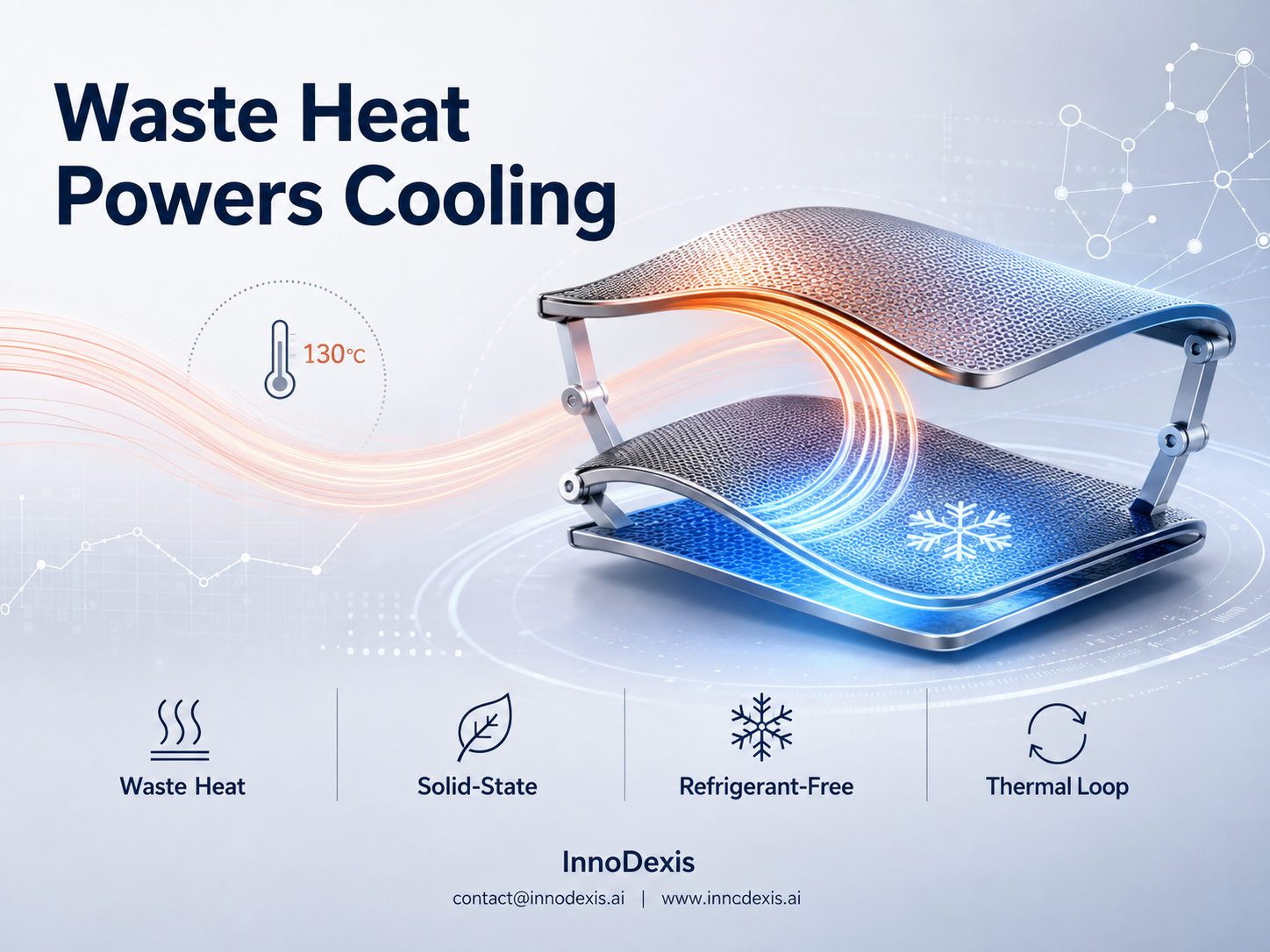
InnoDexis has published its latest Innovation Intelligence Report covering solid-state thermal management and waste heat recovery technology, analyzing a landmark cooling innovation developed jointly by the Karlsruhe Institute of Technology in Germany and the University of Tsukuba in Japan. The report reveals that researchers have experimentally verified a heat-driven elastocaloric cooling system using two coupled nickel-titanium shape-memory films that generates cold without any electrical input, operating at an external heat source temperature of 130°C and delivering a refrigerant temperature change of nearly 13°C — a physically distinct approach to cooling that removes electrical energy demand from the process entirely.
Key Findings
The prototype achieved a refrigerant temperature change of nearly 13°C driven entirely by waste heat, with no electrical input required at any stage of the cooling cycle. This experimentally verified result establishes that elastocaloric cooling driven by thermal energy alone is physically achievable at conditions relevant to real-world waste heat sources, including processors, engines, and solar thermal systems.
The system operates at an external heat source temperature of 130°C, with an actuator temperature of 86°C. These operating parameters place the prototype within the temperature range of waste heat commonly generated by industrial processes, automotive powertrains, and data centre infrastructure — confirming that the heat source requirements are compatible with existing thermal waste streams rather than requiring purpose-built energy inputs.
The design eliminates the electric motor actuator entirely, replacing electrical actuation with direct thermal-to-mechanical energy conversion through the shape-memory behaviour of nickel-titanium films. One film converts waste heat into mechanical work while the second converts that mechanical work into cold — a two-film coupled architecture that removes the electrical intermediary present in all conventional compressor-based cooling systems.
The solid-state design operates with no gaseous or liquid refrigerants. Conventional cooling systems rely on chemical refrigerants that contribute to global warming when released. The elastocaloric approach uses the reversible phase transformation of a solid nickel-titanium alloy as the working medium, eliminating refrigerant-related emissions and the associated regulatory and environmental risks from the cooling system entirely.
The current unoptimised prototype delivers a 4°C temperature difference at the component level. The researchers characterise this as an unoptimised result, indicating that the performance figures reported represent a baseline rather than a ceiling, and that further engineering refinement is expected to improve the temperature differential achievable at the component level.
Strategic Insight and Trend Analysis
The strategic significance of this prototype extends beyond its performance metrics. Cooling is one of the fastest-growing sources of global electricity demand, driven by data centre expansion, electric vehicle adoption, and rising ambient temperatures. Virtually all current cooling technology sits on the same side of the energy ledger — it consumes electricity generated elsewhere. The elastocaloric prototype sits on a structurally different side: it converts energy that is already being wasted into a useful cooling effect, without drawing from the electrical grid.
This inversion of the conventional energy relationship is the core strategic signal in the dataset. The waste heat from a processor, engine, or solar thermal collector — energy that would otherwise be dissipated without recovery — becomes the sole energy input for the cooling system. For applications where waste heat and cooling demand are co-located, this creates a self-contained thermal management loop that removes the cooling function from the electrical demand curve entirely.
The two-film coupled architecture also represents a meaningful engineering simplification relative to conventional cooling systems. By eliminating the electric motor actuator and the refrigerant circuit, the system reduces mechanical complexity, removes moving parts associated with compressor wear, and eliminates the refrigerant handling requirements that add cost and regulatory burden to conventional systems. Each of these simplifications has compounding benefits at scale.
The scaling pathway identified by the researchers — extending the film architecture toward passive thermal management for data centres, automotive powertrains, and off-grid solar installations — targets applications where waste heat availability and cooling demand are structurally aligned. If the performance of the optimised system validates the prototype's directional results, elastocaloric cooling could represent a meaningful structural shift in how thermal management is approached across multiple high-growth industries simultaneously.
Global and Industry Implications
For corporates and R&D teams, the immediate relevance is highest in sectors where waste heat and cooling demand are co-located: data centre operators managing processor thermal loads, automotive manufacturers addressing powertrain thermal management in electric vehicles, and industrial facilities generating process heat. The prototype's operating parameters at 130°C are directly compatible with waste heat profiles in each of these environments, making early-stage technology scouting and partnership evaluation with KIT and the University of Tsukuba a near-term strategic consideration.
For investors and capital allocators, the elastocaloric cooling innovation signals an emerging category at the intersection of solid-state materials, thermal management, and energy efficiency. The elimination of refrigerants and electric motors removes two of the primary cost and regulatory risk components of conventional cooling systems. As data centre energy consumption and electric vehicle adoption continue to grow, thermal management technologies that reduce electrical demand rather than add to it carry a structurally differentiated value proposition in the clean technology investment landscape.
For policymakers and national innovation bodies, the Germany-Japan research collaboration producing this result reflects the value of cross-border basic science partnerships in addressing shared energy and climate challenges. Cooling-related electricity consumption is a material component of national energy demand in most advanced economies, and solid-state alternatives that remove cooling from the electrical grid represent a policy-relevant technology class warranting targeted funding and accelerated translation support.
InnoDexis Statement
"The elastocaloric prototype reframes cooling as a thermal recovery function rather than an electrical consumption function — a structural distinction that, if validated at scale, carries significant implications for the energy footprint of data centres, electric vehicles, and industrial thermal management," noted InnoDexis in its latest intelligence report.
Conclusion
As global cooling demand continues to grow and electricity grid pressure intensifies, the demonstration of waste-heat-driven solid-state cooling without electrical input or chemical refrigerants marks a directionally significant advance in thermal management technology. The KIT and University of Tsukuba prototype establishes physical proof of concept for a cooling paradigm that converts wasted thermal energy into a useful cooling effect — a structural inversion of the conventional energy relationship in cooling systems. InnoDexis will continue to monitor elastocaloric materials development, shape-memory alloy scaling progress, and the translation of solid-state cooling technology toward data centre, automotive, and industrial applications. The complete Solid-State Cooling Innovation Intelligence Report is available to InnoDexis subscribers and enterprise clients.
About InnoDexis
InnoDexis is a global Innovation Intelligence platform that tracks, analyzes, and interprets breakthrough innovations, prototypes, and emerging technologies across industries and countries. Its intelligence helps corporates, investors, and policymakers understand the true structure and direction of global innovation. Learn more at innodexis.ai.