KIER Achieves 26.7% Certified World-Record Efficiency in Perovskite/CIGS Tandem Solar Cell as Flexible Thin-Film Technology Surpasses Silicon's Practical Efficiency Ceiling
Researchers at the Korea Institute of Energy Research have set a new world record in perovskite/CIGS tandem solar efficiency, certified by Fraunhofer ISE, while simultaneously advancing a flexible thin-film design suited for space, automotive, and building applications beyond the reach of rigid silicon.
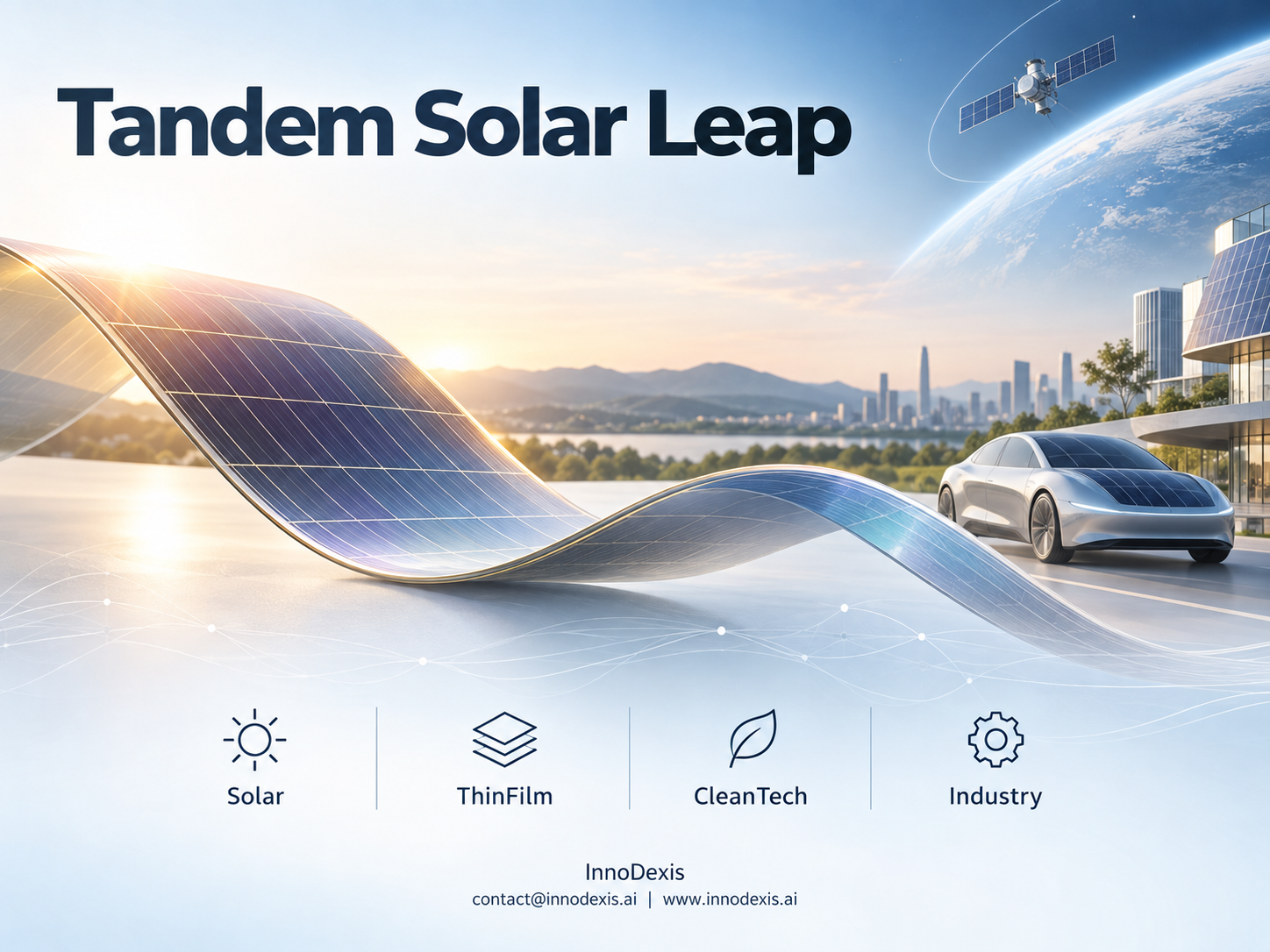
InnoDexis has published its latest Innovation Intelligence Report covering advanced photovoltaic technology, analyzing a certified world-record innovation from South Korea's Korea Institute of Energy Research. The report reveals that KIER researchers have achieved 26.7% certified efficiency in a perovskite/CIGS tandem solar cell — surpassing the previous world record of 26.3% — with certification provided by Fraunhofer ISE, a globally recognised photovoltaic testing authority. The breakthrough simultaneously addresses the two primary loss mechanisms limiting tandem cell performance and advances a lightweight flexible form factor with direct deployment potential in space, automotive, and building-integrated solar applications.
Key Findings
A certified efficiency of 26.7% was achieved in the perovskite/CIGS tandem solar cell, surpassing the previous world record of 26.3% and independently verified by Fraunhofer ISE. Laboratory-scale measurements on small-area devices recorded 27% efficiency, establishing the upper boundary of current performance under optimised conditions. The certification by a globally recognised photovoltaic testing authority distinguishes this result from unverified laboratory claims and positions it as a credible benchmark within the international photovoltaic research community.
Interfacial damage and parasitic absorption were identified as the primary loss mechanisms limiting tandem cell efficiency — not the absorber layers themselves. The research addressed both simultaneously: an advanced interfacial layer was developed to prevent perovskite degradation during top-cell integration, directly resolving the interfacial damage mechanism. Parasitic absorption losses were reduced in parallel. The ability to solve both loss mechanisms within a single device architecture is what enabled performance to exceed prior efficiency limits.
The perovskite/CIGS tandem architecture combines high efficiency with thin-film processing in a configuration that rigid silicon cannot replicate. Silicon-based high-efficiency solar cells require rigid substrates and manufacturing processes that restrict deployment to flat, stable surfaces. The perovskite/CIGS tandem's thin-film design enables lightweight, flexible form factors applicable to curved surfaces, mobile platforms, and weight-sensitive environments — deployment contexts that rigid silicon has not reached.
The flexible form factor directly enables three distinct application domains: space solar, where weight and flexibility are critical constraints; automotive solar integration, where curved surfaces and weight limitations eliminate rigid panel options; and building-integrated photovoltaics, where architectural flexibility and aesthetic integration require non-rigid form factors. Each of these markets represents a deployment context where silicon's physical constraints have historically limited photovoltaic penetration.
Technology transfer discussions are already underway, with KIER actively seeking industrial partners. This signals manufacturing readiness intent rather than a research milestone alone — a materially different signal from a laboratory record that remains confined to academic publication. The gap between laboratory records and commercial module performance at scale remains the primary challenge for perovskite tandem technology, and the active pursuit of industrial partnership indicates KIER's recognition of this transition as the next critical step.
Strategic Insight and Trend Analysis
The strategic significance of the KIER result extends beyond the efficiency number itself. World records in photovoltaic efficiency are regularly set and superseded — what differentiates this result is the combination of independent certification, simultaneous resolution of two distinct loss mechanisms, a flexible form factor with identified commercial deployment contexts, and active industrial partnership discussions. Each of these dimensions individually would be notable; their convergence in a single innovation signals a technology moving from research demonstration toward commercial trajectory.
The framing of the competitive landscape is also shifting. High-efficiency solar has historically been dominated by silicon, with perovskite tandems positioned as a future alternative pending efficiency and stability improvements. The 26.7% certified result places perovskite/CIGS tandem performance beyond silicon's practical efficiency ceiling in a verified, reproducible format. This does not displace silicon in established markets where its cost and manufacturing maturity remain advantages — but it redefines the competitive boundary in markets where silicon's physical rigidity is a structural constraint rather than merely a preference.
The scale-up challenge remains real and should not be minimised. The gap between small-area laboratory efficiency and large-area commercial module performance is a persistent feature of perovskite technology development, and no dataset field suggests this gap has been resolved. However, the combination of a certified record, identified loss mechanisms, and active technology transfer discussions represents the most commercially proximate signal yet visible in perovskite/CIGS tandem research.
For the broader photovoltaic industry, the KIER result accelerates the timeline for evaluating thin-film tandem technology as a serious competitor in high-value, form-factor-sensitive market segments rather than a long-term research aspiration.
Global and Industry Implications
For corporates and R&D teams in the solar, aerospace, and automotive sectors, the KIER result identifies perovskite/CIGS thin-film tandems as a technology warranting active evaluation for deployment contexts where silicon's rigidity is a limiting factor. The active technology transfer discussions signal a near-term opportunity for industrial partnership with a research institution holding a certified world-record platform.
For investors and capital allocators, the certification by Fraunhofer ISE and the active pursuit of industrial partners represent de-risking signals relative to earlier-stage perovskite research. The scale-up gap between laboratory and module performance remains the primary investment risk, and capital allocation should reflect the distinction between efficiency records on small-area devices and commercially deployable module performance.
For policymakers and national innovation bodies, South Korea's KIER result reinforces the strategic value of sustained national investment in next-generation photovoltaic research. The certified world record positions South Korea at the frontier of thin-film tandem solar technology at a moment when energy security and clean energy deployment are central policy priorities globally.
InnoDexis Statement
"The KIER perovskite/CIGS result reframes the efficiency frontier for flexible thin-film solar — not as a future aspiration but as a certified present reality, with technology transfer discussions already signalling the transition from research milestone to commercial intent," noted InnoDexis in its latest intelligence report.
Conclusion
The 26.7% certified efficiency record established by KIER marks a meaningful advance in the trajectory of perovskite/CIGS tandem solar technology. As space, automotive, and building-integrated solar markets expand their demand for high-efficiency flexible photovoltaics, the resolution of interfacial and parasitic absorption losses and the active pursuit of industrial partnerships position this technology for closer monitoring by organisations operating across energy, aerospace, and advanced manufacturing sectors. InnoDexis will continue to track certified efficiency progression, scale-up developments, and commercial partnership formation in perovskite tandem photovoltaics. The complete Perovskite/CIGS Tandem Solar Innovation Intelligence Report is available to InnoDexis subscribers and enterprise clients.
About InnoDexis
InnoDexis is a global Innovation Intelligence platform that tracks, analyzes, and interprets breakthrough innovations, prototypes, and emerging technologies across industries and countries. Its intelligence helps corporates, investors, and policymakers understand the true structure and direction of global innovation. Learn more at innodexis.ai.