KAIST Microneedle Electroceutical Self-Detaches on Abnormal Heating as Closed-Loop PPG Stimulation Cuts Burn Risk
Researchers at KAIST and the Korea Institute of Oriental Medicine have developed a wearable microneedle patch that penetrates the stratum corneum for stable current delivery and automatically detaches before abnormal skin heating can cause a burn.
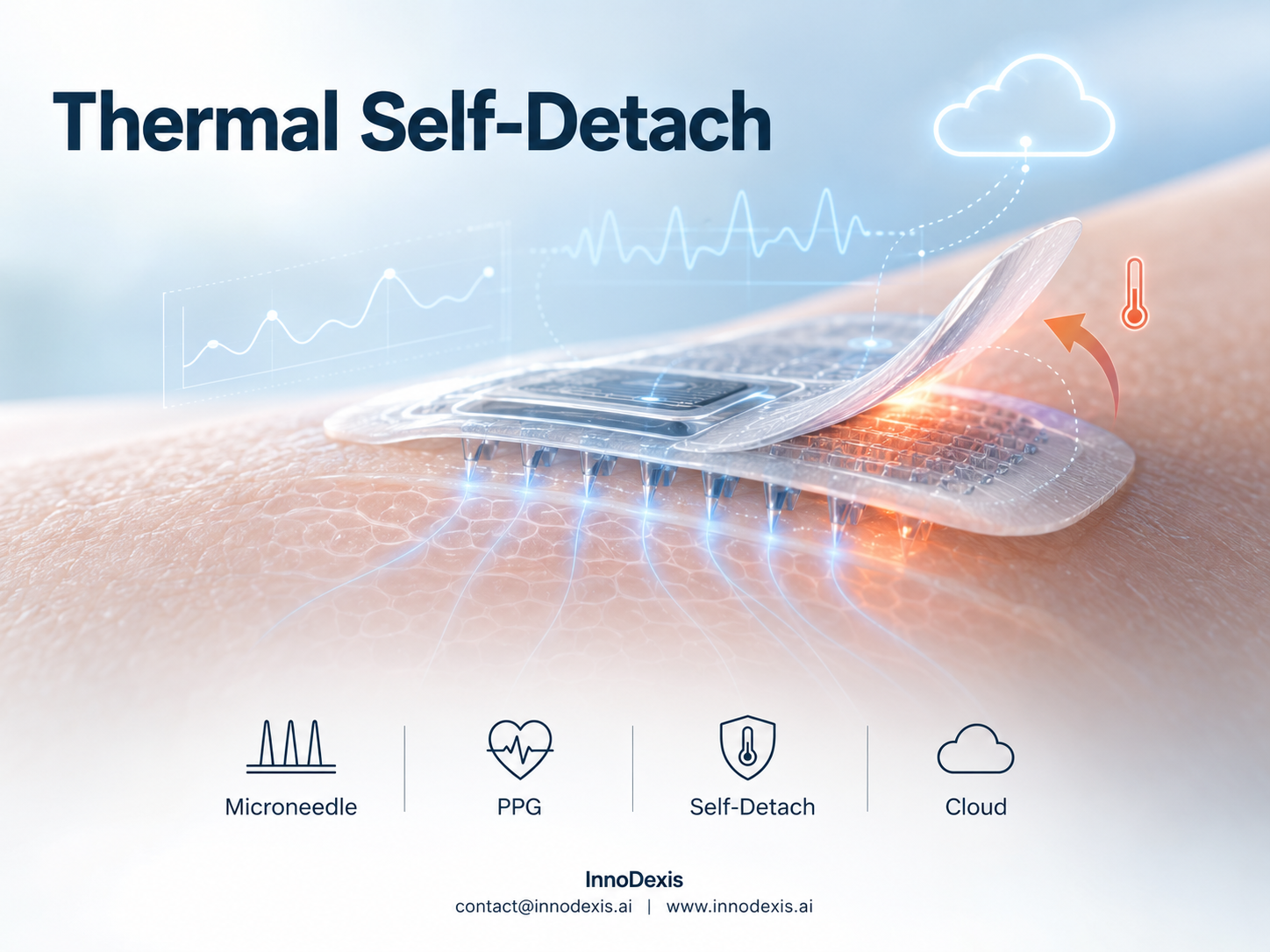
InnoDexis has published its latest Innovation Intelligence Report covering wearable electroceuticals and digital health technology, analyzing a research innovation developed jointly by KAIST and the Korea Institute of Oriental Medicine in South Korea. The report reveals that the research team has developed a wearable microneedle electroceutical that penetrates the stratum corneum for stable current delivery, pairs a PPG sensor with cloud connectivity to trigger stimulation automatically when pain-stress signals are detected, and incorporates a built-in thermal safety mechanism that detaches the electrode before abnormal skin heating can occur.
Key Findings
Microneedles penetrate the stratum corneum, directly reducing interference from sweat and dead skin cells that has historically limited the reliability of surface electrode-based pain relief devices. This structural approach addresses a reliability gap at the physical contact layer rather than through software-based compensation, reflecting the design philosophy of prevention through physics rather than detection through software.
A conductive hydrogel coating delivered current more effectively than conventional gel electrodes in animal experiments. This finding is significant because surface electrode failure from sweat and dead skin accumulation has constrained clinical confidence in unsupervised home use, and a coating that outperforms the conventional standard directly addresses that limitation.
A built-in thermal safety mechanism automatically detaches the electrode upon detecting abnormal skin heating. This mechanism is the central safety innovation in the device, converting burn risk from a monitored hazard into a physically self-regulating one, removing dependence on continuous user or clinician supervision to prevent thermal injury.
Closed-loop stimulation is triggered by real-time PPG-detected physiological pain-stress states, meaning the device activates stimulation automatically based on detected physiological signals rather than operating on a fixed schedule. This shifts the stimulation model from fixed-schedule surface stimulation to a closed-loop system that responds directly to the wearer's physiological state.
The device pairs its PPG sensor with cloud connectivity, enabling remote clinical oversight to travel with the device rather than requiring an in-person visit. This capability extends clinical monitoring into the home environment, a capability not available in conventional fixed-schedule surface stimulation devices.
Strategic Insight and Trend Analysis
The dominant trend emerging from this dataset is a shift in how safety is engineered into wearable pain-management devices — moving from software-based detection and monitoring toward physical self-regulation built directly into the hardware. The thermal safety mechanism does not rely on a software algorithm to detect a problem and then respond; it is a physical process that automatically detaches the electrode when abnormal heating occurs. This distinction matters because a physics-based safety mechanism does not depend on sensor accuracy, software uptime, or connectivity to function.
This same principle extends to how the device addresses reliability. Rather than attempting to compensate for surface electrode signal loss through improved software filtering or calibration, the microneedle architecture physically bypasses the stratum corneum barrier that causes sweat and dead skin interference in the first place. Combined with a conductive hydrogel coating shown to outperform conventional gel electrodes in animal experiments, this represents a materials-and-structure-first approach to solving a problem that the field has historically approached through electronics and software.
The pairing of closed-loop, physiologically triggered stimulation with cloud-connected remote oversight signals a broader trend toward wearable medical devices that combine autonomous physical safety with remote clinical monitoring capability. This combination is strategically significant because it addresses two separate barriers to unsupervised home use simultaneously: the physical safety barrier through thermal self-detachment, and the clinical oversight barrier through cloud connectivity that allows monitoring without requiring a physical visit.
If validated clinically, this closed-loop, physically self-regulating approach could establish a template for how future electroceutical devices balance patient autonomy with clinical safety in home settings.
Global and Industry Implications
For corporates and R&D teams in medical device development, the physics-based thermal safety mechanism and hydrogel-based current delivery represent a design approach that could be applied across other wearable stimulation devices facing similar reliability and safety constraints in unsupervised settings.
For investors and capital allocators, a device that addresses both the reliability gap in surface electrode technology and the safety oversight gap in home-based stimulation represents a differentiated position in the digital health and electroceutical space, with a stated pathway toward reducing reliance on oral analgesics if clinically validated.
For policymakers and national innovation bodies, the device's closed-loop remote monitoring capability offers a potential model for extending clinical oversight into home care settings, relevant to chronic pain management strategies that have historically relied heavily on oral analgesics, including opioids.
InnoDexis Statement
"This device replaces software-dependent safety monitoring with a physics-based thermal detachment mechanism, addressing burn risk and signal reliability simultaneously through structural design rather than detection algorithms," noted InnoDexis in its latest intelligence report.
Conclusion
As chronic pain management continues to rely heavily on oral analgesics administered at home, a closed-loop microneedle electroceutical capable of automatic thermal self-protection and remote clinical oversight represents a potential non-pharmacological pathway worth close monitoring. Clinical validation will determine how quickly this approach could shift reliance away from oral analgesics in home pain management settings. InnoDexis will continue to track developments in wearable electroceuticals, closed-loop physiological stimulation, and digital health monitoring technologies. The complete Wearable Electroceuticals Innovation Intelligence Report is available to InnoDexis subscribers and enterprise clients.
About InnoDexis
InnoDexis is a global Innovation Intelligence platform that tracks, analyzes, and interprets breakthrough innovations, prototypes, and emerging technologies across industries and countries. Its intelligence helps corporates, investors, and policymakers understand the true structure and direction of global innovation. Learn more at innodexis.ai.