KAIST and Singapore Researchers Develop $7 Smartphone Attachment That Detects Hidden Cameras with 94% Accuracy in Under Five Seconds
SweepLED, an AI-powered system combining a low-cost LED attachment with deep learning, automates hidden camera detection via smartphone eliminating the need for trained operators or dedicated hardware.
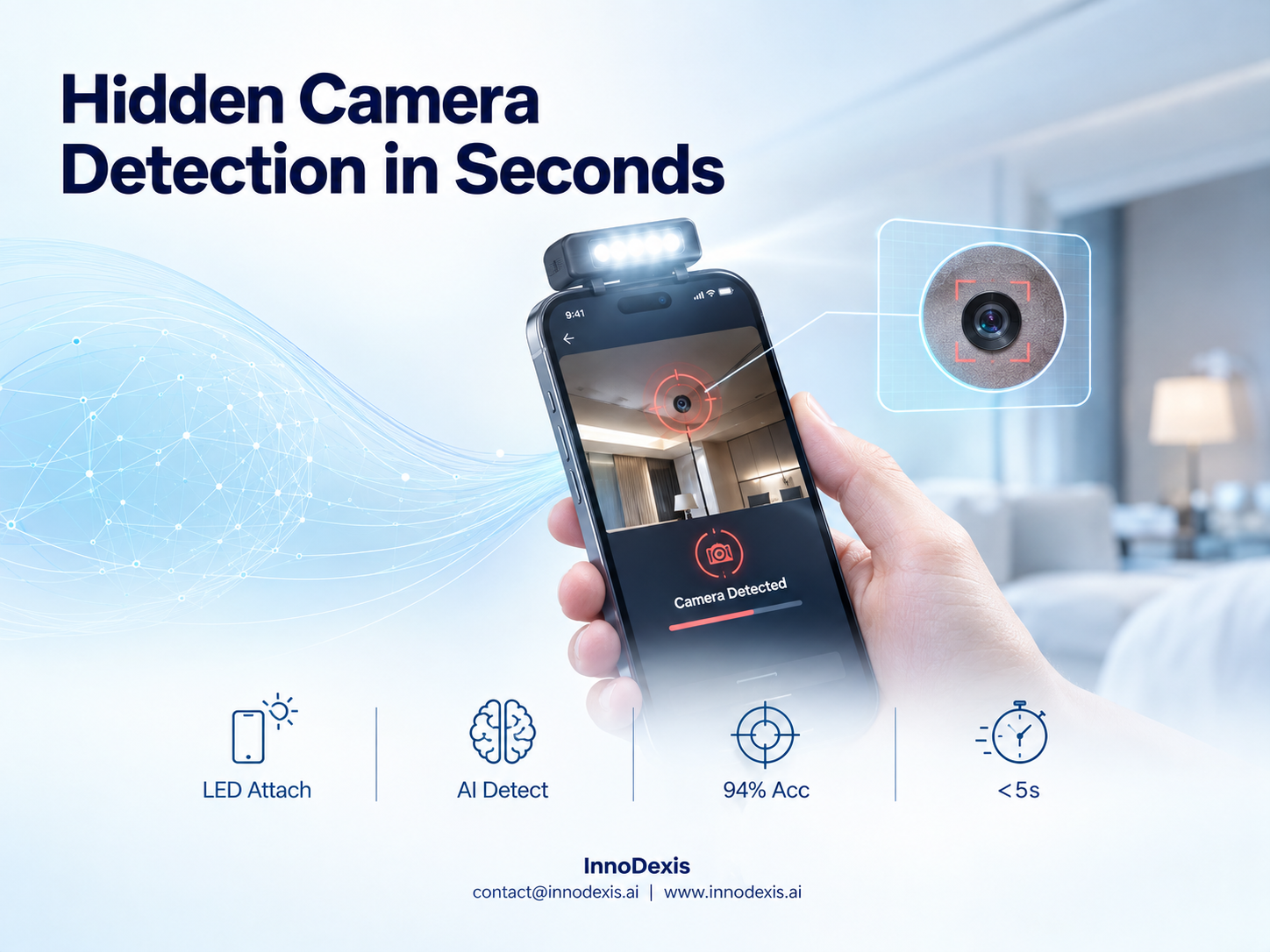
InnoDexis has published its latest Innovation Intelligence Report covering AI-powered privacy and security technology, analyzing a high-significance innovation developed across South Korea and Singapore. The report reveals that researchers from KAIST, Singapore Management University, and the National University of Singapore have developed SweepLED — a smartphone-based hidden camera detection system using a sub-$7 LED attachment and deep learning — that achieves 94% detection accuracy across 30 real-world evaluated objects with an inspection time of under five seconds per object, positioning it as a deployable consumer tool rather than a laboratory prototype.
Key Findings
SweepLED achieves 94% detection accuracy across 30 real-world evaluated objects with an inspection time of under five seconds per object. This performance profile — combining high accuracy with near-instant inspection — distinguishes SweepLED from existing detection approaches and positions it as a practical consumer-grade tool rather than a specialist instrument requiring controlled conditions or trained operation.
The hardware cost of the LED smartphone attachment is under $7 (KRW 10,000), making the system accessible at a price point consistent with mass consumer adoption. Combined with a smartphone application, the total system requires no dedicated detection equipment beyond a device that the majority of users already possess, removing the primary cost barrier that has historically limited hidden camera detection to specialist or institutional contexts.
SweepLED addresses a core limitation of existing hidden camera detectors — the inability to reliably separate genuine lens reflections from ordinary glossy surfaces. The system analyses how reflections move and deform across illumination angles, identifying a pattern unique to camera lens structures. This dynamic reflection analysis, automated through deep learning, eliminates the false positives that conventional detection tools cannot filter, reducing the burden on the user to interpret ambiguous results.
The deep learning layer automates the entire reflection analysis process, removing the requirement for trained visual observation. Detection becomes a repeatable, standardised procedure accessible to any smartphone user regardless of prior knowledge or technical experience. This shift from specialist skill to automated analysis represents the primary operational advance of the system over existing approaches.
The privacy threat from concealed recording devices has, by the researchers' own framing, outpaced the accessibility of detection tools available to consumers. SweepLED directly addresses this asymmetry by delivering detection capability at a cost and accessibility level that matches the consumer contexts — short-term rentals, shared accommodation, and public spaces — where concealed camera threats are most frequently reported.
Strategic Insight and Trend Analysis
The dominant trend this innovation signals is the democratisation of privacy protection technology — the shift from detection tools that require specialist hardware, trained operators, or institutional deployment, toward capabilities that are accessible to any individual with a smartphone.
This transition is structurally significant because the threat environment it addresses is inherently distributed. Concealed cameras in short-term rentals, hotel rooms, changing facilities, and shared spaces are not a centralised security problem amenable to institutional detection programmes. They are a diffuse, individual-level privacy threat that requires a detection response at the same scale — individual, accessible, and requiring no prior expertise.
SweepLED's architecture directly matches this threat profile. A $7 hardware attachment, a smartphone application, and a deep learning model that automates the analytical step together produce a system whose deployment barrier is lower than the threat it addresses. The 94% accuracy figure across 30 real-world evaluated objects is the critical validation: it demonstrates that the system performs under the varied, uncontrolled conditions of real consumer environments rather than only under laboratory conditions.
The deep learning approach to dynamic reflection analysis also signals a broader methodological shift in consumer security tools. Rather than relying on fixed optical signatures or human pattern recognition, SweepLED's model learns the structural characteristics of camera lens reflections as they behave across illumination angles — a more robust and generalisable approach than threshold-based detection methods. This architecture is extensible: improvements in the underlying model can be delivered through software updates without requiring hardware changes.
For organisations operating in the short-term rental, hospitality, and shared workspace sectors, the existence of a consumer-grade detection tool at this accuracy level shifts the context for privacy assurance conversations with users and regulators alike.
Global and Industry Implications
For corporates and R&D teams in mobile security, consumer electronics, and privacy technology, SweepLED establishes a new performance and cost benchmark for AI-assisted detection tools. The architecture — low-cost hardware attachment combined with on-device or application-layer deep learning — is a replicable model for other consumer security applications where the detection task involves analysing physical signatures across variable conditions.
For investors and capital allocators, the innovation signals commercial opportunity at the intersection of consumer privacy, AI, and mobile hardware. The total addressable market spans short-term rental platforms, hospitality, corporate travel, and individual consumer privacy — all segments experiencing heightened awareness of concealed surveillance risks. The sub-$7 hardware cost and smartphone-native deployment model indicate a low-cost-to-market pathway relative to the scale of the addressable user base.
For policymakers and national innovation bodies, SweepLED introduces a practical dimension to ongoing regulatory conversations around concealed surveillance in short-term rental and shared accommodation markets. A deployable, consumer-accessible detection tool changes the enforcement and self-protection landscape, and may inform minimum detection standard discussions in jurisdictions developing privacy regulations for accommodation platforms.
InnoDexis Statement
"SweepLED demonstrates that AI-powered privacy protection can be delivered at consumer scale — shifting hidden camera detection from a specialist capability to a routine, accessible behaviour through a sub-$7 hardware attachment and deep learning," noted InnoDexis in its latest intelligence report.
Conclusion
As concealed surveillance threats in shared and short-term accommodation environments continue to attract regulatory and consumer attention globally, the availability of a deployable, smartphone-native detection tool at sub-$7 hardware cost marks a meaningful shift in the accessibility of privacy protection. InnoDexis will continue to monitor developments in AI-powered consumer security tools, mobile privacy technology, and the regulatory frameworks emerging around concealed surveillance in shared spaces. The complete SweepLED Privacy Technology Innovation Intelligence Report is available to InnoDexis subscribers and enterprise clients.
About InnoDexis
InnoDexis is a global Innovation Intelligence platform that tracks, analyzes, and interprets breakthrough innovations, prototypes, and emerging technologies across industries and countries. Its intelligence helps corporates, investors, and policymakers understand the true structure and direction of global innovation. Learn more at innodexis.ai.