Integrated Waste-to-Hydrogen System Converts Battery Acid and Plastic Waste into Clean Fuel Under Sunlight
A laboratory-scale system demonstrates continuous hydrogen production by combining hazardous waste streams with solar-driven catalysis, indicating a shift toward waste-integrated energy generation models.
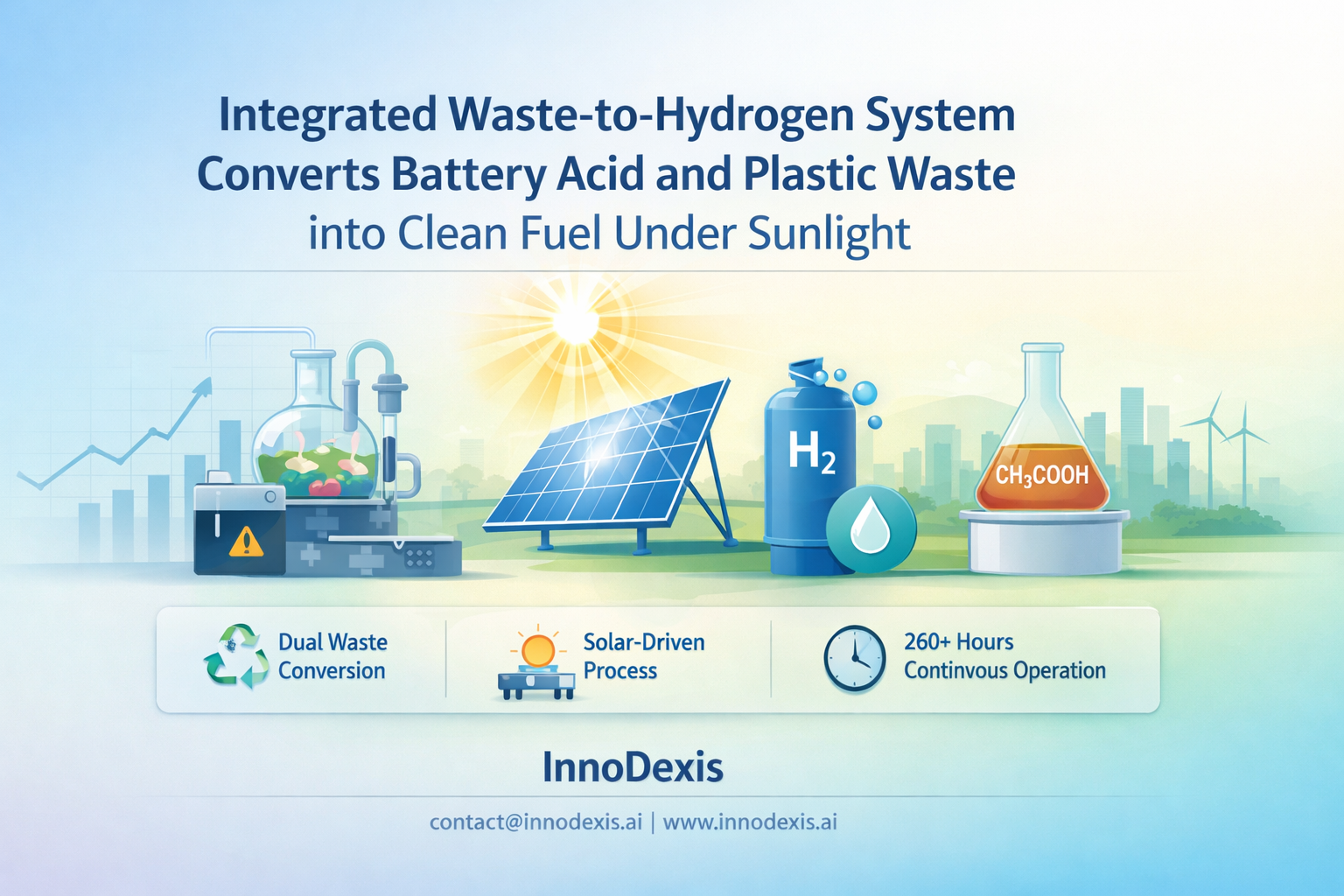
InnoDexis has published its latest Innovation Intelligence Report covering waste-to-energy and hydrogen production systems, analyzing a breakthrough innovation developed at the University of Cambridge. The report reveals that researchers have successfully demonstrated a system that converts used battery acid and plastic waste into hydrogen using sunlight. By integrating waste streams directly into the production process rather than treating them separately, the system produces both clean hydrogen and acetic acid, while maintaining continuous operation for over 260 hours at laboratory scale.
Key Findings
Researchers have developed an integrated system that combines used battery acid and plastic waste to generate hydrogen under solar irradiation. This approach departs from conventional waste treatment models by embedding waste conversion directly into the energy production process rather than handling each waste stream independently.
The system utilizes a dual-process mechanism involving acid-driven plastic breakdown and solar photoreforming within a single reaction environment. This integration enables simultaneous chemical conversion and energy generation, reducing process fragmentation typically associated with waste-to-energy systems.
A corrosion-resistant photocatalyst has been engineered to sustain reactions in highly acidic conditions. This materials innovation is critical, as conventional catalysts degrade under such environments, limiting their applicability in systems involving battery acid or similar hazardous inputs.
The process produces two outputs: hydrogen as a clean energy carrier and acetic acid as a secondary industrial product. This dual-output structure introduces an additional value stream, linking energy production with chemical manufacturing potential.
The system demonstrated operational stability exceeding 260 hours without performance degradation at laboratory scale. This sustained activity suggests that the process maintains catalytic integrity and reaction efficiency over extended durations under controlled conditions.
Strategic Insight and Trend Analysis
The reported system reflects a broader shift toward integrating circular economy principles directly into energy generation processes. Rather than treating waste management and energy production as separate domains, the approach combines them into a unified system where waste functions as a primary input rather than a residual byproduct.
Hydrogen production has historically been constrained by high energy requirements and input costs. By utilizing existing waste streams such as battery acid and plastic, the system repositions feedstock sourcing as a central variable in the economics of hydrogen generation. This suggests that future competitiveness in hydrogen systems may depend not only on production efficiency but also on access to unconventional input materials.
The dual-output model further reinforces this shift by aligning energy production with chemical value chains. The generation of acetic acid alongside hydrogen introduces an additional economic layer, potentially improving system viability by diversifying output streams.
The development also highlights the importance of materials innovation in enabling new process environments. The ability to operate under strongly acidic conditions expands the range of usable inputs, allowing previously incompatible waste streams to be incorporated into energy systems.
Collectively, the findings indicate a transition from linear production models toward integrated systems where waste, energy, and chemical outputs are co-optimized. This structural shift may influence how hydrogen technologies are designed, evaluated, and deployed in resource-constrained environments.
Global and Industry Implications
For corporates and R&D teams, the system introduces a framework for integrating waste streams into core production processes rather than treating them as externalities. This may open pathways for industrial symbiosis, where waste outputs from one sector become inputs for another.
For investors and capital allocators, the findings suggest emerging opportunities in waste-integrated energy platforms. Systems that combine feedstock flexibility with dual-output value generation may represent differentiated investment pathways within the broader hydrogen economy.
For policymakers and national innovation bodies, the approach highlights the potential to align waste management strategies with clean energy objectives. Regions facing challenges in plastic waste and hazardous disposal may be positioned to leverage these liabilities as inputs for distributed hydrogen production systems.
InnoDexis Statement
“Integrating hazardous waste streams into hydrogen production systems reflects a structural shift in how energy inputs are defined, suggesting that future competitiveness may depend as much on feedstock strategy as on production efficiency,” noted InnoDexis in its latest intelligence report.
Conclusion
The development of a solar-driven system capable of converting battery acid and plastic waste into hydrogen introduces a new model for aligning waste management with energy production. As the system demonstrates sustained operation and dual-output generation at laboratory scale, further attention will focus on scalability, process economics, and deployment contexts. The findings indicate that resource-constrained regions may emerge as potential hubs for such integrated systems, depending on waste availability and infrastructure alignment. The complete Waste-to-Hydrogen Innovation Intelligence Report is available to InnoDexis subscribers and enterprise clients.
About InnoDexis
InnoDexis is a global Innovation Intelligence platform that tracks, analyzes, and interprets breakthrough innovations, prototypes, and emerging technologies across industries and countries. Its intelligence helps corporates, investors, and policymakers understand the true structure and direction of global innovation. Learn more at innodexis.ai.