Innovation Lifecycle Data Shows 92.6% of Company Announcements at TRL 7–9 While Research Holds 6.2 Times More TRL 5–6 Records Than the Entire Corporate Stream
An analysis of 2,884 research and 2,280 corporate records finds that company announcements reveal the middle of the lifecycle only where an outside gate forces disclosure, 16.5 percent of health and 24.3 percent of space company records against 3.2 percent in AI and software.
InnoDexis has published its latest Innovation Intelligence Report covering the innovation lifecycle on a TRL 1–9 scale, analyzing 2,884 research records from 41 countries and 1,018 institutions and 2,280 corporate records from 2,157 organisations during the complete 1–31 October 2026 window. The report reveals that companies announce at the finish line: 92.6 percent of the 2,177 company records describe technology at TRL 7–9, while research holds 604 records at TRL 5–6 against 98 in the whole corporate stream, a ratio of 6.2 to one.
Key Findings
The corporate stream confirms rather than discovers. Of 2,177 company records, 2,016, 92.6 percent, are at TRL 7–9, a share that reaches 96.8 percent in AI and software, and in every thread with more than 30 company records at least 76 percent of announcements are at TRL 7–9.
The validated middle is readable only in research. Research holds 604 records at TRL 5–6 against 98 corporate, and 422 of those 604 name no industrial partner, while research sits 27.5 percent at TRL 1–2 and 39.4 percent at TRL 3–4.
Outside gates make the middle visible. Pre-commercial records are 16.5 percent of health company records and 24.3 percent of space against 3.2 percent in AI and software, and corporate records where an asset passed an outside gate carry High momentum 28.5 percent of the time against 11.9 percent.
Thread maturity diverges. Mobility and Transport research is 75.9 percent at TRL 5 or above, Robotics and Autonomy 54.8 percent and Advanced Materials and Chemistry 19.2 percent, and five open positions survive the artefact check: quantum at 21 research against 1 corporate, neuroscience 205 against 15, infectious disease 123 against 16, catalysis 93 against 13 and earth observation 77 against 7.
Verified money is a seventh of announced money. US$14.6 billion of verified commitments compares with US$102 billion of announced project values, 1,156 research records name a public funder led by NIH at 53, and 27 of 66 funding rounds were in AI and software.
Strategic Insight and Trend Analysis
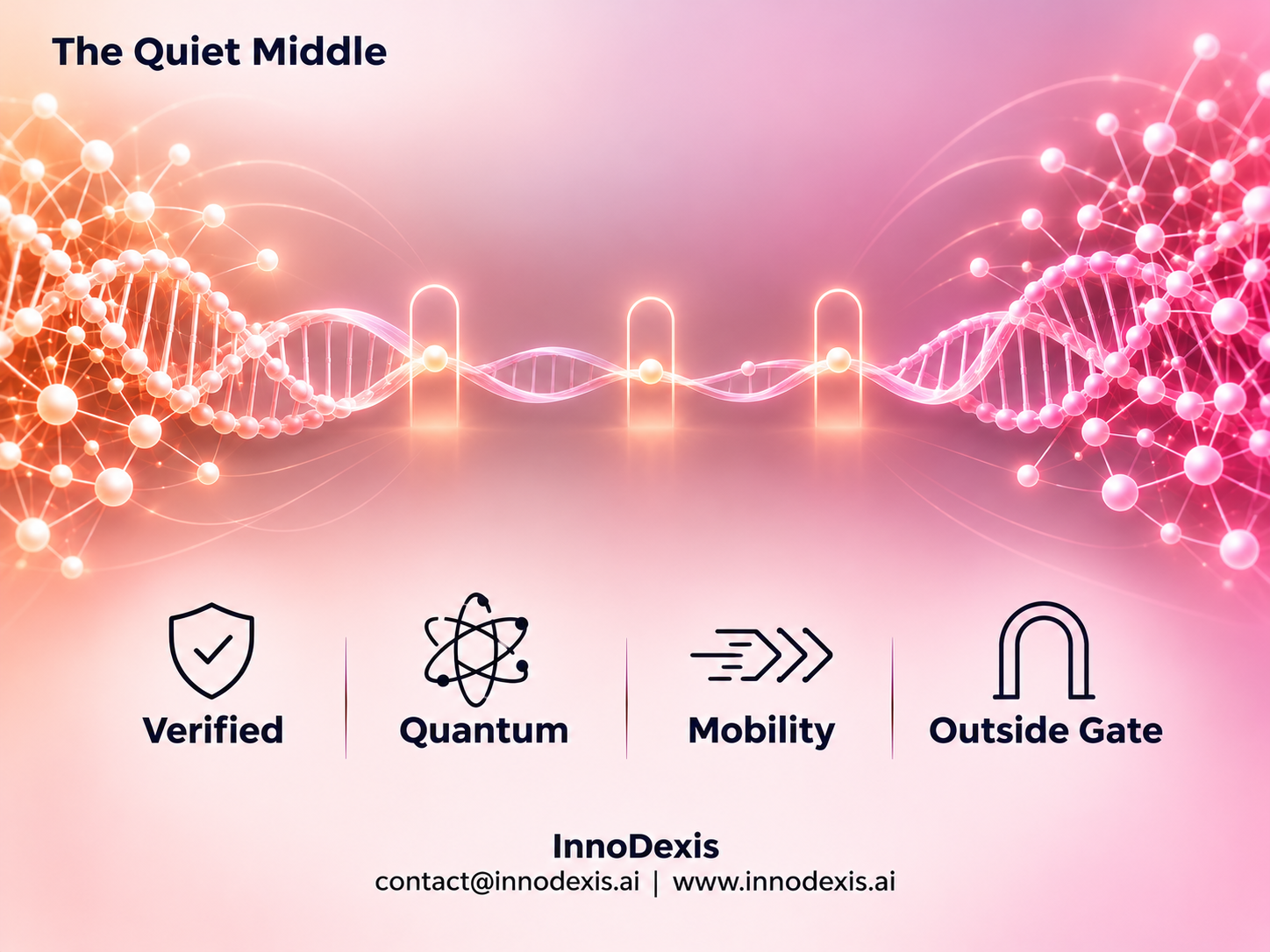
The defining structural finding is a lifecycle with a crowded beginning, a crowded end and a quiet middle. Research fills TRL 1–6, companies fill TRL 7–9, and the middle is visible only where a regulator, clinical endpoint, agency customer or co-funder forces disclosure, which explains why momentum attaches to gates, why open positions persist in quantum and neuroscience, and why public and private money miss each other. Raw name matching overstates bridges, with 79 verified cross-stream parties from 265 raw matches.
Laboratory-bound threads meet an already-mature market. In materials, 64.1 percent of research sits at TRL 3–4 while 110 of 122 corporate records are deployment-stage manufacturing and supply, and in compute 61.3 percent of research is at TRL 3–4 against a corporate stream of fabrication capacity, so manufacturers and foundries, not spin-outs alone, will build the bridge. Germany’s research arrives partnered, 59.0 percent against 36.2 percent in the United States.
Even the visible middle is often research in disguise, with 40 of 201 pre-commercial corporate records issued by universities or hospitals, and several cautions apply. The TRL proxy is analyst-assigned, the public-versus-private finding rests on counts rather than amounts from a single month of 66 rounds, and an absent corporate record is evidence of silence, not of inactivity.
Global and Industry Implications
For corporates and R&D teams, shift scouting from corporate news to research at TRL 5–6 in your own threads, where 65 energy, 199 health and 71 AI and software results are validated, and call the unpartnered pools first, led by 141 in health. Open sponsored pilots with the robotics groups at TU Delft, MIT, UPenn and TUM, and take research agreements in quantum and catalysis before companies arrive.
For investors and capital allocators, source at TRL 5–6 in research and back company formation before the result is announced commercially, and insist on an outside gate, since gate-passed records carry 28.5 percent High momentum. Named unpartnered assets include Chonnam National University’s non-flammable sodium-metal electrolyte and the University of Illinois’ record 2.75 GHz micro-LED, and announced project values should be priced as ceilings.
For policymakers and national innovation bodies, public money builds biological and agricultural capability while private money buys software, so bridging validation and scale-up is the gap, and co-funded field tests, as in UNSW’s ARENA-funded perovskite trial, make the pilot stage visible. No October energy record claims a battery-safety standard, an unclaimed compliance position, and MCP is the most-claimed agent standard with 22 claims.
InnoDexis Statement
“The market announces at the finish line — the validated middle of the lifecycle is readable only in research and in the industries where an outside gate forces disclosure,” noted InnoDexis in its latest intelligence report.
Conclusion
Because the TRL proxy is analyst-assigned, the funding comparison rests on counts from one month of 66 rounds and an absent corporate record signals silence rather than inactivity, the findings are cross-sectional, and this is the first lifecycle edition built on two complete monthly windows. The signals to watch are whether outside gates spread beyond health and space, whether a quantum or catalysis laboratory announces a spin-out, and whether an agent standard is ratified. The complete Innovation Lifecycle Intelligence (TRL 1–9) Report October 2026 is available to InnoDexis subscribers and enterprise clients.
About InnoDexis
InnoDexis is a real-time innovation intelligence platform connecting scientific discovery to commercial opportunity. Powered by InnoGraph, its proprietary innovation knowledge graph, the platform maps technologies across the entire lifecycle, from early-stage research (TRL 1) to market deployment (TRL 9), connecting researchers, institutions, startups, companies, products and emerging opportunities.
Covering 40+ specialised industry segments and 360 technology areas, InnoDexis delivers innovation tracking, research discovery, product and startup intelligence, investment insights, and AI-powered reports. Its mission is to bridge the gap between scientific discovery and real-world impact.
InnoDexis — From Lab to Market: Real-Time Innovation Intelligence.