Implantable Bioelectronic System Achieves 65% Cell Survival Without External Oxygen, Enabling Continuous In-Body Drug Production
Northwestern University’s HOBIT platform integrates engineered cells and oxygen-generating bioelectronics to support sustained biologic drug delivery within the body.
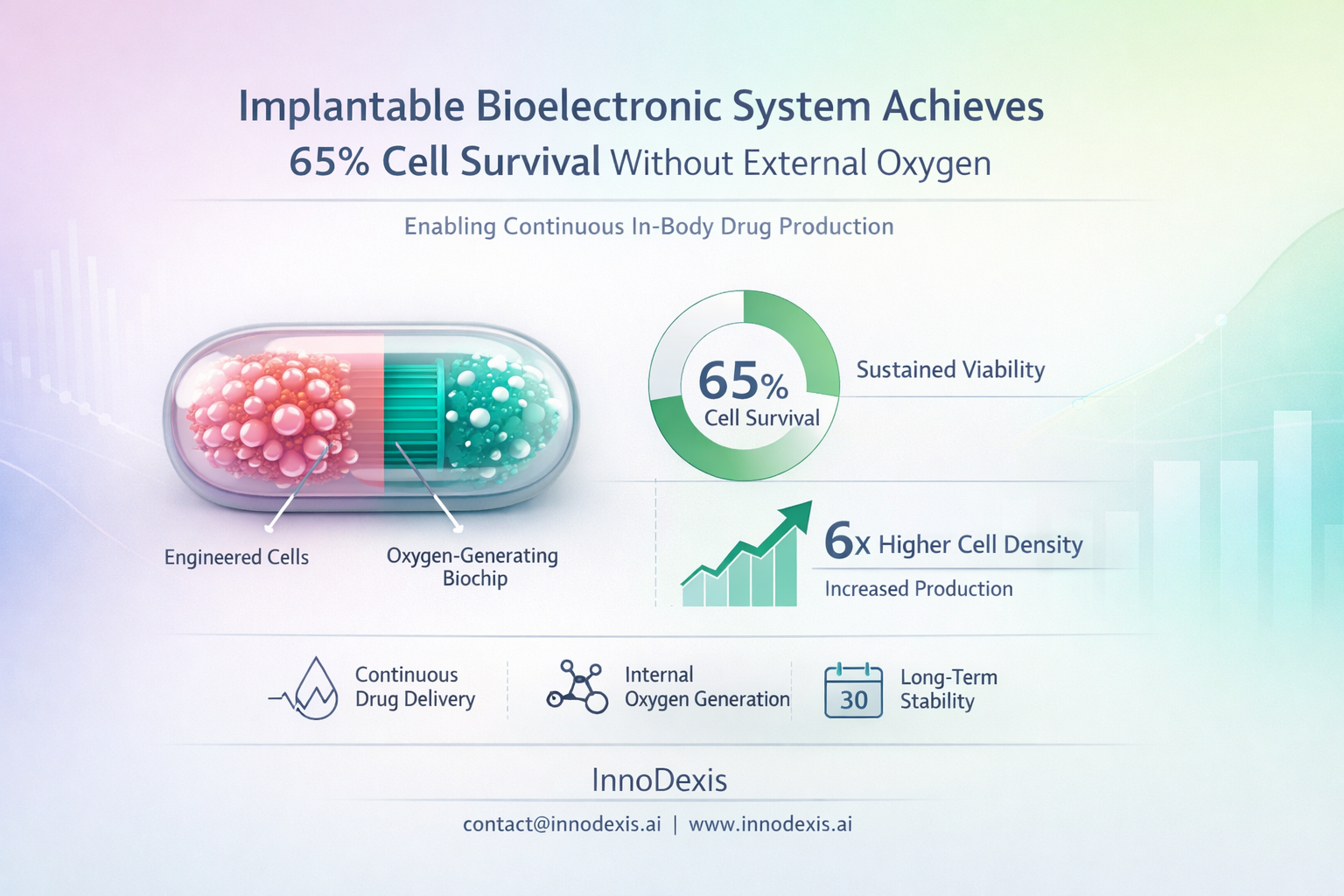
InnoDexis has published its latest Innovation Intelligence Report covering implantable bioelectronic drug delivery systems, analyzing recent advances in engineered cell therapies and in-body biologic production. The report reveals that a research team led by Northwestern University has demonstrated an implantable system, HOBIT, capable of sustaining approximately 65% cell viability without external oxygen supply. By integrating engineered cells with bioelectronic oxygen generation, the platform enables continuous production of biologic drugs within the body. The findings indicate a shift toward internalized, programmable drug delivery models for chronic disease management.
Key Findings
The HOBIT system developed by researchers at Northwestern University represents an implantable “living pharmacy” designed to produce therapeutic biologics directly within the body. Engineered cells within the system are capable of generating multiple drugs, enabling localized and sustained treatment delivery.
A central technical challenge in implantable cell therapies has been oxygen supply. The HOBIT platform addresses this constraint by incorporating bioelectronic components that generate oxygen internally, removing reliance on external oxygen diffusion and supporting cell survival in vivo.
The system demonstrated approximately 65% cell viability, compared to roughly 20% in non-oxygenated implantable systems. This increase in survival rate indicates the impact of integrated oxygen generation on maintaining functional therapeutic cells over time.
In addition to improved viability, the platform achieved approximately six times higher cell density. This increase supports greater production capacity within a confined implant space, enabling more efficient delivery of biologic therapies.
The system also demonstrated stable delivery of three biologic drugs over a 30-day period. Sustained multi-drug output suggests the feasibility of long-duration therapeutic deployment without repeated external dosing.
Strategic Insight and Trend Analysis
The HOBIT platform reflects a broader transition in therapeutic delivery models from episodic administration toward continuous, in-body production of biologics. Traditional drug delivery relies on periodic dosing through injections, oral medications, or infusions, often resulting in fluctuating drug concentrations and patient adherence challenges.
By embedding engineered cells within an implantable system capable of sustained function, the HOBIT approach introduces a model in which the body itself becomes a site of ongoing drug production. This model shifts the role of treatment from external intervention to internalized biological processes.
The integration of bioelectronics to generate oxygen represents a convergence of biological and electronic systems. Oxygen availability has historically limited the viability and scalability of implantable cell therapies. By solving this constraint, the platform enables higher cell densities and longer functional lifetimes, which are critical for practical therapeutic applications.
The ability to deliver multiple biologic drugs from a single implant further indicates potential for complex treatment regimens to be managed within a unified system. This capability may be particularly relevant for chronic diseases requiring sustained and multi-faceted therapeutic approaches.
More broadly, the platform reflects the emergence of programmable therapeutics, where engineered biological systems can be designed to produce specific outputs over time. This trend aligns with developments in synthetic biology, where cells are increasingly used as controllable units for therapeutic function.
Global and Industry Implications
For corporates and R&D teams in biotechnology and medical devices, the development of implantable bioelectronic systems introduces a new category of therapeutic platforms. Integrating engineered cells with electronic components may enable the design of long-duration treatment systems that reduce reliance on traditional dosing methods.
For investors and capital allocators, the demonstrated improvements in cell viability, density, and multi-drug delivery highlight the potential for scalable platforms in chronic disease management. Technologies that enable continuous biologic production may represent an emerging segment within advanced therapeutics.
For policymakers and national innovation bodies, the convergence of bioelectronics and synthetic biology raises considerations around regulatory frameworks, safety standards, and long-term monitoring of implantable therapeutic systems. As such technologies progress, regulatory pathways may need to adapt to hybrid biological-electronic platforms.
InnoDexis Statement
“The integration of engineered cells with bioelectronic oxygen generation demonstrates how therapeutic systems can transition from external dosing to continuous in-body production,” noted InnoDexis in its latest intelligence report.
Conclusion
The HOBIT platform illustrates how implantable systems may redefine drug delivery by enabling continuous, internal production of biologics. By addressing oxygen supply constraints and improving cell survival, the approach supports sustained therapeutic output over extended periods. As research advances, such systems may influence the treatment of chronic diseases by reducing intervention frequency and stabilizing drug delivery. The complete Bioelectronic Drug Delivery Intelligence Report is available to InnoDexis subscribers and enterprise clients.
About InnoDexis
InnoDexis is a global Innovation Intelligence platform that tracks, analyzes, and interprets breakthrough innovations, prototypes, and emerging technologies across industries and countries. Its intelligence helps corporates, investors, and policymakers understand the true structure and direction of global innovation. Learn more at innodexis.ai.