Hybrid Immersion Cooling Cuts Simulated Chip Hotspot Temperatures Up to 17°C in 15 Seconds as University of Waterloo Targets AI Data Center Heat
University of Waterloo researchers paired deionized water immersion with encapsulated, lower-boiling-point coolant drops that boil only on hotspots, lowering a simulated chip hotspot temperature by up to 17°C within 15 seconds.
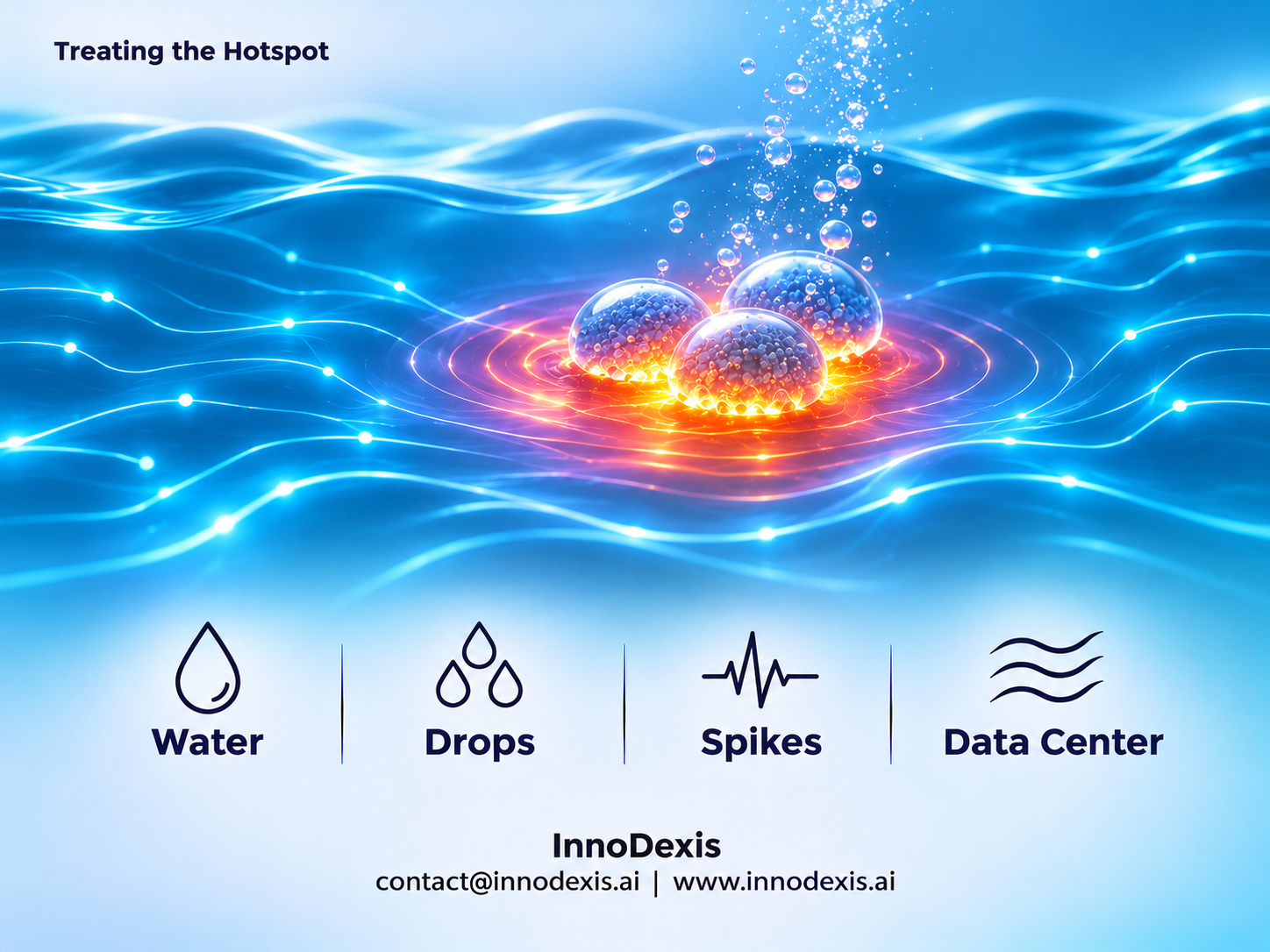
InnoDexis has published its latest Innovation Intelligence Report covering data center thermal management, analyzing one innovation from the University of Waterloo in Canada, developed at the Waterloo Institute for Nanotechnology, published on 10 November 2026. The report reveals that a hybrid immersion cooling method, which pairs deionized water with targeted drops of a lower-boiling-point coolant encapsulated in a silicone oil skin containing ceramic particles, lowered a simulated chip hotspot temperature by up to 17°C within 15 seconds in laboratory testing, with the hotspot submerged in a tank of water.
Key Findings
The method lowered the temperature of a simulated computer chip hotspot by up to 17°C within 15 seconds. The result comes from laboratory tests on a simulated hotspot submerged in a tank of water, so it is proof of concept rather than a demonstration on live hardware.
Cooling is split between two fluids. Inexpensive deionized water handles bulk immersion and steady heat, while drops of a lower-boiling-point electronics coolant handle sudden spikes by boiling where and when needed. The drops are heavier than water, which keeps them in place on hotspots instead of mixing into the tank.
Each coolant drop is wrapped in a thin skin of silicone oil embedded with heat-conducting ceramic particles. The skin lets the drop sit directly on a hotspot and controls the boiling rate, and the approach avoids complete immersion in expensive fluorinated fluids.
Cooling speed is described as several times faster than standard immersion cooling, and operating costs as lower because less specialized coolant is consumed. Neither claim is quantified beyond the 17°C and 15-second results, so the economic case still needs measurement at larger scale.
The technology is at laboratory stage, with commercial readiness rated low. A pilot demonstration and initial commercial adoption in data centers are estimated at 3 to 5 years away, and no regulatory approval requirement is apparent. Next steps include sensor-guided and self-circulating drop delivery.
Strategic Insight and Trend Analysis
The dominant trend in this research is a shift from cooling the whole system to treating the transient hotspot. Standard immersion relies on homogeneous fluid flow, while this approach applies a high-efficiency boiling coolant only to localized thermal spikes. Sushanta Mitra, executive director of the Waterloo Institute for Nanotechnology, describes it as a division of labour: water manages steady, everyday heat and the drops take care of sudden spikes.
The significance comes from demand. Market demand is growing rapidly with the surge in high-power AI server deployments, and operators of high-density AI accelerators are seeking cost-effective thermal management. If commercialized, the method could lower operational energy requirements and capital costs for AI data centers while improving chip reliability, longevity and sustained processing speed, and it could displace conventional single-fluid immersion and air cooling in high-density facilities.
The evidence stops at the benchtop. The primary risk is the move to reliable continuous operation inside live server racks, including droplet circulation stability and mechanical delivery integrity. Ceramic particles could foul narrow fluid channels, encapsulated drops could degrade or rupture during continuous circulation, and operators may resist multi-fluid chemical regimes inside server chassis.
Competing direct-to-chip microfluidic cooling architectures are also emerging. The next proof points are sensor-triggered or self-circulating drop delivery and testing on actual GPU and AI accelerator chips, which will show whether the laboratory result survives real operating conditions.
Global and Industry Implications
For corporates and R&D teams, the technology is positioned for direct transfer or licensing to thermal management system integrators, data center operators and semiconductor manufacturers. It requires a supply chain for encapsulated coolant droplets and precision micro-dosing delivery systems, and partnerships with data center hardware manufacturers and cooling providers for pilot testbed deployment. Laser diodes, LED lighting and EV battery packs during fast charging are adjacent applications.
For investors and capital allocators, targeted transient hotspot management could yield operational energy reductions compared with full-chassis immersion in specialized coolant. The stage is early: laboratory proof of concept, commercial readiness rated low, a 3 to 5 year path to pilot demonstration, operator resistance to novel multi-fluid regimes, and competing direct-to-chip microfluidic architectures as the main threat. Substituting bulk coolant with deionized water is the source of the cost saving.
For policymakers and national innovation bodies, data center energy efficiency and artificial intelligence infrastructure are the identified domains. No regulatory approval is apparent, so the barriers are engineering validation in live server racks and operator adoption rather than certification, which makes pilot testbeds the practical next step.
InnoDexis Statement
“Cooling for AI hardware is shifting from treating the whole chassis to treating the spike, and the decisive test is whether encapsulated drops stay stable and deliverable inside live server racks,” noted InnoDexis in its latest intelligence report.
Conclusion
The next milestones to watch are automated or sensor-guided droplet delivery, self-circulating drops that target hotspots on their own, and testing on actual GPU and AI accelerator chips rather than simulated heat sources. Long-term droplet integrity and ceramic-oil coating stability during continuous flow will determine whether the laboratory result scales. Pilot testbeds with data center hardware manufacturers are the practical route. InnoDexis will continue to track thermal management, encapsulated microfluidics and data center energy efficiency as this field develops. The complete Hybrid Immersion Cooling Innovation Intelligence Report is available to InnoDexis subscribers and enterprise clients.
About InnoDexis
InnoDexis is a real-time innovation intelligence platform connecting scientific discovery to commercial opportunity. Powered by InnoGraph, its proprietary innovation knowledge graph, the platform maps technologies across the entire lifecycle, from early-stage research (TRL 1) to market deployment (TRL 9), connecting researchers, institutions, startups, companies, products and emerging opportunities.
Covering 40+ specialised industry segments and 360 technology areas, InnoDexis delivers innovation tracking, research discovery, product and startup intelligence, investment insights, and AI-powered reports. Its mission is to bridge the gap between scientific discovery and real-world impact.
InnoDexis — From Lab to Market: Real-Time Innovation Intelligence.