Hybrid AI Coordination Systems Increase Warehouse Throughput by ~25% as Congestion Management Emerges as Core Constraint
A hybrid reinforcement learning and planning system demonstrates significant throughput gains by addressing congestion rather than hardware limitations in autonomous warehouse environments.
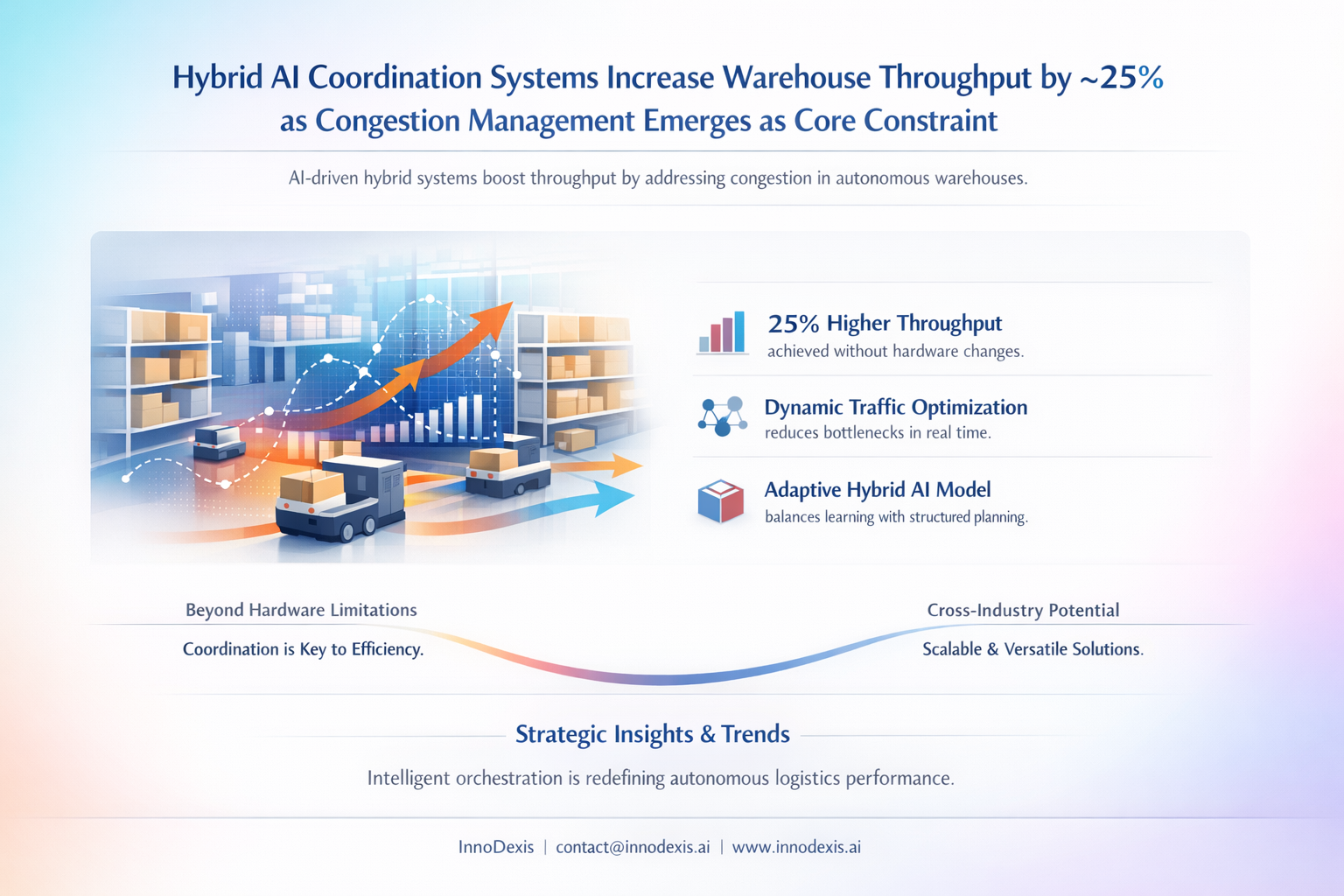
InnoDexis has published its latest Innovation Intelligence Report covering artificial intelligence in logistics and autonomous systems, analyzing emerging coordination technologies in warehouse environments. The report reveals that a hybrid AI system developed by researchers at the Massachusetts Institute of Technology in collaboration with Symbotic achieved approximately 25% higher throughput in simulation by addressing congestion dynamics rather than increasing robot speed or hardware capacity. The findings highlight coordination as a primary constraint in autonomous logistics systems.
Key Findings
A hybrid system combining deep reinforcement learning with classical planning demonstrated approximately 25% higher throughput in simulated warehouse environments. The improvement was achieved without modifying hardware capabilities, indicating that system-level coordination can unlock significant performance gains.
The system operates by prioritizing actions in real time based on emerging traffic patterns rather than predefined rules. This approach allows the system to anticipate congestion and adjust robot behavior dynamically, reducing bottlenecks before they fully develop.
Unlike traditional rule-based optimization models, the system shifts decision-making toward learning-based coordination. By integrating reinforcement learning with structured planning, the model balances adaptability with operational stability in complex environments.
The approach generalizes across different warehouse layouts and varying robot densities. This indicates that the system is not confined to a single configuration, suggesting broader applicability across logistics facilities with diverse operational conditions.
The findings position congestion, rather than speed or hardware, as the primary limiting factor in autonomous warehouse efficiency. Addressing coordination challenges yields measurable performance gains that exceed incremental improvements in mechanical or system speed.
Strategic Insight and Trend Analysis
The reported 25% throughput increase signals a shift in how performance constraints are being addressed in autonomous logistics systems. Rather than focusing on hardware upgrades or incremental speed improvements, the emphasis is moving toward system intelligence and coordination efficiency.
The integration of deep reinforcement learning with classical planning reflects a broader trend in artificial intelligence toward hybrid architectures. These systems combine the adaptability of learning-based models with the reliability of deterministic planning, enabling more effective operation in environments characterized by dynamic interactions and congestion.
The ability to anticipate and mitigate congestion in real time represents a transition from reactive optimization to proactive orchestration. In complex multi-agent systems such as autonomous warehouses, localized decision-making can lead to systemic inefficiencies. The hybrid model addresses this by aligning individual robot actions with system-wide flow optimization.
The generalization capability across layouts and robot densities suggests that the approach is not limited to controlled environments. This scalability is a critical factor in logistics, where operational variability is high and infrastructure configurations differ significantly.
Collectively, the findings indicate that AI in logistics is evolving from predictive analytics toward real-time coordination systems. This transition marks a stage where algorithmic control begins to manage complexity beyond the scope of manually designed optimization rules.
Global and Industry Implications
For corporates and R&D teams, the findings suggest that performance improvements in warehouse automation may increasingly depend on coordination algorithms rather than hardware investments. Integrating hybrid AI systems into existing infrastructure could provide efficiency gains without requiring large-scale physical upgrades.
For investors and capital allocators, the demonstrated throughput improvement highlights a potential shift in value creation toward software-driven optimization layers. Technologies that enhance system-wide coordination may represent scalable opportunities within logistics and automation markets.
For policymakers and national innovation bodies, the development reflects the growing importance of advanced AI systems in supply chain infrastructure. As logistics efficiency becomes a strategic priority, investment in AI-driven coordination technologies may support broader economic and industrial competitiveness.
InnoDexis Statement
“The observed performance gains indicate that coordination, rather than capacity, is becoming the defining factor in autonomous system efficiency, positioning hybrid AI architectures as a key mechanism for managing complexity in logistics environments,” noted InnoDexis in its latest intelligence report.
Conclusion
The emergence of hybrid AI coordination systems in warehouse environments highlights a shift toward addressing systemic inefficiencies through intelligent orchestration. With demonstrated gains of approximately 25% in simulated settings, the focus is moving from hardware scaling to coordination optimization. As real-world deployment progresses, validation under operational conditions will determine the extent to which these systems can transform logistics performance. The complete AI in Autonomous Logistics Innovation Intelligence Report is available to InnoDexis subscribers and enterprise clients.
About InnoDexis
InnoDexis is a global Innovation Intelligence platform that tracks, analyzes, and interprets breakthrough innovations, prototypes, and emerging technologies across industries and countries. Its intelligence helps corporates, investors, and policymakers understand the true structure and direction of global innovation. Learn more at innodexis.ai.