High-Temperature Thermal Storage Achieves Over 40% Efficiency, Signaling Alternative to Battery-Based Energy Systems
A system developed at Fourth Power, demonstrates long-duration energy storage using heat at 2,400°C, offering a scalable pathway beyond lithium-ion batteries.
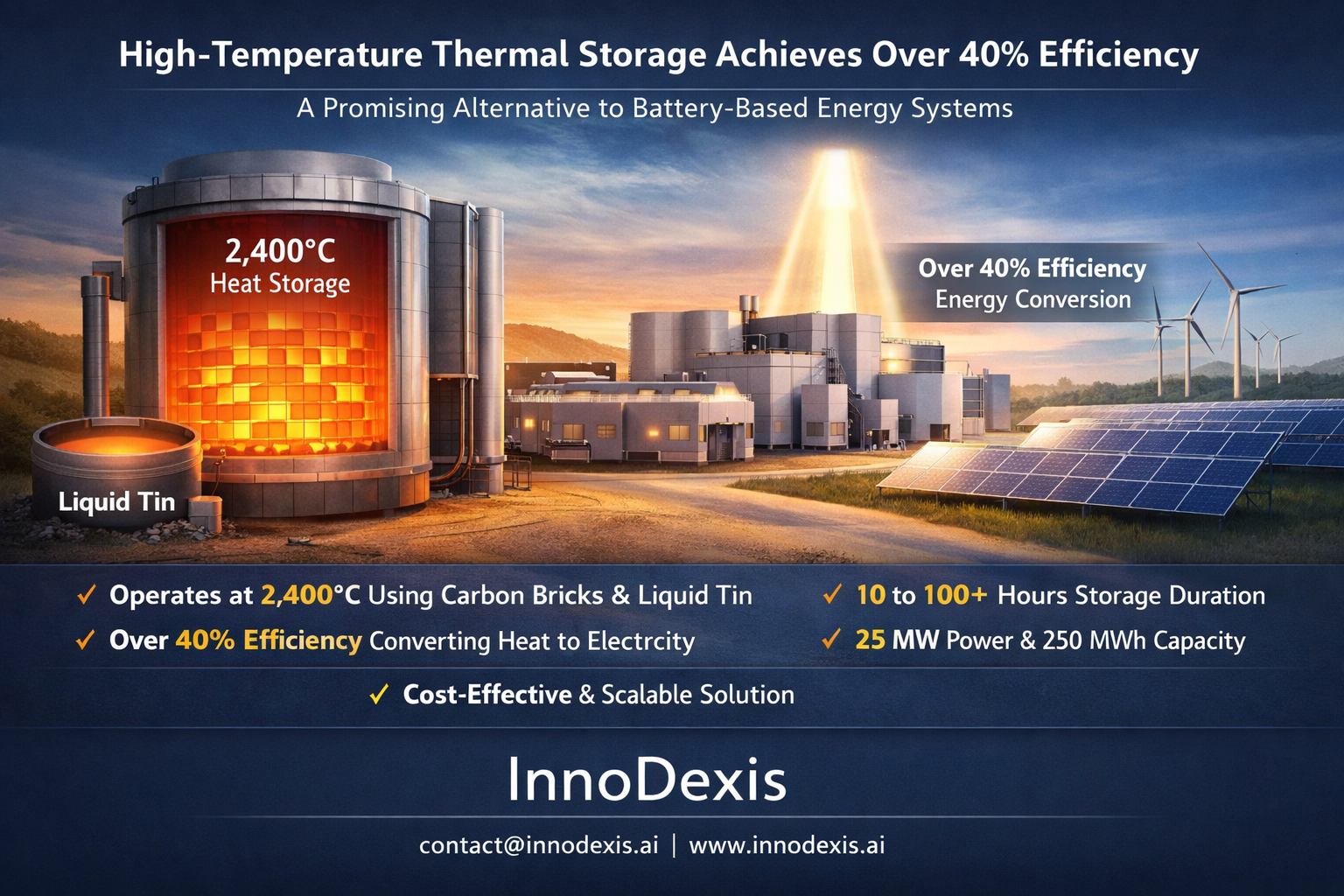
InnoDexis has published its latest Innovation Intelligence Report covering long-duration Energy storage technologies, analyzing emerging alternatives to battery-based systems for grid-scale applications. The report reveals that researchers at the Massachusetts Institute of Technology have developed a thermal storage system capable of storing energy as heat at temperatures up to 2,400°C and converting it back into electricity with over 40% efficiency. Using carbon bricks and liquid tin instead of rare materials, the system demonstrates characteristics that may support scalable, cost-effective deployment for stabilizing renewable energy systems.
Key Findings
Researchers at the Massachusetts Institute of Technology have developed a thermal energy storage system that operates by storing electricity as high-temperature heat and later converting it back into electricity. The system reaches temperatures of up to 2,400°C, positioning it among high-temperature storage approaches designed for grid-scale applications.
The system demonstrates conversion efficiency exceeding 40% when transforming stored heat back into electricity. This level of efficiency indicates that thermal storage systems may provide a viable pathway for energy recovery in long-duration storage scenarios.
Material composition represents a key differentiator. The system uses carbon bricks and liquid tin, avoiding reliance on rare or supply-constrained materials typically associated with battery technologies. This material choice may support scalability and cost considerations in large-scale deployments.
The storage duration ranges from 10 to over 100 hours, addressing one of the central challenges in renewable energy systems—intermittency. This duration positions the system within the category of long-duration energy storage technologies capable of supporting grid stability over extended periods.
Performance metrics indicate a power density of approximately 100 MW per acre, significantly higher than many conventional energy storage systems. In addition, the system exhibits approximately 1% daily heat loss, suggesting relatively efficient retention of stored energy over time.
A full-scale deployment is expected to deliver 25 MW of power and 250 MWh of storage capacity, while a 1 MWh demonstration system is currently underway. The system is designed with modular architecture, enabling potential scalability across grid-level infrastructure.
Strategic Insight and Trend Analysis
The development of high-temperature thermal storage systems reflects a broader shift in energy storage innovation beyond electrochemical batteries. While lithium-ion batteries have become the dominant solution for short-duration storage, their cost structure and material dependencies present challenges for scaling to long-duration applications.
Thermal storage systems operate on a fundamentally different principle by storing energy as heat rather than chemical potential. This approach enables the use of widely available materials and may reduce exposure to supply chain constraints associated with critical minerals.
The MIT system demonstrates how high-temperature storage combined with modular design can address both duration and scalability requirements. Storage durations exceeding 100 hours position such systems as candidates for balancing renewable generation over multi-day periods, particularly in solar and wind-dominated grids.
Efficiency remains a key consideration. While over 40% conversion efficiency is lower than typical battery round-trip efficiencies, the trade-off may be acceptable in applications where long-duration storage and lower material costs are prioritized over short-term efficiency.
The observed power density and low daily heat loss indicate that thermal systems can achieve both compact deployment and energy retention. These characteristics suggest that thermal storage may complement rather than replace battery systems, serving distinct roles within diversified energy storage portfolios.
Global and Industry Implications
For corporates and R&D teams, thermal energy storage systems provide an alternative pathway for addressing long-duration storage requirements. Integration of such systems may support renewable energy deployment in industrial and utility-scale environments where battery costs become prohibitive.
For investors and capital allocators, the emergence of thermal storage technologies introduces a new category within energy infrastructure investment. Systems that combine scalable materials with long-duration capabilities may attract attention as renewable energy penetration increases.
For policymakers and national innovation bodies, long-duration storage solutions are critical for enabling stable, renewable-heavy energy systems. Technologies that reduce dependence on critical minerals while supporting grid reliability may align with broader decarbonization and energy security strategies.
InnoDexis Statement
“The development of high-temperature thermal storage systems indicates a structural expansion in energy storage approaches, where material availability and duration capabilities may define the next phase of grid-scale deployment,” noted InnoDexis in its latest intelligence report.
Conclusion
The advancement of thermal energy storage capable of operating at 2,400°C introduces a potential alternative to conventional battery-based systems for long-duration applications. By combining scalable materials, extended storage durations, and modular deployment, such systems may contribute to stabilizing renewable energy grids. As energy systems transition toward higher shares of intermittent generation, diversified storage technologies may play a central role in ensuring reliability and efficiency. The complete Thermal Energy Storage Intelligence Report is available to InnoDexis subscribers and enterprise clients.
About InnoDexis
InnoDexis is a global Innovation Intelligence platform that tracks, analyzes, and interprets breakthrough innovations, prototypes, and emerging technologies across industries and countries. Its intelligence helps corporates, investors, and policymakers understand the true structure and direction of global innovation. Learn more at innodexis.ai.