High-Precision W Boson Measurement Reaffirms Standard Model Alignment After Prior Discrepancies
A large-scale experimental analysis resolves earlier inconsistencies by delivering one of the most precise W boson mass measurements to date.
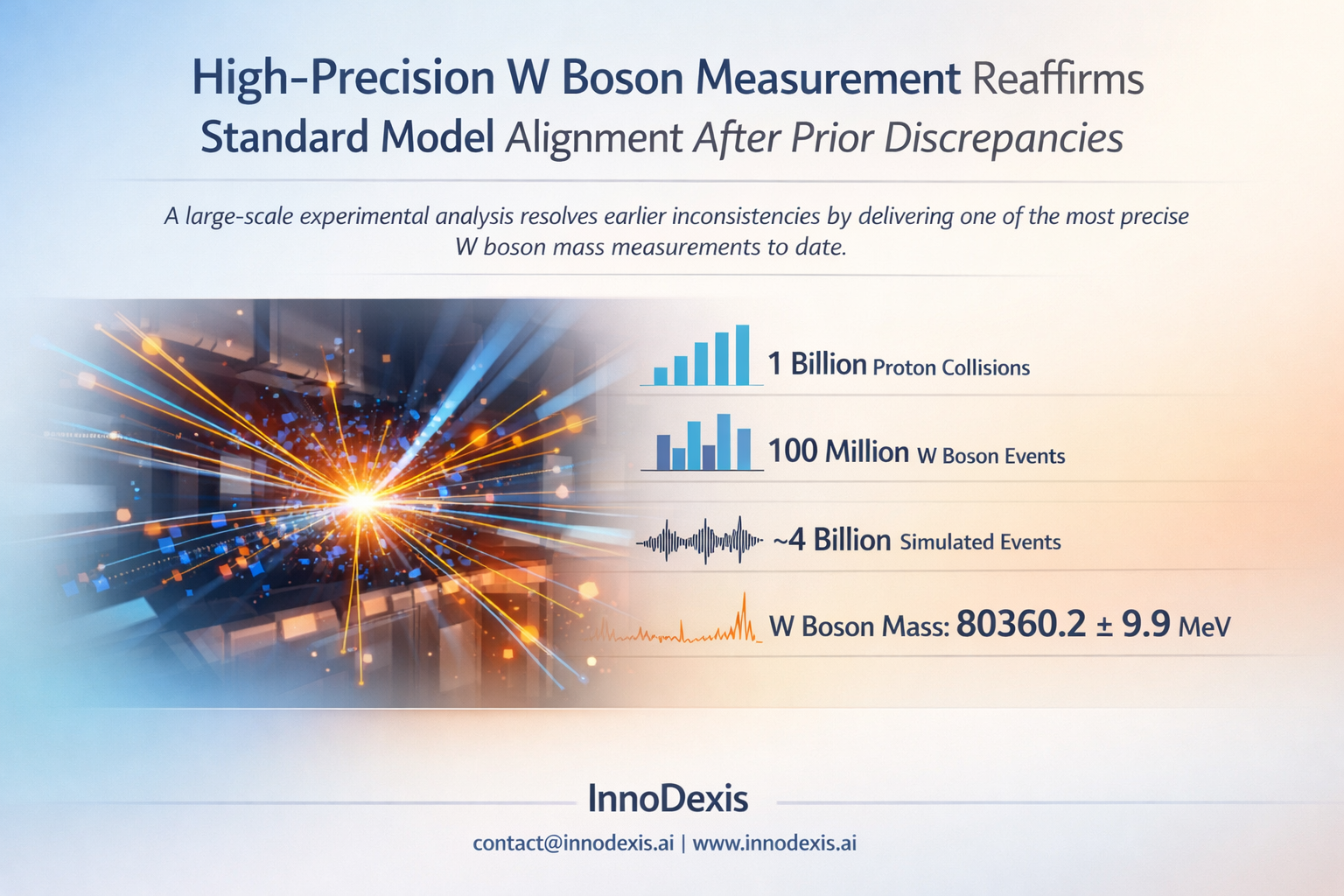
InnoDexis has published its latest Innovation Intelligence Report covering particle physics, analyzing high-precision experimental measurements conducted across large-scale collider environments. The report reveals that a new W boson mass measurement, derived from extensive proton collision data and simulation modeling, aligns with the Standard Model, resolving prior discrepancies reported in earlier studies. Based on approximately one billion proton collisions and supported by multi-billion-event simulations, the findings reinforce the current theoretical framework under conditions of extreme measurement precision.
Key Findings
A large-scale dataset of approximately one billion proton collisions was analyzed at the Large Hadron Collider, providing the experimental foundation for the W boson measurement. This scale of data collection reflects one of the most extensive observational efforts undertaken in particle physics for a single parameter estimation.
From this dataset, approximately 100 million W boson events were isolated for detailed analysis. The ability to extract such a high volume of relevant particle events enabled a statistically robust measurement process, reducing uncertainty and increasing confidence in the observed results.
The experimental analysis was complemented by approximately four billion simulated events, allowing researchers to compare real-world observations against theoretical expectations. This simulation depth played a critical role in validating the measurement and ensuring consistency with the Standard Model framework.
The resulting W boson mass was measured at 80360.2 ± 9.9 MeV, representing one of the most precise determinations of this parameter to date. The precision level achieved significantly narrows the margin of error compared to earlier measurements and aligns closely with theoretical predictions.
The findings contrast with a 2022 measurement that suggested deviations from the Standard Model, which had raised the possibility of undiscovered physical phenomena. The current analysis resolves that discrepancy, bringing experimental results back into agreement with established theory.
Strategic Insight and Trend Analysis
The updated W boson measurement reflects a broader trend in particle physics toward ultra-high precision validation rather than exploratory deviation. While earlier conflicting results suggested the potential emergence of new physics beyond the Standard Model, the latest findings demonstrate that increased data scale and simulation depth can resolve apparent inconsistencies within the existing theoretical framework.
The integration of billion-scale experimental datasets with multi-billion-event simulations indicates a methodological shift in how foundational physics questions are addressed. Rather than relying on isolated experimental anomalies, current approaches emphasize reproducibility, statistical rigor, and cross-validation at scale. This shift reduces the likelihood of false signals while increasing confidence in confirmed measurements.
The reaffirmation of the Standard Model under such high precision suggests that the threshold for identifying new physics is becoming significantly higher. Deviations must now withstand not only experimental observation but also extensive simulation comparison and large-scale reproducibility.
This development also highlights the role of global research infrastructure, including institutions such as CERN and Massachusetts Institute of Technology, in enabling large-scale collaborative experiments. Their combined capabilities support the level of data generation and analysis required to test theoretical physics at this level of precision.
Global and Industry Implications
For corporates and R&D teams, particularly those engaged in advanced materials, quantum systems, and high-performance computing, the findings reinforce the stability of foundational physics models that underpin long-term technology development. Confidence in theoretical consistency supports continued investment in applications derived from established physical laws.
For investors and capital allocators, the results indicate that near-term opportunities in fundamental physics are less likely to emerge from paradigm shifts and more likely to arise from incremental advancements in measurement technologies, simulation capabilities, and experimental infrastructure. This may influence capital allocation toward enabling technologies rather than speculative theoretical disruptions.
For policymakers and national innovation bodies, the study underscores the importance of sustained investment in large-scale scientific infrastructure. Facilities such as the Large Hadron Collider demonstrate how long-term funding commitments enable high-impact discoveries and maintain global leadership in fundamental research.
InnoDexis Statement
“High-precision validation at scale is redefining how progress is measured in fundamental science, where alignment with theory under extreme conditions increasingly holds as much significance as deviation,” noted InnoDexis in its latest intelligence report.
Conclusion
The latest W boson measurement highlights a phase in particle physics where precision, scale, and reproducibility are central to scientific advancement. By resolving prior discrepancies and reinforcing alignment with the Standard Model, the findings establish a higher benchmark for future discoveries. As experimental capabilities continue to expand, the distinction between anomaly and confirmation will increasingly depend on data depth and analytical rigor. The complete W Boson Measurement Intelligence Report is available to InnoDexis subscribers and enterprise clients.
About InnoDexis
InnoDexis is a global Innovation Intelligence platform that tracks, analyzes, and interprets breakthrough innovations, prototypes, and emerging technologies across industries and countries. Its intelligence helps corporates, investors, and policymakers understand the true structure and direction of global innovation. Learn more at innodexis.ai.