Green Roofs Cut Peak Rainwater Runoff by Up to 90% in 222 Heavy Rainfall Tests as Leipzig’s MaNuGrün Study Finds Sewer Models Overestimate Up to 8x
HTWK Leipzig’s MaNuGrün project found that green roofs with at least 10 cm of substrate or restricted drainage cut peak runoff by up to 90% and delay it by about 20 minutes, while standard sewer models overestimate runoff by up to eight times.
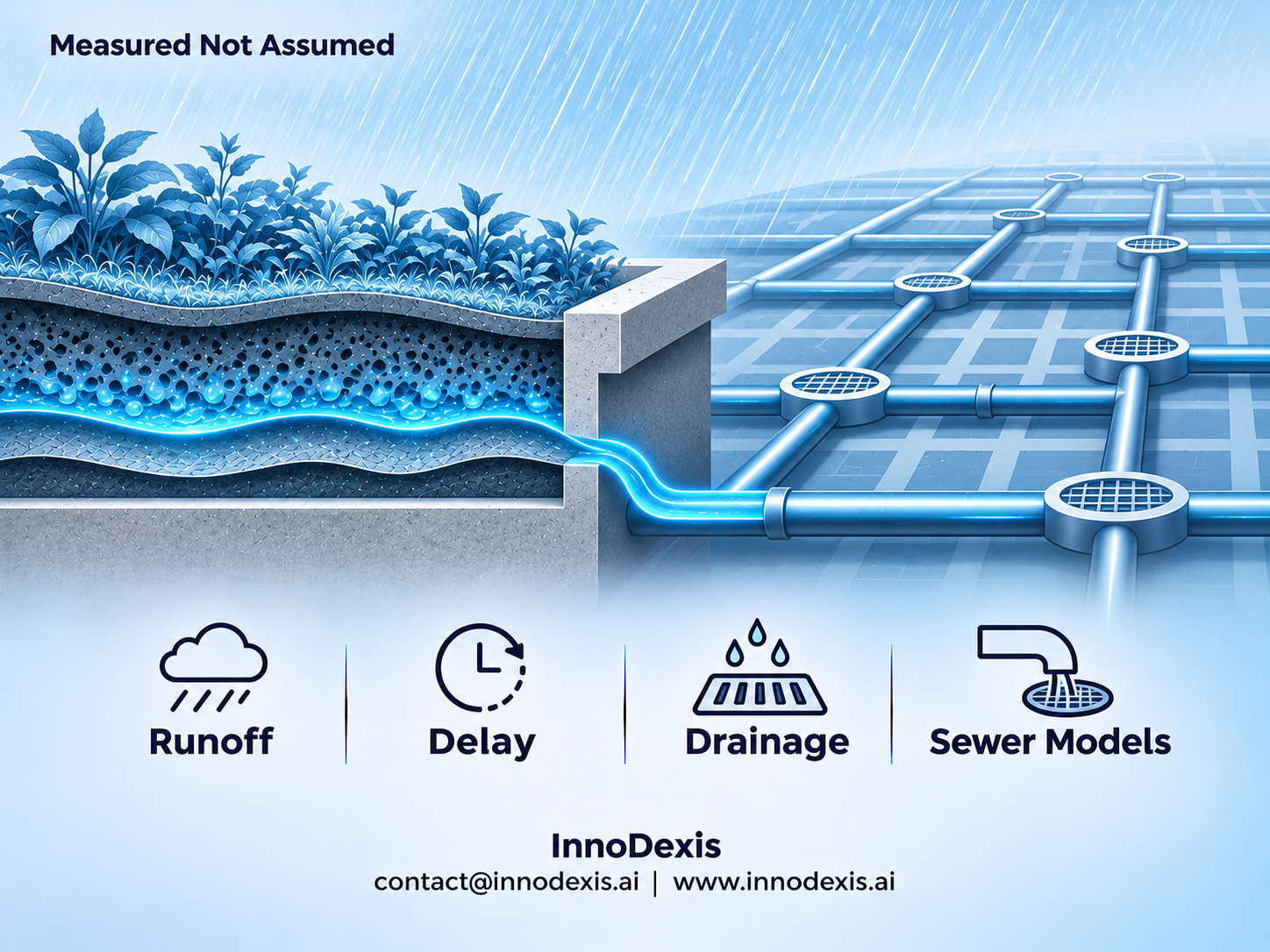
InnoDexis has published its latest Innovation Intelligence Report covering urban rainwater management with green roofs, analyzing one innovation from Leipzig University of Applied Sciences (HTWK Leipzig) in Germany, published on 2 November 2026. The report reveals that the MaNuGrün project, which ran 222 heavy rainfall trials across ten roof structures between June and September 2025, found that green roofs can reduce peak runoff by up to 90% and delay it by about 20 minutes, while standard sewer models overestimate green roof runoff by up to eight times.
Key Findings
MaNuGrün ran 222 heavy rainfall trials across ten roof structures, using sensor-based measurement of inflow and outflow. The tests varied pre-saturation intervals (1, 4 and 72 hours) and rainfall intensities from a one-in-a-year to a one-in-a-century downpour, and compared eight commercially available green roof systems with a gravel roof and a conventional roof, which gives the findings an unusually broad empirical base.
Green roofs reduced peak runoff by up to 90%. The strongest results came from systems with a substrate depth of at least 10 cm or restricted drainage, so the benefit depends on how the roof is built rather than on green cover alone.
Runoff peaks were delayed by about 20 minutes. A delay of this kind reduces the hydraulic load on urban sewerage systems during heavy rainfall, because the water reaches the network later and at a lower peak.
Standard sewer models can overestimate green roof runoff by up to eight times. The new modeling approach accounts for substrate depth, roof structure and restricted drainage, capturing storage and evaporation more accurately and helping to prevent costly over-dimensioning of drainage infrastructure.
The results were compiled into a practical guide for local authorities, municipalities and planning offices. The four-year project has been funded since December 2021 by the German Federal Environmental Foundation (DBU), and commercial readiness is rated medium to high, with immediate implementation possible for municipal planning offices.
Strategic Insight and Trend Analysis
The dominant trend in this research is the replacement of assumed green roof behavior with measured retention data in urban drainage planning. Legacy sewer network models simplify how green roofs store, evaporate and release water. MaNuGrün supplies calibrated parameters from 222 controlled scenarios, and shows that the simplification can overstate runoff by up to eight times.
This matters because sewer systems are sized on those estimates. Realistic modeling parameters allow municipalities to optimize sewer system sizing and lower infrastructure costs, while improving city resilience against flash floods. Hubertus Milke, Professor of Water Resources Management and Urban Water Management at HTWK Leipzig, describes the aim of water-sensitive urban development as a balance between evaporation, runoff and groundwater recharge, similar to what occurs in nature.
The evidence also carries limits. Performance depends heavily on structural parameters such as a substrate depth above 10 cm, so tailored construction is required. Long-term structural performance across multi-year vegetation life cycles, plant health deterioration and substrate compaction remain open questions, and further field validation across wider climatic zones and regional plant species is still needed.
The main barrier is adoption rather than science. Technical and methodology risks are low because the findings rest on extensive physical testing, but institutional inertia among municipalities and planners who rely on legacy sewer models, together with building codes that do not yet require high-retention structures, will determine how quickly the data changes practice.
Global and Industry Implications
For corporates and R&D teams, the findings define product targets. Green roof manufacturers and contractors are advised to focus on substrate depths of at least 10 cm and restricted drainage modules tailored to municipal retention targets, while civil engineering firms and sewer modeling software providers can incorporate the calibrated runoff parameters into standard tools. The approach is directly transferable to civil engineering firms, municipal drainage utilities, urban planning offices and commercial green roof developers.
For investors and capital allocators, the opportunity lies in commercializing calibrated green roof planning software and specialized restricted-drainage green roof systems. The constraints are real: initial capital expenditure for intensive green roof installation is higher than for standard roofing, and the work was supported by a research grant rather than venture funding.
For policymakers and national innovation bodies, the results support integrating green roofs into municipal climate adaptation policies and updating building codes to reflect precise retention categories. No regulatory approval is apparent, because the recommendations can be adopted voluntarily or built into local municipal building guidelines, which lowers the barrier to early action.
InnoDexis Statement
“Replacing assumed green roof behavior with measured retention data moves urban drainage planning from over-engineering to calibration, and adoption now depends on updating legacy sewer models and building codes,” noted InnoDexis in its latest intelligence report.
Conclusion
The next milestones to watch are dissemination of the practical guide to municipal planning offices and engineering consultants, incorporation of the calibrated green roof runoff parameters into standard commercial sewer modeling software, and field validation across wider climatic zones. Long-term performance across multi-year vegetation life cycles will show whether the 90% reduction holds in practice. InnoDexis will continue to track green roof systems, sewer hydraulic modeling and climate-adapted urban infrastructure as this field develops. The complete Green Roof Rainwater Management Innovation Intelligence Report is available to InnoDexis subscribers and enterprise clients.
About InnoDexis
InnoDexis is a real-time innovation intelligence platform connecting scientific discovery to commercial opportunity. Powered by InnoGraph, its proprietary innovation knowledge graph, the platform maps technologies across the entire lifecycle, from early-stage research (TRL 1) to market deployment (TRL 9), connecting researchers, institutions, startups, companies, products and emerging opportunities.
Covering 40+ specialised industry segments and 360 technology areas, InnoDexis delivers innovation tracking, research discovery, product and startup intelligence, investment insights, and AI-powered reports. Its mission is to bridge the gap between scientific discovery and real-world impact.
InnoDexis — From Lab to Market: Real-Time Innovation Intelligence.