Green Hydrogen Fertiliser Production Expands Beyond Europe as $95M Investment Targets Industrial-Scale Deployment
A European Investment Bank-backed project in Paraguay signals the transition of green hydrogen from pilot-stage initiatives to large-scale industrial applications in global supply chains.
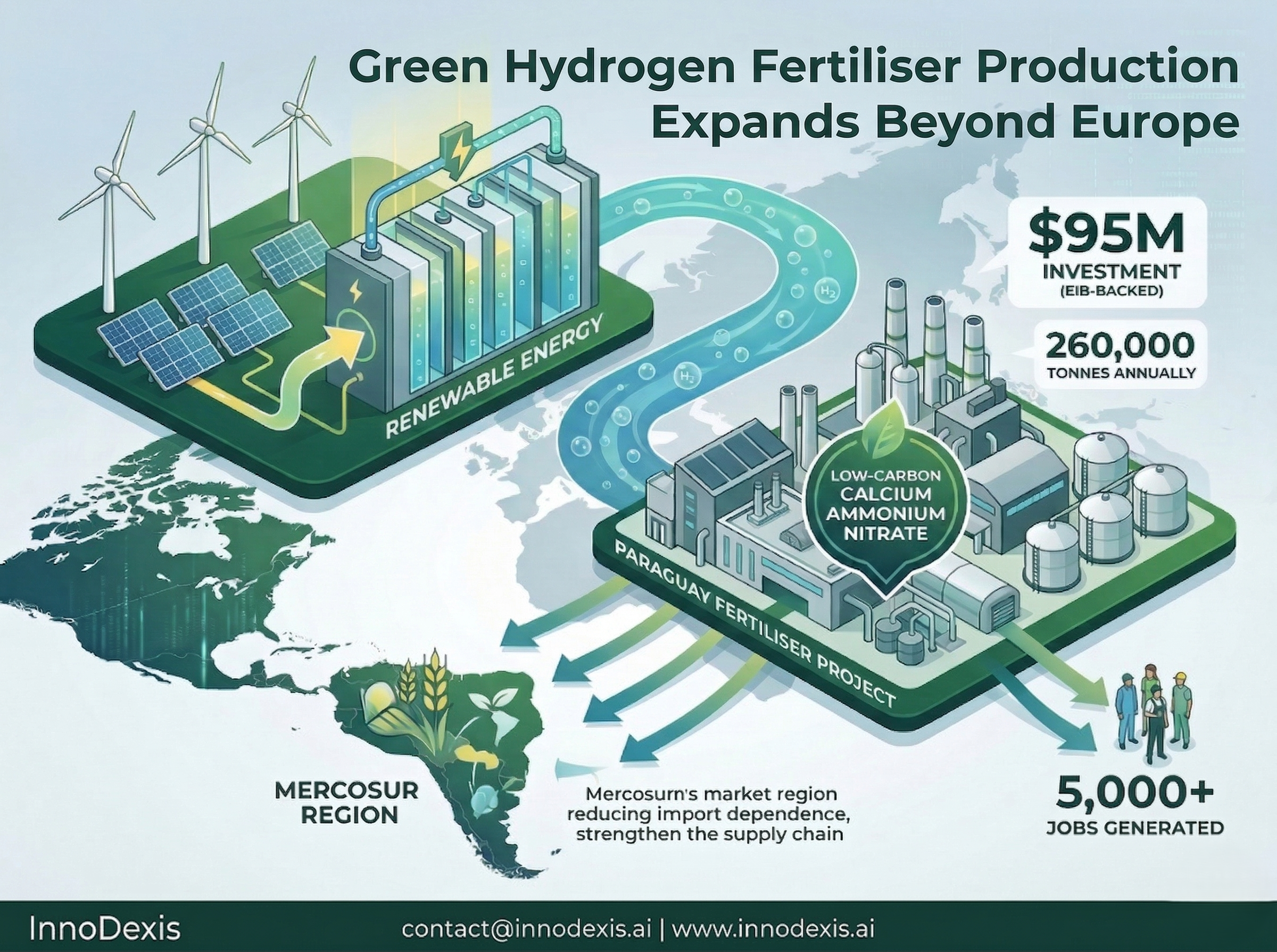
InnoDexis has published its latest Innovation Intelligence Report covering green hydrogen applications in industrial production, analyzing a new fertiliser project in Paraguay supported by a $95 million investment from the European Investment Bank. The report reveals that the facility is expected to produce approximately 260,000 tonnes of low-carbon calcium ammonium nitrate annually using renewable energy. The findings highlight a shift toward industrial-scale deployment of green hydrogen technologies, particularly in regions outside Europe, with implications for fertiliser supply chains, energy transition strategies, and regional manufacturing ecosystems.
Key Findings
A new fertiliser production facility in Paraguay, backed by a $95 million investment from the European Investment Bank, is set to produce approximately 260,000 tonnes of low-carbon calcium ammonium nitrate annually. The plant will operate using renewable energy, positioning it as a green hydrogen-enabled industrial application within the fertiliser sector.
The project represents one of the first large-scale green hydrogen fertiliser initiatives outside the European Union. This indicates geographic expansion of hydrogen-based industrial applications beyond early deployment regions, reflecting broader global adoption patterns.
The facility is strategically positioned to serve the Mercosur region, one of the world’s largest fertiliser import markets. By establishing local production capacity, the project aims to reduce reliance on imported fertilisers and strengthen regional supply chains.
The shift toward low-carbon fertiliser production also addresses dependence on fossil fuel-based inputs traditionally used in fertiliser manufacturing. By integrating renewable energy into production processes, the facility aligns with decarbonization objectives across agriculture and industrial sectors.
The project is expected to generate more than 5,000 jobs, indicating potential economic impact alongside industrial development. This highlights how green hydrogen initiatives may contribute not only to emissions reduction but also to regional employment and infrastructure growth.
Strategic Insight and Trend Analysis
The Paraguay fertiliser project reflects a broader transition in the role of green hydrogen within industrial systems. Initially positioned as a technology for pilot-scale experimentation, green hydrogen is increasingly being integrated into large-scale production processes tied directly to essential commodities such as fertilisers.
The use of renewable energy to produce low-carbon calcium ammonium nitrate illustrates how hydrogen-based processes can be embedded within established industrial value chains. Fertiliser production, which traditionally relies on fossil fuel-derived inputs, represents a sector where decarbonization can have both environmental and economic implications.
The geographic location of the project is also significant. The expansion of green hydrogen infrastructure into emerging regions suggests a shift toward distributed industrial production models. Rather than being concentrated solely in advanced economies, climate-focused manufacturing is beginning to develop in regions with access to renewable energy resources and growing demand for industrial inputs.
The targeting of the Mercosur region further indicates alignment between hydrogen deployment and regional market demand. By reducing import dependence and enabling localized production, such projects may contribute to more resilient supply chains while addressing structural inefficiencies in global fertiliser distribution.
Overall, the data suggests that green hydrogen is entering a phase of industrial scaling, where its adoption is increasingly linked to core sectors such as agriculture, energy, and manufacturing. This transition may define the next stage of hydrogen’s role within the global energy and industrial landscape.
Global and Industry Implications
For corporates and R&D teams, the project demonstrates the feasibility of integrating green hydrogen into large-scale industrial processes. Fertiliser production may serve as an early example of how hydrogen can be deployed within established manufacturing systems to reduce emissions and improve process sustainability.
For investors and capital allocators, the $95 million investment signals growing financial commitment to hydrogen-based industrial infrastructure. Projects aligned with essential commodities and regional demand may represent scalable opportunities within the broader energy transition.
For policymakers and national innovation bodies, the development highlights the role of emerging regions in advancing climate technology deployment. Investments in green hydrogen infrastructure may support both decarbonization objectives and economic development through job creation and supply chain localization.
InnoDexis Statement
“The project reflects a transition from pilot-stage hydrogen applications to industrial-scale deployment, where production is increasingly aligned with regional demand and integrated into core supply chains,” noted InnoDexis in its latest intelligence report.
Conclusion
The development of a green hydrogen-powered fertiliser facility in Paraguay signals a broader shift in how industrial inputs are produced and distributed. By combining renewable energy with large-scale manufacturing, the project illustrates the potential for hydrogen technologies to move beyond experimentation into commercially relevant applications. As similar models are replicated across regions and industries, green hydrogen may play an expanding role in reshaping global supply chains and industrial production systems. The complete Green Hydrogen Industrial Applications Intelligence Report is available to InnoDexis subscribers and enterprise clients.
About InnoDexis
InnoDexis is a global Innovation Intelligence platform that tracks, analyzes, and interprets breakthrough innovations, prototypes, and emerging technologies across industries and countries. Its intelligence helps corporates, investors, and policymakers understand the true structure and direction of global innovation. Learn more at innodexis.ai.