Global Space Innovation Expands Beyond Launch Systems as AI, Autonomous Operations, and Orbital Infrastructure Accelerate
The latest InnoDexis Space Innovation Ecosystem 2026 report indicates that the space sector is increasingly evolving into an interconnected operational infrastructure layer integrating AI, communications, autonomy, sensing, and planetary-scale systems.
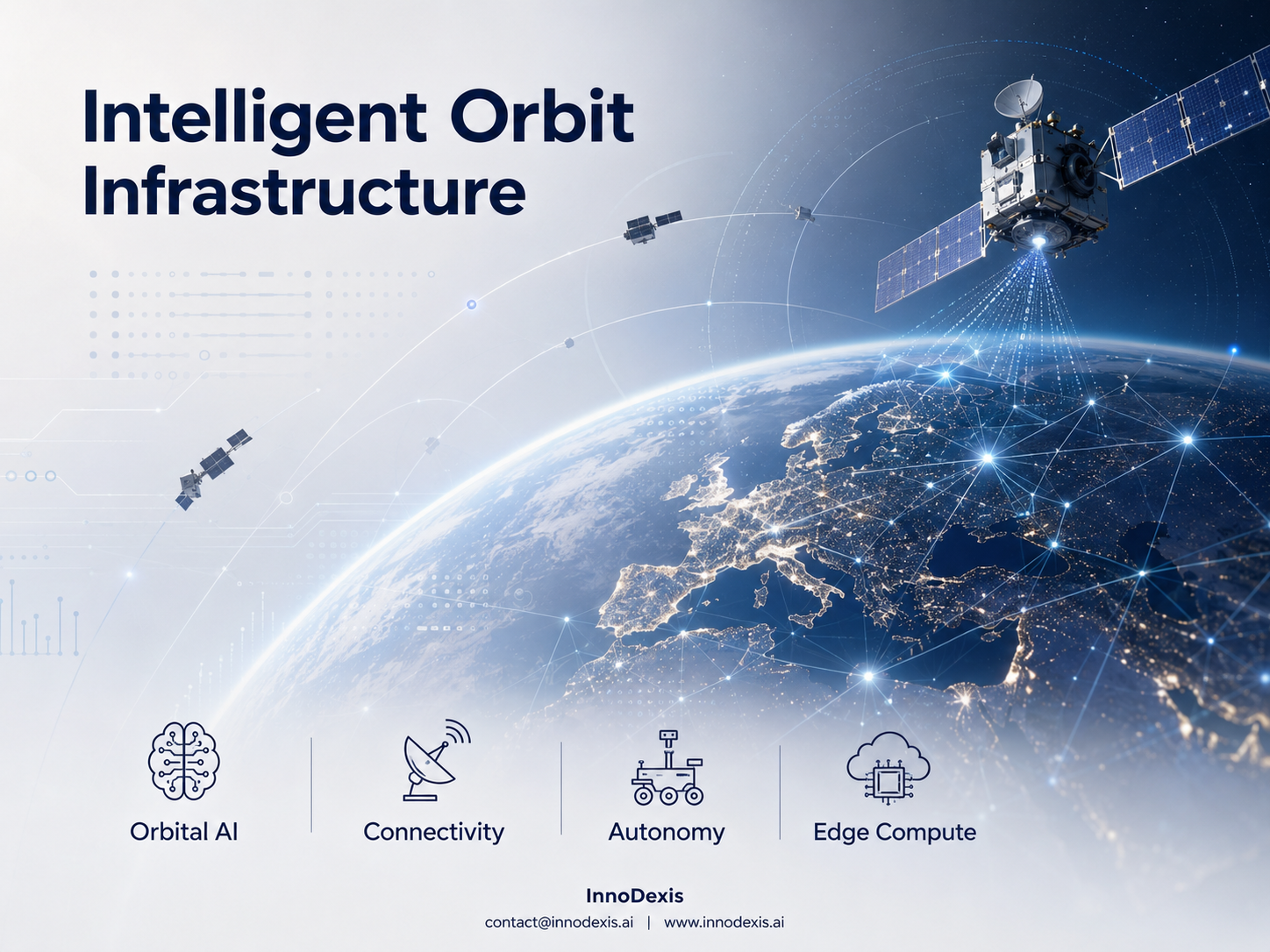
InnoDexis has published its latest Innovation Intelligence Report covering the global space innovation ecosystem, analyzing emerging developments across AI-enabled satellites, autonomous exploration systems, orbital communications, and infrastructure technologies during 2025–2026. The report reveals that space innovation is increasingly shifting beyond launch-focused competition toward the creation of intelligent operational infrastructure surrounding Earth and extending into deep-space environments. The findings suggest that AI-enabled computing, autonomous decision-making systems, and orbital connectivity platforms are becoming central components of the next phase of the global space economy.
Key Findings
The report identifies a significant acceleration in AI integration directly within space systems and orbital platforms. NASA and Microchip advanced the development of a radiation-hardened AI space chip designed to deliver up to 500× onboard computing gains, highlighting growing industry focus on enabling real-time processing and autonomous operations beyond Earth-based computing dependence.
Autonomous mobility and machine decision-making capabilities also continued advancing in planetary exploration environments. NASA’s Perseverance rover completed its first AI-planned autonomous drive on Mars, signaling the increasing operational role of onboard intelligence in reducing communication delays and improving mission adaptability in deep-space conditions.
The report further highlights the emergence of AI-enabled satellite architectures capable of processing complex workloads directly in orbit. The launch of CUHK-1 with onboard large-model AI processing capabilities indicates that satellites may increasingly evolve from passive sensing assets into distributed orbital compute systems capable of handling analysis and operational decisions independently.
Satellite communications infrastructure also entered a new deployment phase during the period analyzed. Vodafone and AST SpaceMobile began deploying direct-to-device satellite broadband services for standard smartphones in Europe, suggesting that space-based connectivity networks are moving closer to integration with mainstream terrestrial communications ecosystems.
Collectively, these developments indicate that the competitive structure of the space sector may increasingly depend not only on launch capability, but also on intelligent infrastructure control, autonomous system coordination, orbital computing capacity, and persistent global connectivity networks.
Strategic Insight and Trend Analysis
The broader trend emerging from the report suggests that space innovation is entering an infrastructure-centric phase shaped by convergence across AI, communications, sensing, autonomy, and distributed computing systems. The sector appears to be transitioning away from isolated mission-driven architectures toward continuously operating orbital ecosystems capable of supporting commercial, industrial, scientific, and strategic functions simultaneously.
A key structural shift identified in the report is the movement of intelligence directly into space infrastructure itself. Satellites are increasingly evolving from transmission and observation platforms into autonomous computational nodes capable of onboard processing, local decision-making, and adaptive coordination across distributed systems. This reduces dependence on Earth-based control layers while enabling faster operational responsiveness across orbital and planetary environments.
The findings also indicate that future competitive advantage in the space economy may increasingly depend on ownership and integration of interconnected infrastructure layers rather than launch access alone. AI-enabled orbital systems, direct satellite communications, autonomous navigation platforms, and planetary-scale sensing networks are becoming strategically linked components of a larger operational ecosystem.
The report further suggests that the long-term trajectory of the sector may involve the emergence of persistent intelligent infrastructure supporting communications, Earth observation, autonomous mobility, defense applications, environmental monitoring, and lunar or deep-space logistics. In this environment, the ability to coordinate data, compute capacity, and autonomous operations across distributed orbital systems may become a defining strategic capability.
Global and Industry Implications
For corporates and R&D teams, the findings suggest that space technologies are increasingly intersecting with AI infrastructure, telecommunications, semiconductors, robotics, and cloud-scale data systems. Organizations operating across these sectors may face growing pressure to develop capabilities that integrate orbital infrastructure with terrestrial digital ecosystems.
For investors and capital allocators, the report indicates that future value creation in the space sector may increasingly concentrate around intelligent infrastructure layers rather than launch activity alone. Companies developing orbital AI systems, autonomous operations platforms, satellite communications networks, and space-based computing architectures may attract heightened strategic interest as infrastructure dependency expands.
For policymakers and national innovation bodies, the findings highlight the growing strategic importance of sovereign space infrastructure capabilities. AI-enabled orbital systems, resilient communications networks, and autonomous sensing architectures may increasingly influence national competitiveness, technological resilience, and long-term geopolitical positioning within the global space economy.
InnoDexis Statement
“As orbital systems evolve into intelligent operational infrastructure, competitive advantage in the space sector may increasingly depend on the integration of AI, autonomous coordination, communications resilience, and distributed compute capabilities,” noted InnoDexis in its latest intelligence report.
Conclusion
The report suggests that the next phase of space innovation may be defined less by isolated missions and more by the development of continuously operating intelligent infrastructure ecosystems surrounding Earth and extending into deep-space environments. As AI, autonomy, communications, and orbital computing capabilities continue converging, the strategic structure of the global space economy may undergo substantial transformation over the coming decade. InnoDexis will continue tracking the technologies, infrastructure shifts, and ecosystem developments shaping the future of the intelligent space economy. The complete Space Innovation Ecosystem 2026 Report is available to InnoDexis subscribers and enterprise clients.
About InnoDexis
InnoDexis is a global Innovation Intelligence platform that tracks, analyzes, and interprets breakthrough innovations, prototypes, and emerging technologies across industries and countries. Its intelligence helps corporates, investors, and policymakers understand the true structure and direction of global innovation. Learn more at innodexis.ai.