Global Innovation Pipeline Expands as Only 51 of 4,390 Technologies Reach Market Readiness - March 2026
An analysis of 4,390 innovations reveals that while 93% remain in development, a small subset of near-market technologies is emerging as the primary zone of commercial opportunity.
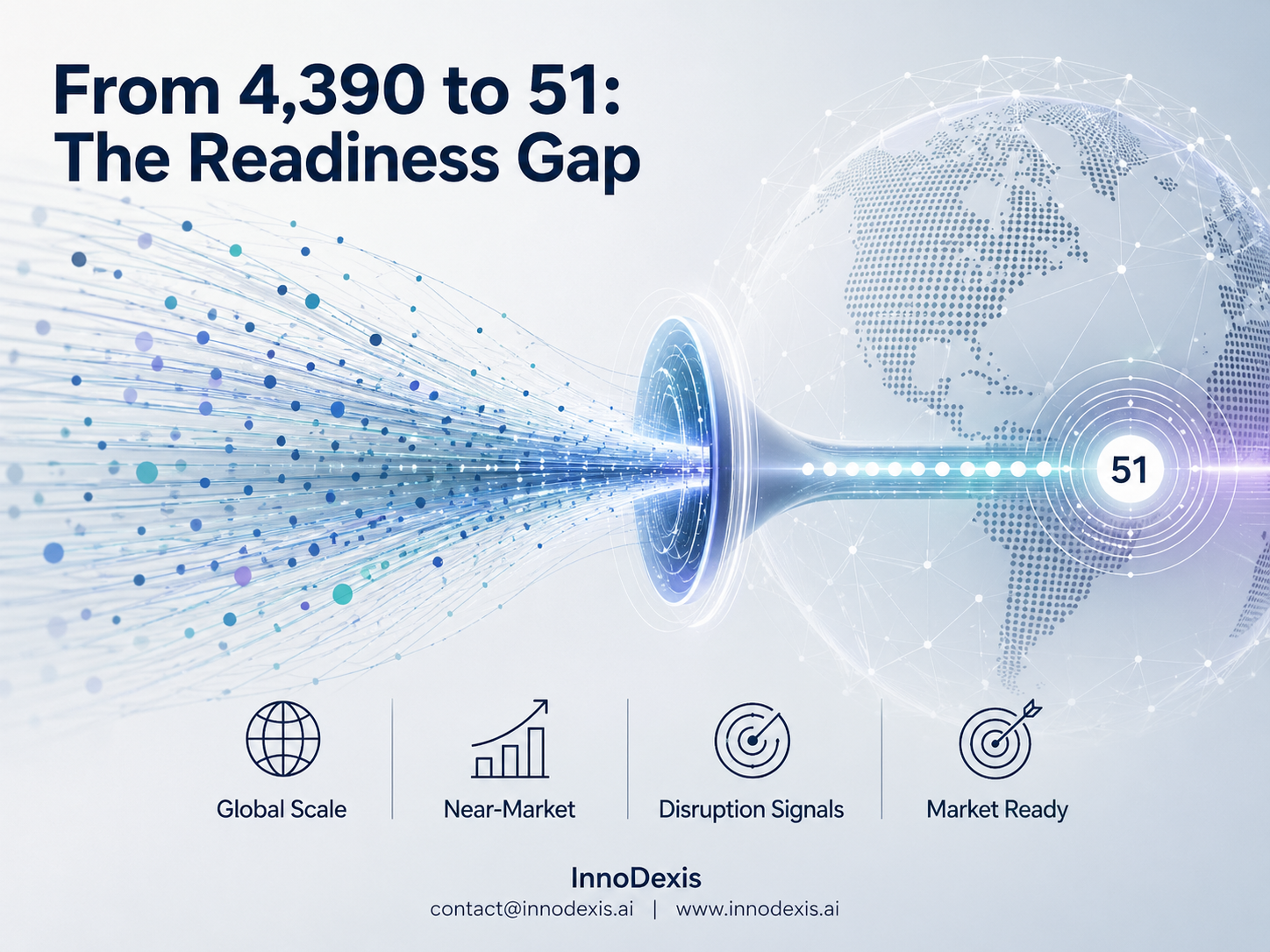
InnoDexis has published its latest Innovation Intelligence Report covering commercial readiness across global innovation, analyzing 4,390 innovations across multiple domains during March 2026. The report reveals that only 51 technologies have reached full market deployment, while 93% remain in the developing stage. With 65 assets identified in near-market readiness levels (TRL 7–9) and 1,388 disruption signals recorded, the data indicates a deep and active pipeline where the transition from development to deployment represents a critical phase for value creation.
Key Findings
A total of 4,390 innovations were tracked in March 2026, reflecting a broad and active global innovation pipeline. The scale of activity spans multiple sectors, indicating sustained research and prototype development across industries and regions.
Approximately 93% of all tracked innovations remain in the “Developing” stage. This distribution suggests that the innovation pipeline is not constrained by lack of activity, but is instead heavily weighted toward early and mid-stage development.
Only 51 technologies have reached full market readiness and deployment. This indicates that the conversion from innovation to scalable, market-ready solutions remains highly selective and limited relative to overall activity.
A total of 65 innovations fall within near-market readiness levels (Technology Readiness Levels 7–9). These assets represent technologies that have progressed beyond validation and are positioned for scaling, licensing, or commercial deployment.
The report identifies 1,388 disruption signals, representing the highest recorded level to date. This suggests an increase in breakthrough-oriented activity, indicating that the pace of innovation is accelerating even as market conversion remains constrained.
Strategic Insight and Trend Analysis
The March 2026 data highlights a structural shift in how innovation value is formed. While traditional metrics have focused on the volume of inventions or early-stage breakthroughs, the current distribution suggests that value is increasingly concentrated in the transition from development to deployment.
With 93% of innovations in the developing stage and only 51 reaching full deployment, the gap between creation and commercialization is pronounced. However, this gap does not indicate stagnation. Instead, it reflects a pipeline with significant depth, where a large number of technologies are progressing but only a limited subset achieves the criteria required for market readiness.
The identification of 65 near-market assets provides a clearer view of where immediate opportunities may exist. These technologies, positioned at Technology Readiness Levels 7–9, represent a stage where technical feasibility has been largely established and the primary challenge shifts toward scaling and integration into market environments.
The presence of 1,388 disruption signals further reinforces the dynamic nature of the pipeline. As breakthrough activity increases, the importance of distinguishing between early-stage innovation and deployable solutions becomes more pronounced. The data suggests that competitive advantage may increasingly depend on identifying technologies at the point of readiness rather than at the point of invention.
This transition reflects a broader evolution in innovation intelligence. Rather than tracking how much is being developed, attention is shifting toward understanding which technologies are approaching commercialization and how efficiently they can be converted into market outcomes.
Global and Industry Implications
For corporates and R&D teams, the findings indicate a need to focus on integration and scaling capabilities. With a large volume of innovations in development, identifying and adopting near-market technologies may provide a more immediate pathway to competitive differentiation than internal early-stage research alone.
For investors and capital allocators, the distribution highlights a concentration of opportunity within the near-market segment. The limited number of fully deployed technologies, combined with a defined group of 65 near-market assets, suggests that capital deployment strategies may increasingly target technologies with demonstrated readiness and shorter paths to commercialization.
For policymakers and national innovation bodies, the data underscores the importance of supporting transition mechanisms that move innovations from development to deployment. While early-stage research remains critical, enabling pathways for scaling and market entry may be equally important in realizing economic and societal value.
InnoDexis Statement
“The March 2026 data indicates that the primary concentration of innovation value is shifting toward the transition phase between development and deployment, where readiness—not volume—determines which technologies achieve market impact,” noted InnoDexis in its latest intelligence report.
Conclusion
The March 2026 Commercial Readiness Intelligence Report presents a global innovation landscape defined by scale, depth, and selective conversion to market outcomes. With 4,390 innovations tracked and only 51 reaching full deployment, the transition from development to commercialization emerges as the defining phase for value creation. As disruption signals continue to rise and near-market technologies advance, the ability to identify and act on readiness will shape competitive positioning. The complete March 2026 Commercial Readiness Intelligence Report is available to InnoDexis subscribers and enterprise clients.
About InnoDexis
InnoDexis is a global Innovation Intelligence platform that tracks, analyzes, and interprets breakthrough innovations, prototypes, and emerging technologies across industries and countries. Its intelligence helps corporates, investors, and policymakers understand the true structure and direction of global innovation. Learn more at innodexis.ai.