Global Deep Tech Pipeline Expands to 1,852 Innovations as Only 33 Reach Deployment Readiness
The April 2026 InnoDexis Prototype Intelligence Report identifies a widening commercialization gap as convergence-driven innovation accelerates across AI, biotech, materials science, and quantum technologies.
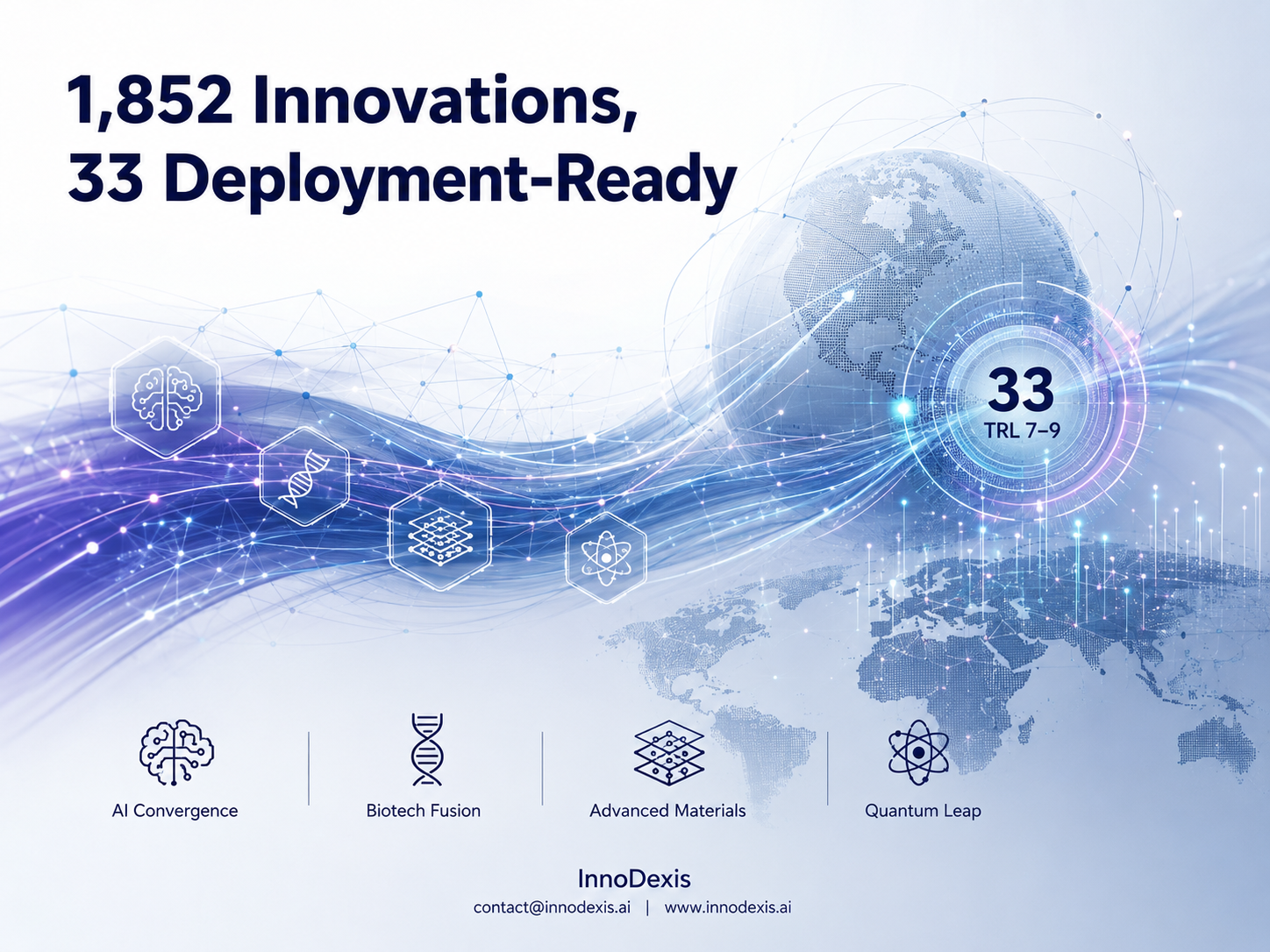
InnoDexis has published its latest Prototype Intelligence Report analyzing 1,852 validated innovations across more than 22 countries and 13 technology domains during April 2026. The report reveals that while global deep tech innovation activity continues to expand, only 33 prototypes currently demonstrate Technology Readiness Level (TRL) 7–9 deployment maturity. The findings indicate that the primary bottleneck in emerging technology ecosystems is no longer scientific discovery, but the transition from laboratory validation to scalable commercial deployment across converging technology sectors.
Key Findings
The April 2026 dataset identified 1,852 validated innovations spanning 13 technology domains and more than 22 countries. This scale of activity reflects one of the largest mapped prototype pipelines currently emerging across global research and commercialization ecosystems.
Among the 1,852 innovations, 644 prototypes were classified as high-disruption signals. However, only 33 innovations demonstrated TRL 7–9 readiness, indicating proximity to operational or real-world deployment. The disparity between disruptive potential and deployment maturity highlights a substantial commercialization bottleneck across deep technology sectors.
AI × MedTech emerged as the largest convergence cluster with 117 identified signals. The concentration of activity suggests that artificial intelligence is increasingly functioning as an enabling infrastructure layer within healthcare systems, diagnostics, clinical workflows, and medical technologies.
AI × Biotech followed closely with 98 identified convergence signals. The findings indicate growing integration between computational intelligence and biological systems, particularly in drug discovery, predictive biology, and molecular analysis workflows.
Advanced Materials recorded the highest disruption intensity at 63.6%, outperforming all other analyzed technology domains in proportional high-impact prototype concentration. This suggests that materials science continues to generate a comparatively high density of technically transformative innovations.
The report also indicates that innovation leadership is increasingly being shaped by cross-domain interaction rather than isolated technological progress. Multiple high-signal prototypes demonstrated convergence between AI, biotechnology, energy systems, advanced materials, and quantum-related technologies.
Strategic Insight and Trend Analysis
The April 2026 findings suggest that the global innovation economy is entering a convergence-driven phase in which value creation increasingly depends on interactions between technology domains rather than standalone breakthroughs. The emergence of large AI × MedTech and AI × Biotech clusters indicates that artificial intelligence is transitioning from an independent sector into embedded infrastructure across multiple industries.
At the same time, the gap between 644 high-disruption prototypes and only 33 deployment-ready systems highlights a structural challenge in deep technology commercialization. The data suggests that technical feasibility is no longer the primary limiting factor. Instead, deployment readiness, manufacturing scalability, regulatory navigation, and capital alignment are emerging as the dominant constraints.
The concentration of disruption intensity within Advanced Materials further reinforces the importance of enabling technologies within broader innovation ecosystems. Materials breakthroughs often function as foundational layers supporting advances in energy systems, semiconductors, healthcare technologies, and industrial manufacturing. Their high disruption density suggests that infrastructure-level innovation remains central to long-term technological competitiveness.
The findings also indicate a shift in how innovation ecosystems should be evaluated. Traditional approaches focused on isolated sectors may no longer capture the highest-value opportunities. Instead, convergence density and deployment readiness appear to be becoming more relevant indicators of future commercial significance. This reflects a broader transition from linear innovation pipelines toward interconnected systems-level development.
Global and Industry Implications
For corporates and R&D teams, the findings indicate that competitive advantage may increasingly depend on cross-domain integration capabilities. Organizations operating within isolated technology silos could face limitations as convergence-driven innovation ecosystems continue to expand.
For investors and capital allocators, the gap between high-disruption prototypes and deployment-ready systems highlights a growing opportunity in commercialization-stage infrastructure. The scarcity of TRL 7–9 systems suggests that execution capability, scaling capacity, and deployment financing may become critical differentiators.
For policymakers and national innovation bodies, the report underscores the importance of supporting translational ecosystems that bridge research and commercialization. Strengthening pilot deployment frameworks, manufacturing pathways, and interdisciplinary collaboration may become essential for converting scientific output into economic and industrial impact.
InnoDexis Statement
“The April 2026 data indicates that the next phase of deep technology competition will likely be determined less by discovery volume and more by the ability to convert convergence-driven prototypes into deployable commercial systems,” noted InnoDexis in its latest intelligence report.
Conclusion
The April 2026 Prototype Intelligence Report highlights a global innovation landscape characterized by strong prototype generation but limited deployment maturity. As convergence between AI, biotechnology, advanced materials, energy systems, and quantum technologies accelerates, commercialization readiness is emerging as the defining challenge. The findings suggest that future category leadership may depend not only on breakthrough invention, but on the ability to integrate, scale, and operationalize multi-domain technologies. The complete April 2026 Prototype Intelligence Report is available to InnoDexis subscribers and enterprise clients.
About InnoDexis
InnoDexis is a global Innovation Intelligence platform that tracks, analyzes, and interprets breakthrough innovations, prototypes, and emerging technologies across industries and countries. Its intelligence helps corporates, investors, and policymakers understand the true structure and direction of global innovation. Learn more at innodexis.ai.