Global Climate Innovation Accelerates Toward Deployment as Germany Leads and Solar Technologies Dominate
A Q1 2026 analysis of 402 innovations reveals a decisive shift from research to deployment, with solar, hydrogen, and integrated systems shaping the next phase of climate technology evolution.
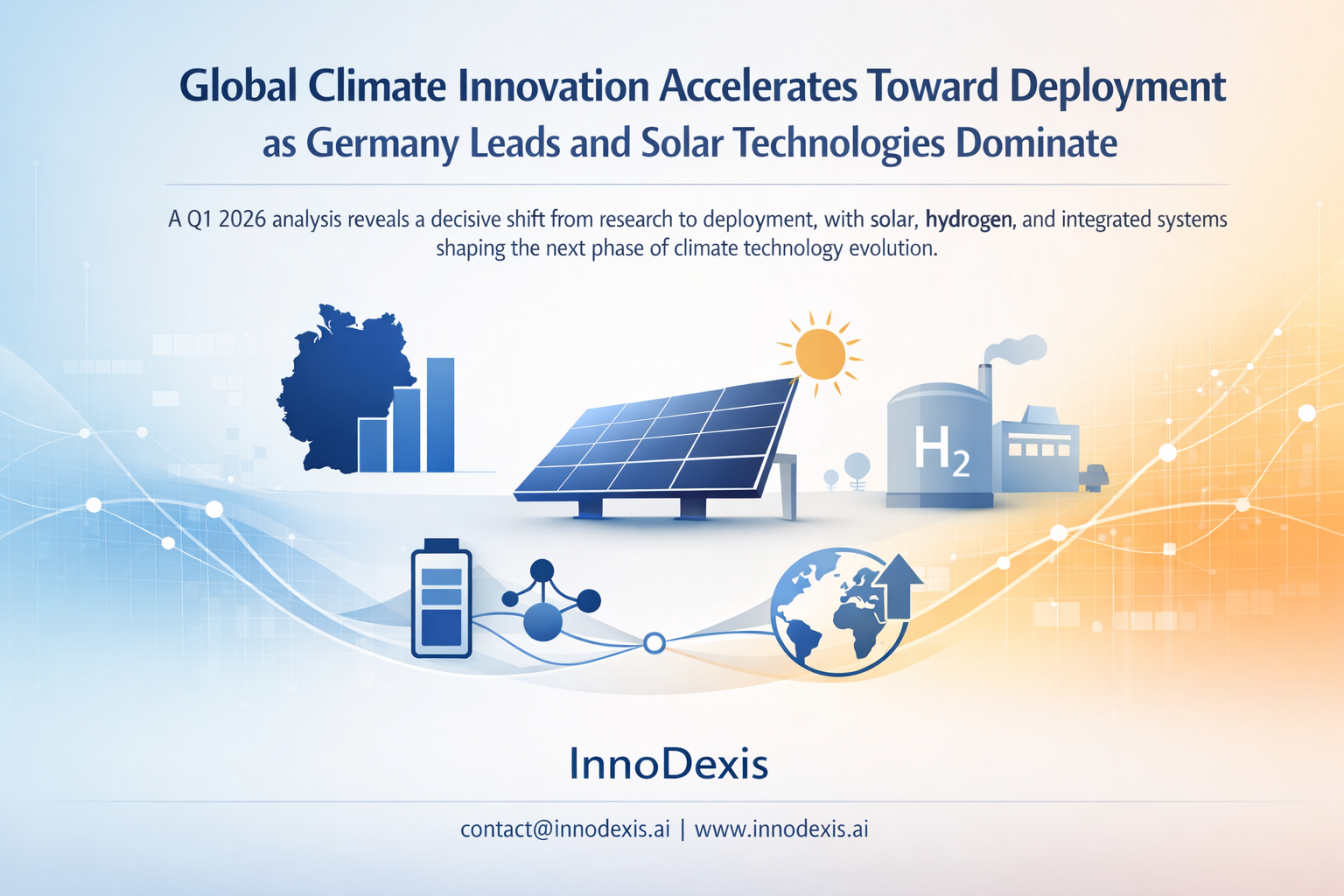
InnoDexis has published its latest Innovation Intelligence Report covering global climate technology innovation, analyzing 402 innovations across 32 countries during January 1 to March 9, 2026. The report reveals that climate innovation is transitioning from scientific discovery to early-stage deployment, led by advanced economies while facing persistent commercialisation and scale-up challenges.
KEY FINDINGS
Germany has emerged as the leading climate innovation hub, accounting for 126 of 402 innovations—nearly one-third of global activity. This concentration reflects strong alignment between policy, research infrastructure, and industrial transformation, particularly in offshore wind, hydrogen, and industrial decarbonisation.
Solar and photovoltaics represent the largest technology domain, with 157 innovations. Breakthroughs at the material level, including ultrafast electron charge separation, are redefining design principles and accelerating next-generation solar efficiency pathways.
Green hydrogen is moving into operational reality. Innovations demonstrate commercially viable decentralised production models and integrated carbon capture-conversion systems, significantly reducing process complexity and energy requirements.
Energy storage innovation is advancing at the materials level, with sodium-ion batteries approaching mid-stage readiness and new frameworks addressing fast-charging limitations. These developments directly target performance, safety, and lifecycle constraints in electric mobility and grid storage.
Industrial decarbonisation remains strategically critical despite lower innovation volume. Large-scale initiatives such as green steel programmes illustrate how sustained policy and capital commitment can enable measurable emission reductions while highlighting risks of delayed commercial scale-up.
Artificial intelligence is now embedded across climate innovation, appearing in 247 records. Its role is primarily as an accelerator of materials discovery, system optimisation, and modelling, rather than as a standalone innovation domain.
STRATEGIC INSIGHT AND TREND ANALYSIS
The collective findings point to a structural transition in climate innovation: the convergence of scientific breakthroughs, system integration, and deployment-focused engineering. The defining trend is not isolated technological advancement, but the integration of previously separate domains into unified systems.
At the scientific level, innovation is increasingly occurring at the molecular and materials scale. Discoveries in solar physics and battery chemistry indicate that efficiency gains are now being driven by fundamental scientific reconfiguration rather than incremental engineering improvements. This signals a new phase where physics-level insights directly shape commercial technologies.
Simultaneously, system integration is emerging as a dominant innovation logic. Technologies that combine capture, conversion, storage, and utilisation into unified processes are reducing energy costs and operational complexity. This shift reflects a move toward infrastructure efficiency rather than standalone optimisation.
Artificial intelligence is reinforcing this transformation by accelerating research cycles and enabling predictive design. However, the data consistently shows that AI is most effective when combined with domain expertise, establishing hybrid human-AI systems as the dominant research model.
Despite this progress, a structural gap remains between innovation and deployment. The dataset highlights a persistent imbalance between early-stage breakthroughs and commercially deployed technologies. This gap is not technological but systemic—driven by financing constraints, policy inconsistency, and industrial scale limitations.
The emergence of ocean-based carbon removal and agrivoltaics further indicates that the climate innovation frontier is expanding into new domains where environmental systems and infrastructure intersect. These areas represent the next phase of scalable climate solutions.
GLOBAL AND INDUSTRY IMPLICATIONS
For corporates and R&D teams, the findings emphasise the need to prioritise integrated systems and hybrid innovation models. Companies must align materials science, digital capabilities, and engineering deployment to remain competitive in a rapidly converging technology landscape.
For investors and capital allocators, the data identifies high-conviction areas including solar materials, integrated carbon capture systems, hydrogen production, and biosolutions. The presence of both early-stage breakthroughs and emerging deployment signals suggests a diversified investment approach across the innovation lifecycle.
For policymakers and national innovation bodies, the report highlights the importance of sustained, long-term policy frameworks. Successful cases demonstrate that coordinated state support, regulatory clarity, and industrial strategy are essential to translate innovation into competitive advantage at scale.
INNODEXIS STATEMENT
“The global climate innovation system is entering a phase defined by integration, acceleration, and deployment readiness, where the primary challenge is no longer discovery, but the ability to scale solutions within coherent policy and industrial frameworks,” noted InnoDexis in its latest intelligence report.
CONCLUSION
The Q1 2026 climate innovation landscape signals a decisive shift toward deployment-driven progress, underpinned by scientific breakthroughs, system integration, and expanding global participation. The trajectory suggests that the coming years will be defined by the ability to bridge the gap between innovation and large-scale implementation.
Key areas to watch include the scaling of hydrogen infrastructure, the commercialisation of advanced solar materials, the evolution of ocean-based carbon removal, and the role of AI in accelerating research cycles. The complete Global Climate Innovation Landscape 2026 report is available to InnoDexis subscribers and enterprise clients.
ABOUT INNODEXIS
InnoDexis is a global Innovation Intelligence platform that tracks, analyzes, and interprets breakthrough innovations, prototypes, and emerging technologies across industries and countries. Its intelligence helps corporates, investors, and policymakers understand the true structure and direction of global innovation. Learn more at innodexis.ai.