Global Clean Energy Innovation Enters Engineering and Systems Integration Phase as 157 Developments Converge Across 20 Countries
An analysis of 157 clean energy innovations indicates that technology readiness is increasingly giving way to challenges in large-scale systems integration and deployment.
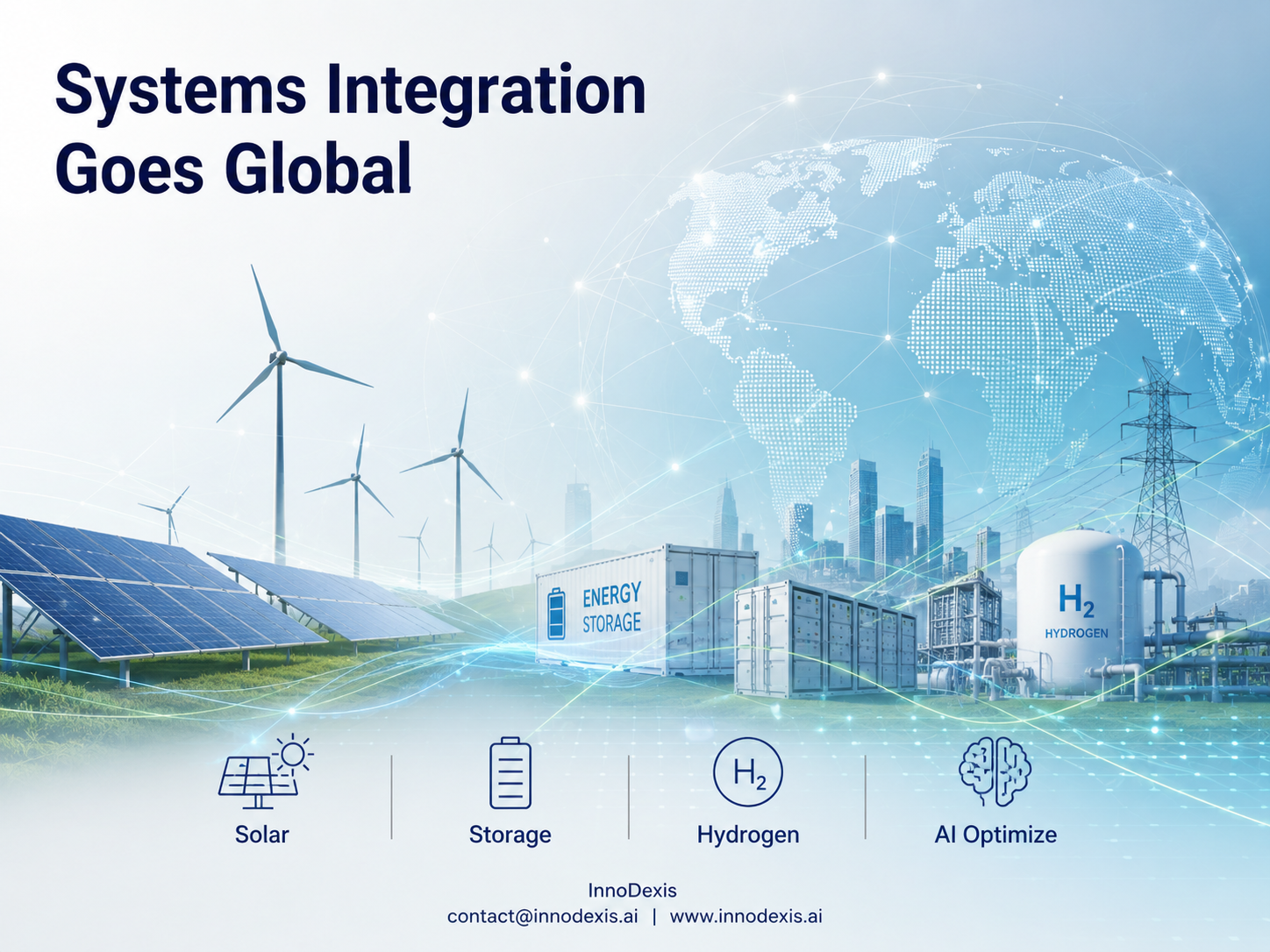
InnoDexis has published its latest Innovation Intelligence Report covering clean energy innovation, analyzing 157 innovations across 20 countries and more than 100 institutions. The report reveals that clean energy development is transitioning from a technology discovery phase toward an engineering and deployment phase, with advances emerging simultaneously across solar energy, hydrogen, energy storage, artificial intelligence, and infrastructure integration. The findings indicate that the primary challenge is no longer proving technical feasibility, but coordinating and scaling interconnected systems across industrial and energy networks.
Key Findings
A total of 157 clean energy innovations were identified across 20 countries and more than 100 institutions, reflecting broad international participation in the energy transition. The distribution of activity across multiple domains indicates that clean energy advancement is no longer concentrated in isolated technologies but increasingly spans interconnected infrastructure layers.
The transition from policy-driven momentum to execution-focused deployment is becoming more visible. Multiple technologies within solar, storage, hydrogen, and AI-enabled optimization are reaching engineering-grade performance thresholds, suggesting that the focus is shifting toward implementation at industrial and grid scale.
Artificial intelligence is being integrated throughout the clean energy stack. AI-driven optimization is accelerating design, modeling, monitoring, and operational efficiency across energy systems, contributing to shorter development cycles and faster iteration timelines compared with traditional infrastructure innovation pathways.
Hydrogen technologies are entering a cost-engineering phase rather than a purely experimental phase. Emerging efficiency benchmarks are already exceeding some targeted performance levels, indicating that attention is moving toward scaling production, transportation, and industrial integration.
Systems integration is emerging as the dominant operational bottleneck. While individual technologies continue to advance, the coordination of energy generation, storage, distribution, and industrial demand remains a primary constraint in achieving large-scale deployment efficiency.
Strategic Insight and Trend Analysis
The collective findings indicate that clean energy innovation is entering a convergence phase in which multiple technology layers are advancing simultaneously. Rather than relying on isolated breakthroughs, the current transition is increasingly defined by how effectively solar systems, storage infrastructure, hydrogen technologies, AI optimization, and grid integration operate together as interconnected systems.
This shift represents a structural change in the innovation cycle. Historically, clean energy development focused heavily on validating technical feasibility and improving standalone performance metrics. The latest findings suggest that many core technologies have moved beyond proof-of-concept and are now encountering engineering, orchestration, and deployment challenges associated with scaling across national and industrial systems.
The integration of artificial intelligence across the energy stack is accelerating this transition. AI is not functioning solely as a support tool but increasingly as a systems coordination layer that compresses modeling, optimization, and operational timelines. This capability is contributing to faster adaptation and integration across infrastructure networks.
The emergence of systems integration as the central bottleneck also indicates that future competitive advantage may depend less on inventing individual technologies and more on managing interoperability between them. The ability to coordinate generation assets, storage systems, industrial demand, and transmission infrastructure may determine the pace of energy transition outcomes. Collectively, the findings suggest that clean energy progress is evolving from incremental technological advancement toward infrastructure-scale system engineering.
Global and Industry Implications
For corporates and R&D teams, the findings highlight the increasing importance of interoperability and systems-level engineering. Organizations operating in clean energy may need to focus not only on individual technology performance but also on how solutions integrate across industrial and grid environments.
For investors and capital allocators, the convergence across hydrogen, storage, AI, and infrastructure suggests that future value creation may emerge from deployment platforms and integration capabilities rather than isolated technology assets. Capital allocation strategies may increasingly prioritize scalable system coordination models.
For policymakers and national innovation bodies, the transition from technology readiness to deployment orchestration has implications for infrastructure planning and regulatory alignment. Supporting integrated energy networks, grid modernization, and industrial coordination frameworks may become critical for accelerating decarbonization objectives.
InnoDexis Statement
“The current phase of clean energy development reflects a transition from technology validation to systems orchestration, where infrastructure integration and operational coordination are becoming the defining determinants of scalable deployment,” noted InnoDexis in its latest intelligence report.
Conclusion
The latest clean energy findings indicate that innovation constraints are increasingly shifting away from technical feasibility and toward deployment coordination. As solar systems, hydrogen technologies, AI infrastructure, storage platforms, and industrial integration continue to align, the pace of energy transition may depend on how effectively these systems operate together at scale. Monitoring integration efficiency, infrastructure readiness, and capital deployment will be essential in understanding the next phase of global clean energy expansion. The complete Clean Energy Innovation Intelligence Report is available to InnoDexis subscribers and enterprise clients.
About InnoDexis
InnoDexis is a global Innovation Intelligence platform that tracks, analyzes, and interprets breakthrough innovations, prototypes, and emerging technologies across industries and countries. Its intelligence helps corporates, investors, and policymakers understand the true structure and direction of global innovation. Learn more at innodexis.ai.