Global AI Innovation Surges to 535 Breakthroughs Across 28 Countries as Venture Capital Participation Remains Below 1%
InnoDexis finds that 43% of February 2026 AI innovations were government-backed, while venture capital participation was cited in fewer than 1% of cases.
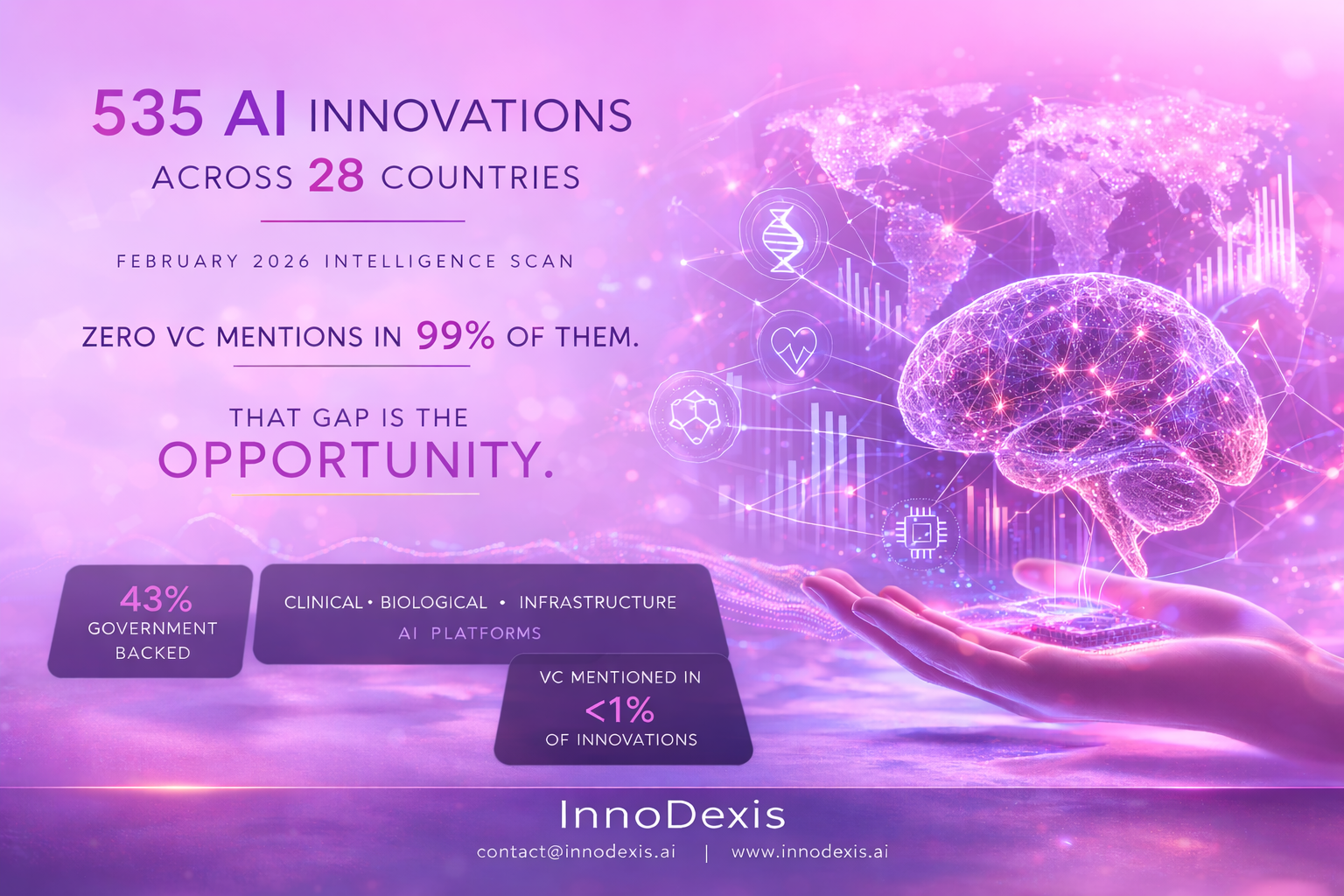
InnoDexis has published its latest Innovation Intelligence Report covering artificial intelligence, analyzing 535 innovations across 28 countries during February 2026. The report reveals that while 43% of identified AI innovations were supported by government grants, venture capital participation was mentioned in fewer than 1% of cases. This imbalance highlights a widening gap between research-stage maturity and early-stage capital deployment. The findings indicate that the global AI ecosystem is advancing scientifically, but commercial investment remains highly concentrated and limited relative to innovation output.
Key Findings
The February 2026 scan identified 535 quantified AI innovations across 28 countries, reflecting broad geographic participation in artificial intelligence development. This distribution underscores that AI research activity is not confined to a small group of markets but is instead structurally global.
Government support played a significant role in AI advancement during the period analyzed. The report finds that 43% of tracked innovations were backed by government grants, indicating sustained public-sector involvement in de-risking early scientific and technical development.
In contrast, venture capital participation was mentioned in fewer than 1% of innovations. This suggests that private capital engagement at the research and prototype stage remains limited, despite substantial innovation volume.
Clinical AI platforms emerged as one visible cluster within the data. Applications including AI-enabled stethoscopes, dermatology diagnostic systems, and radiation planning software demonstrated expert-level performance benchmarks. In these cases, regulatory progression rather than technical validation appears to be the next milestone.
Biological AI platforms also featured prominently. Protein large language models associated with the Arc Institute achieved a reported 256-fold improvement, while the University of Liverpool’s NAi® drug discovery platform has progressed to spinout activity. These examples indicate commercialization pathways through pharmaceutical partnerships or acquisitions.
Infrastructure-focused AI development was further represented by the Technical University of Munich’s university-developed AI chip initiative, targeting commercial production by 2028. This project reflects a strategic shift toward AI infrastructure capacity.
Strategic Insight & Trend Analysis
Taken collectively, the data points to a structural disconnect between scientific progress and early-stage private capital allocation. The high volume of innovations across 28 countries, combined with substantial public grant participation, indicates that foundational AI research is being systematically supported at the national level. Governments appear to be absorbing early technical risk, particularly in healthcare, biological modeling, and semiconductor infrastructure.
However, the near absence of venture capital references suggests that commercialization pipelines remain narrow relative to innovation supply. Rather than indicating weak scientific quality, this imbalance may reflect risk concentration within venture markets, extended regulatory timelines in sectors such as healthcare, and capital selectivity in infrastructure-heavy domains.
The emergence of three distinct archetypes — clinical AI platforms, biological AI platforms, and infrastructure AI systems — suggests that AI innovation is diversifying beyond software applications into regulated medical technologies, computational biology, and hardware sovereignty. These categories differ in capital intensity, regulatory complexity, and acquisition dynamics, yet all demonstrate technical maturation.
At a structural level, the data indicates that AI science is advancing faster than capital deployment. The opportunity space therefore lies not in the absence of innovation, but in bridging validated research outputs with scalable commercialization frameworks.
Global & Industry Implications
For corporates and R&D teams, the findings signal a widening external innovation landscape. With 535 AI developments recorded in a single month, structured scouting and partnership models will be critical to identifying acquisition or collaboration candidates before valuation inflection points.
For investors and capital allocators, the concentration of venture participation below 1% suggests limited competition at the research-to-commercialization transition stage. Clinical AI tools with demonstrated expert-level performance and biological AI platforms progressing toward spinouts may represent structured entry points for early-stage positioning.
For policymakers and national innovation bodies, the data affirms the role of government grants in sustaining AI development. However, the translation of publicly funded research into scaled commercial outcomes may require mechanisms that attract private capital into later validation and regulatory phases.
InnoDexis Statement
“The February data indicates that AI research capacity is expanding globally, yet early-stage capital deployment remains highly selective. The structural gap between validated science and venture participation defines the current commercialization landscape,” noted InnoDexis in its latest intelligence report.
Conclusion
The February 2026 analysis highlights a global AI ecosystem characterized by high research output, strong public-sector backing, and limited early-stage venture engagement. Clinical validation, biological modeling advancements, and infrastructure sovereignty initiatives signal technological maturity across multiple domains. The central variable to monitor will be whether private capital participation expands in proportion to scientific output. InnoDexis will continue tracking this commercialization dynamic across geographies and sectors. The complete February 2026 AI Innovation Intelligence Report is available to InnoDexis subscribers and enterprise clients.
About InnoDexis
InnoDexis is a global Innovation Intelligence platform that tracks, analyzes, and interprets breakthrough innovations, prototypes, and emerging technologies across industries and countries. Its intelligence helps corporates, investors, and policymakers understand the true structure and direction of global innovation. Learn more at innodexis.ai.