Glioblastoma Organoid Model Shows Direct Tumour Contact Drives T-Cell Dysfunction as MHC-I Stays Preserved in Luxembourg Institute of Health Study
Luxembourg Institute of Health researchers used patient-derived glioblastoma organoid co-cultures with human T cells to show that local cell-to-cell contact, not MHC-I loss, drives T-cell suppression, creating a patient-relevant platform for testing immunotherapy combinations.
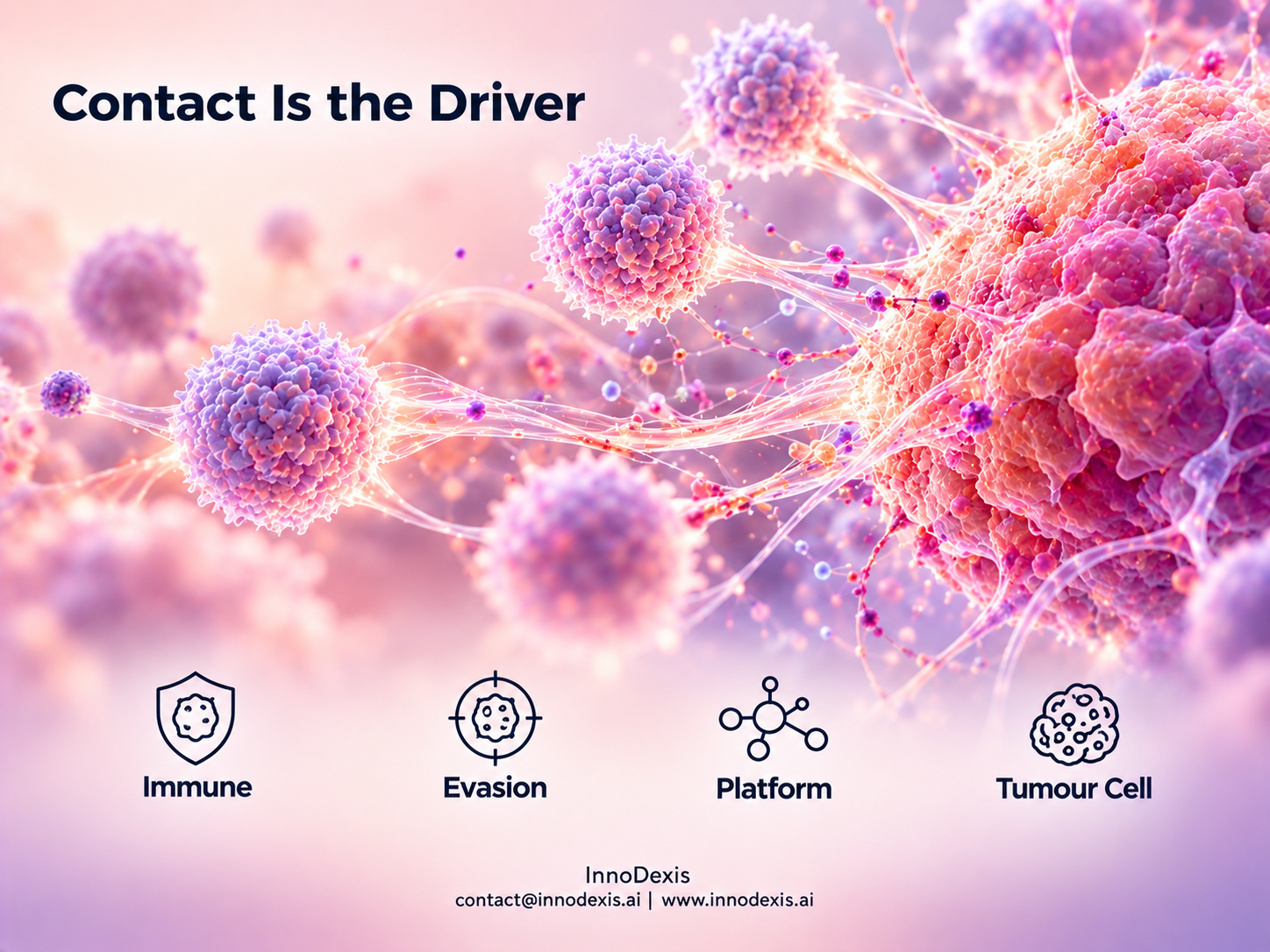
InnoDexis has published its latest Innovation Intelligence Report covering glioblastoma immunotherapy research, analyzing one innovation from the Luxembourg Institute of Health (LIH), with a collaborator in Ireland, published on 19 October 2026. The report reveals that patient-derived 3D glioblastoma organoid co-culture models show that direct tumour-cell contact drives T-cell dysfunction and immunosuppression, while MHC-I surface expression is largely preserved, giving researchers a patient-relevant platform for evaluating personalized immunotherapy strategies and treatment combinations in a cancer where immunotherapies have shown limited effectiveness.
Key Findings
Direct tumour-cell contact drives T-cell dysfunction and immunosuppressive states in glioblastoma organoids. The finding identifies local cell-to-cell contact as a driver of immune suppression, and it gives a more precise view of the local signals that weaken immune responses in this cancer.
MHC-I surface expression is preserved across patient tumours and the models built from them. This indicates that immune evasion in glioblastoma is not primarily driven by loss of MHC-I, which redirects attention toward contact-dependent mechanisms as the explanation for T-cell suppression. It also means the models retain a feature seen in the patient tumours they are derived from.
The platform co-cultures patient-derived 3D glioblastoma organoids with human T cells and preserves the parental tumour characteristics and cellular diversity. It draws on the PRECISION-PDX collection, which the Neurosurgery Department of the Centre Hospitalier de Luxembourg helped establish, and its development stage is rated at a TRL proxy of 4.
The models provide a patient-relevant system for evaluating future immunotherapies and identifying promising treatment combinations. They also support research into why immunotherapy responses differ between patients, which matters to immunotherapy researchers and to people living with glioblastoma. Evaluating direct tumour-cell to T-cell contact is built into the platform’s design.
The work was published in the Journal of Neuroinflammation, with the Royal College of Surgeons in Ireland as a scientific research collaborator. It addresses a cancer that remains difficult to treat, where immunotherapies have shown limited effectiveness because of tumour-induced immunosuppression.
Strategic Insight and Trend Analysis
The dominant trend in this research is a shift from asking whether glioblastoma hides from the immune system to asking how it suppresses it locally. The finding that MHC-I surface expression is preserved indicates that MHC-I loss is not the primary driver of immune evasion, and the finding that direct tumour-cell contact drives T-cell dysfunction points to a mechanism that can be studied and tested.
This matters because immunotherapies have shown limited effectiveness in glioblastoma, and the reason has been tumour-induced immunosuppression. A model that reproduces the interaction between patient-derived tumour cells and human T cells in a controlled setting makes it possible to examine the local signals involved, and to investigate how those mechanisms might be overcome. Anna Golebiewska, who leads the NORLUX Neuro-Oncology Laboratory and is the corresponding author, describes the models as a valuable platform for exactly that purpose.
The work also reflects a move toward patient-specific preclinical systems. Because the organoids preserve parental tumour characteristics and cellular diversity, they offer a way to evaluate candidate immunotherapies and combination strategies in a setting that reflects individual patients, and to explore why responses differ from one patient to another.
The evidence has clear limits. This is a preclinical platform at a TRL proxy of 4, positioned for evaluating future immunotherapies rather than demonstrating treatment results. The announcement is classed as an R&D commitment, with medium market momentum and medium disruption potential as a new application. The research was funded by European, national and philanthropic sources.
Global and Industry Implications
For corporates and R&D teams in biopharmaceuticals and oncology, the platform offers a patient-relevant preclinical system for evaluating candidate immunotherapies and treatment combinations in glioblastoma. The preserved MHC-I finding narrows the question of immune evasion toward contact-dependent mechanisms, which is where screening effort can be directed. Immunotherapy researchers are the identified beneficiaries, alongside glioblastoma patients.
For investors and capital allocators, the signal is early and research-stage. Investment attractiveness is rated medium and the target industries are biopharmaceuticals and oncology, but no funding amounts, commercial partners or patent information are reported. The opportunity lies in preclinical immunotherapy screening rather than a near-term product.
For policymakers and national innovation bodies, the work was supported by a broad mix of public and philanthropic funders, including the European Union’s Horizon Europe programme, the Luxembourg National Research Fund, ERA-NET TRANSCAN-3, Télévie-FNRS and Fondation Cancer Luxembourg. It also shows cross-border research between Luxembourg and Ireland linking a research institute with hospital neurosurgery.
InnoDexis Statement
“Showing that local cell-to-cell contact, rather than MHC-I loss, drives T-cell suppression gives glioblastoma immunotherapy a more precise target, and patient-derived organoids offer a preclinical system for testing which combinations to pursue,” noted InnoDexis in its latest intelligence report.
Conclusion
The next developments to watch are the use of the organoid co-culture platform to evaluate candidate immunotherapies and combination strategies, and what it reveals about why immunotherapy responses differ between patients. Whether the contact-dependent mechanisms can be overcome is the central open question. Because the work is at a preclinical stage, progress will be measured by how the platform is applied in future immunotherapy evaluation. InnoDexis will continue to track glioblastoma immunotherapy, 3D organoid models and neuro-oncology research as this field develops. The complete Glioblastoma Organoid Immunotherapy Innovation Intelligence Report is available to InnoDexis subscribers and enterprise clients.
About InnoDexis
InnoDexis is a real-time innovation intelligence platform connecting scientific discovery to commercial opportunity. Powered by InnoGraph, its proprietary innovation knowledge graph, the platform maps technologies across the entire lifecycle, from early-stage research (TRL 1) to market deployment (TRL 9), connecting researchers, institutions, startups, companies, products and emerging opportunities.
Covering 40+ specialised industry segments and 360 technology areas, InnoDexis delivers innovation tracking, research discovery, product and startup intelligence, investment insights, and AI-powered reports. Its mission is to bridge the gap between scientific discovery and real-world impact.
InnoDexis — From Lab to Market: Real-Time Innovation Intelligence.