Germany Records Lowest VC Attribution at 4% as R&D-Led Translation Model Outpaces US and UK
InnoDexis data reveals that Germany’s innovation system operates through state-backed R&D collaboration rather than venture-capital validation, reshaping how deep-tech commercialization should be assessed.
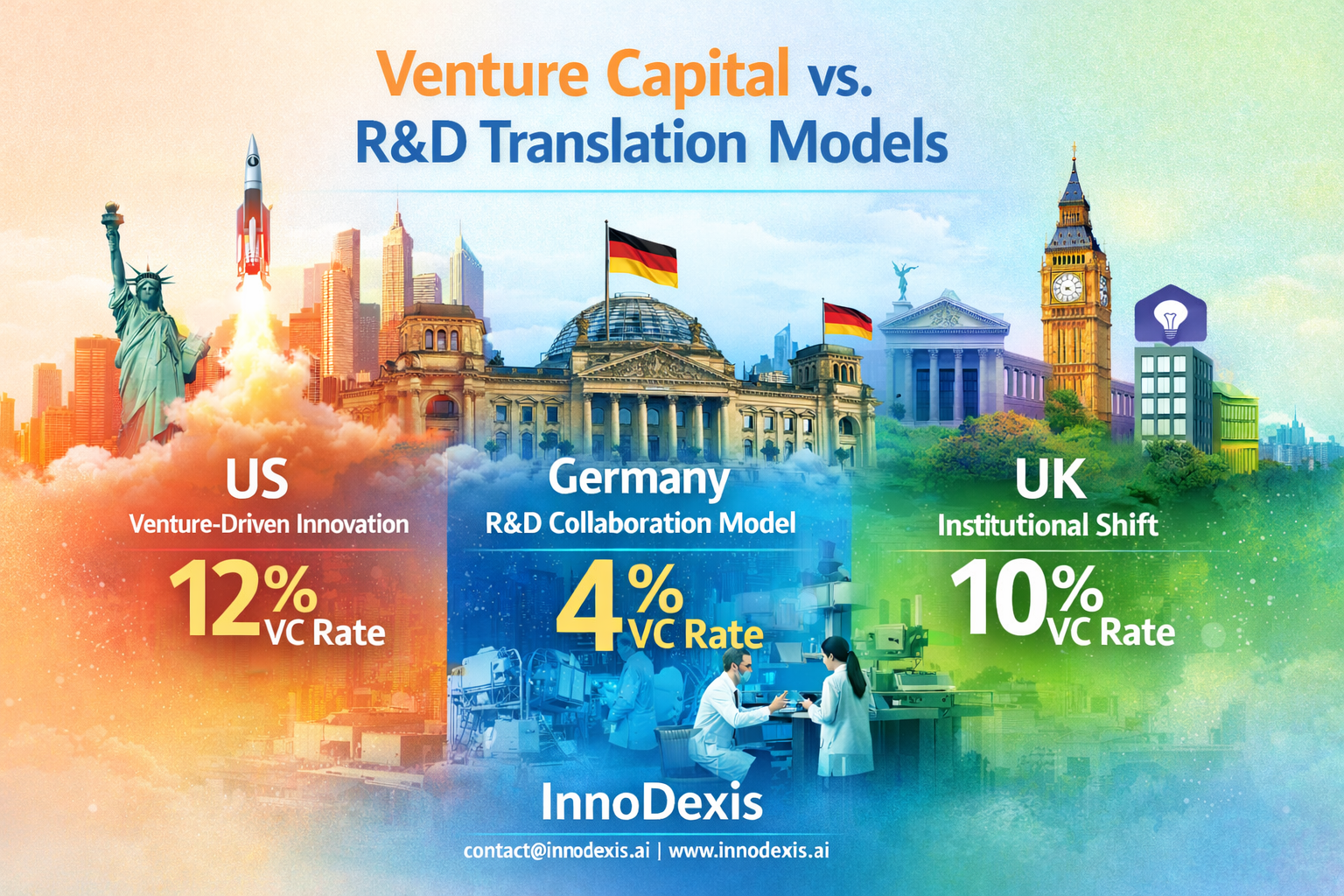
InnoDexis has published its latest Innovation Intelligence Report covering venture capital attribution and innovation translation dynamics across the United States, Germany, and the United Kingdom, analyzing 158 innovation articles across three countries during January and February 2026. The report reveals that Germany recorded only 4% named venture capital attribution per research breakthrough, compared with 12% in the United States and 10% in the United Kingdom. However, the data indicates that Germany’s innovation system operates through a distinct funding architecture centered on R&D collaboration and state-backed translation rather than early-stage venture signaling.
KEY FINDINGS
Germany recorded the lowest named venture capital attribution among the three countries analyzed. For every 25 German research breakthroughs tracked during the 30-day period, only one attracted named venture capital participation, equating to 4%. By contrast, the United States recorded a 12% rate, and the United Kingdom recorded 10%.
The United States demonstrated the strongest formal spin-off conversion rate. Sixty-two percent of U.S. articles tracked during the period translated into named spin-offs, reflecting a structured pathway from research disclosure to company formation.
Germany led in R&D collaboration signaling intensity. Eighty percent of German innovation articles carried formal research and development collaboration indicators — the highest proportion among the three countries analyzed. This suggests systemic institutional involvement at early research stages.
A significant institutional capital movement occurred in February 2026, when Qatar’s sovereign wealth fund committed over $1 billion to German deep-tech ventures through ESMT Berlin. The allocation did not emerge through mainstream technology media channels but appeared within institutional research reporting streams.
Across the same 30-day window and methodology, the three countries displayed materially different innovation-to-commercialization profiles, underscoring structural divergence rather than performance variance.
STRATEGIC INSIGHT AND TREND ANALYSIS
The data collectively indicates that venture capital attribution alone is an incomplete proxy for innovation vitality. Germany’s 4% rate may appear weak under a venture-led analytical lens. However, the elevated 80% R&D collaboration signal suggests a system in which state-supported research translation precedes, rather than depends upon, private venture validation.
This structural distinction is significant. The United States exhibits a venture-amplified commercialization model characterized by high spin-off visibility and rapid corporate formation. The United Kingdom appears to be recalibrating its translation infrastructure, positioning itself between institutional support and venture engagement. Germany, by contrast, operates through a coordinated public research ecosystem, where institutions systematically de-risk science prior to market transfer.
The February 2026 sovereign wealth allocation reinforces this interpretation. The $1 billion commitment into German deep-tech ventures through ESMT Berlin demonstrates that institutional capital may be engaging downstream of research translation, rather than at early public signaling stages.
Taken together, the findings point to three distinct innovation archetypes operating within the same advanced economies: venture-amplified acceleration, infrastructure rebuilding, and state-anchored translation. Evaluating them through a single venture-capital visibility metric obscures these structural differences.
GLOBAL AND INDUSTRY IMPLICATIONS
For corporates and R&D teams, the findings suggest that Germany’s innovation landscape may offer systematically de-risked deep-tech assets emerging from structured research ecosystems. Engagement strategies may require institutional partnerships rather than early-stage venture sourcing.
For investors and capital allocators, the divergence highlights the need to recalibrate screening models. Venture visibility metrics may underrepresent opportunities in markets where state-supported translation mechanisms dominate early-stage development.
For policymakers and national innovation bodies, the comparative data underscores that innovation performance cannot be measured solely by venture activity rates. The architecture connecting research institutions, translation frameworks, and downstream capital determines how innovation manifests in public data.
The divergence across the United States, Germany, and the United Kingdom suggests that national innovation strategies produce distinct commercialization signatures, each with different implications for competitiveness and capital deployment.
INNODEXIS STATEMENT
“Venture capital visibility is not equivalent to innovation intensity; structural funding architecture determines how innovation surfaces in public data,” noted InnoDexis in its latest intelligence report.
CONCLUSION
The January–February 2026 window reveals that identical measurement methodologies can expose fundamentally different innovation systems operating beneath surface metrics. As deep-tech competition intensifies globally, stakeholders must assess not only funding volumes but structural translation pathways. Monitoring how institutional capital, R&D collaboration, and venture formation interact will be critical in the coming quarters. InnoDexis will continue tracking these country-level intelligence patterns to provide comparative visibility into global innovation architecture.
The complete Country Intelligence Brief: USA · Germany · UK is available to InnoDexis subscribers and enterprise clients.
ABOUT INNODEXIS
InnoDexis is a global Innovation Intelligence platform that tracks, analyzes, and interprets breakthrough innovations, prototypes, and emerging technologies across industries and countries. Its intelligence helps corporates, investors, and policymakers understand the true structure and direction of global innovation. Learn more at innodexis.ai.