Germany Leads Global Energy Innovation as AI–Storage Convergence Drives 44.6% of Breakthrough Activity
A Q1 2026 analysis of 643 innovations across 33 countries reveals that energy systems are evolving through simultaneous multi-domain advancement, led by AI-enabled infrastructure and battery technologies.
InnoDexis has published its latest Innovation Intelligence Report covering energy and cleantech innovation, analyzing 643 innovations across 33 countries during January 1 to March 27, 2026. The report reveals that global energy innovation has reached a structural inflection point, where multiple technology domains—including AI-driven energy systems and battery storage—are advancing simultaneously, with convergence between intelligent software and physical infrastructure emerging as the defining trend.
KEY FINDINGS
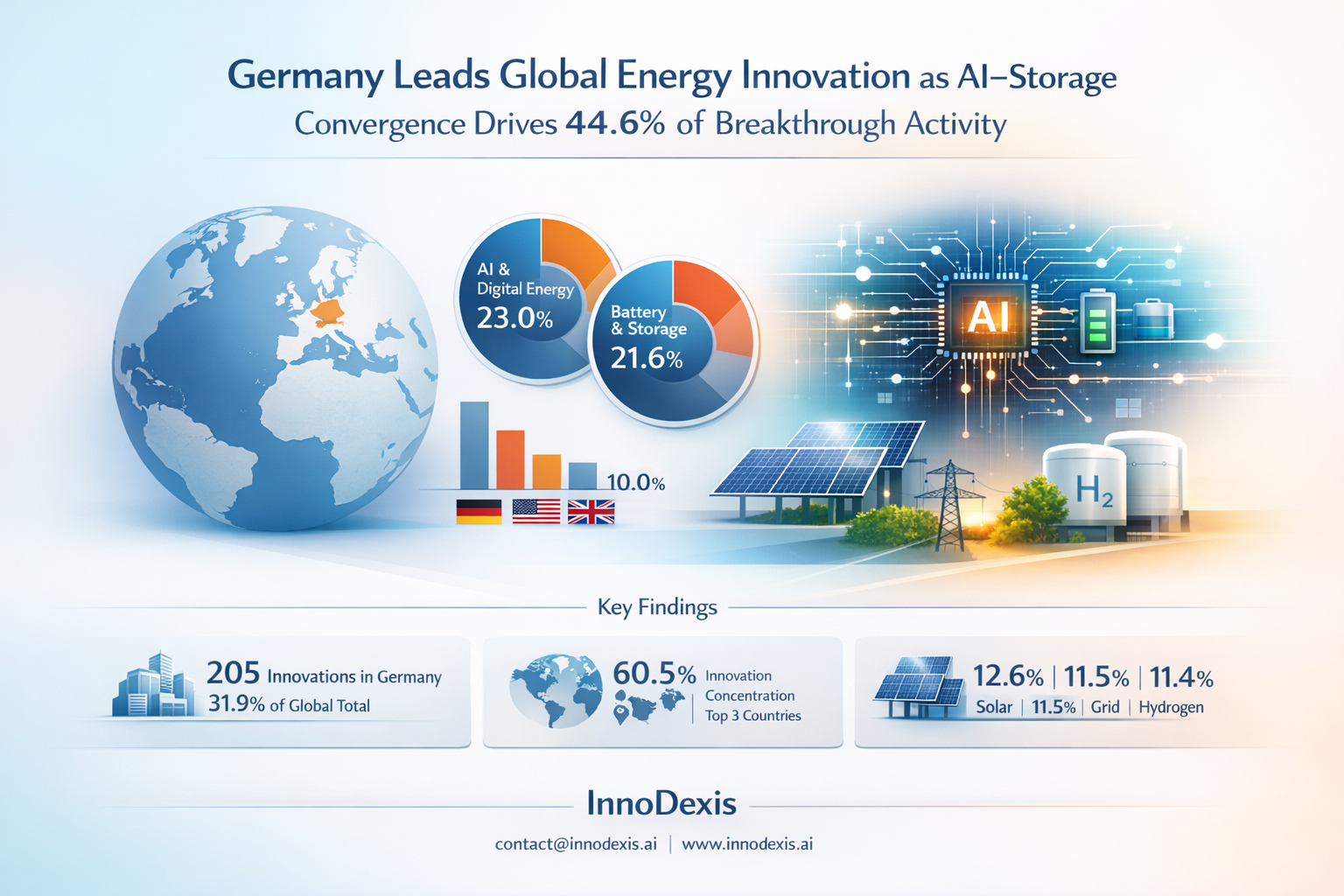
AI & Digital Energy and Battery & Energy Storage have emerged as the two dominant innovation segments, accounting for 23.0% and 21.6% of total activity respectively. Together, they represent 44.6% of all innovations, signalling that the most significant progress is occurring at the intersection of intelligent energy management and physical storage infrastructure.
Germany leads global energy innovation with 205 innovations, representing 31.9% of total output. This leadership is driven by applied research ecosystems such as Fraunhofer and Helmholtz, which demonstrate strong alignment between scientific research and industrial deployment across grid resilience, battery manufacturing, and solar technologies.
The United States, Germany, and United Kingdom collectively account for 389 innovations, or 60.5% of global activity. This concentration reflects structural dominance across breakthrough science, applied engineering, and commercialisation, with each country contributing distinct capabilities across the energy innovation stack.
Solar and photovoltaics, grid systems, and hydrogen technologies form a second tier of innovation activity, with shares of 12.6%, 11.5%, and 11.4% respectively. This distribution indicates that every major node of the energy system—generation, storage, transmission, and fuel alternatives—is advancing in parallel rather than sequentially.
Battery innovation has entered a phase of simultaneous multi-chemistry advancement, including sodium-ion, iron-oxide anodes, solid-state electrolytes, and water-based manufacturing processes. These developments represent parallel architectural shifts rather than incremental improvements, indicating a diversification of storage technologies.
Government funding supports 46.3% of all innovations, while venture capital participation remains below 1%. This imbalance highlights a structural funding gap in the commercialisation of energy technologies, particularly in capital-intensive hardware segments.
STRATEGIC INSIGHT AND TREND ANALYSIS
The Q1 2026 dataset points to a fundamental shift in how energy innovation is evolving: from isolated breakthroughs to system-level convergence. The defining trend is the integration of multiple technology layers—AI, materials science, storage, and infrastructure—into unified energy systems.
AI has transitioned from a supporting tool to a foundational infrastructure layer, appearing in 148 innovations. Its role spans predictive grid management, materials discovery, and optimisation of complex energy systems. This indicates that future energy systems will be designed as computational platforms as much as physical infrastructure.
At the same time, innovation is occurring simultaneously across all major components of the energy system. Advances in perovskite solar efficiency and durability, battery chemistry diversification, fusion capital mobilisation, and hydrogen cost competitiveness are all occurring within the same time frame. This simultaneity marks a departure from historical patterns of sequential technological progress.
The convergence between AI and energy infrastructure represents the most significant structural development. Intelligent systems are increasingly responsible for managing variability, optimising performance, and enabling new operational models such as autonomous grids. This convergence is effectively creating a new category of AI-enabled energy systems.
Despite these advancements, a persistent gap remains between innovation and commercial deployment. Limited venture capital participation and challenges in manufacturing scale-up—particularly for batteries and solar technologies—indicate that the primary constraint is no longer scientific discovery but industrial execution.
The dataset also highlights expanding innovation frontiers, including ocean energy, geothermal systems, and circular carbon technologies. These areas reflect the broadening scope of energy innovation beyond traditional domains, driven by the need for system-wide decarbonisation.
GLOBAL AND INDUSTRY IMPLICATIONS
For corporates and R&D teams, the findings indicate that competitive advantage will depend on integrating AI capabilities with physical energy systems. Organisations must prioritise system-level innovation, combining materials science, digital infrastructure, and engineering deployment into unified strategies.
For investors and capital allocators, the report highlights a significant opportunity in the commercialisation gap. With government funding dominating early-stage innovation, private capital can play a critical role in scaling technologies such as long-duration storage, advanced batteries, and hydrogen systems.
For policymakers and national innovation bodies, the data underscores the importance of sustained, coordinated policy frameworks. Countries leading in innovation demonstrate strong alignment between research funding, industrial policy, and infrastructure investment, which is essential for translating innovation into economic and strategic advantage.
INNODEXIS STATEMENT
“The energy innovation landscape is no longer defined by individual breakthroughs, but by the convergence of intelligence, infrastructure, and materials science into integrated systems that determine scalability and global competitiveness,” noted InnoDexis in its latest intelligence report.
CONCLUSION
The Q1 2026 energy innovation landscape reflects a transition toward system-level transformation, where simultaneous advancements across multiple domains are reshaping the structure of the global energy system. The convergence of AI, storage, and generation technologies is establishing the foundation for next-generation energy infrastructure.
Looking ahead, key developments to monitor include the commercialisation of long-duration storage, scaling of alternative battery chemistries, deployment of hydrogen infrastructure, and continued capital mobilisation in fusion energy. The complete Energy Innovation Landscape 2026 report is available to InnoDexis subscribers and enterprise clients.
ABOUT INNODEXIS
InnoDexis is a global Innovation Intelligence platform that tracks, analyzes, and interprets breakthrough innovations, prototypes, and emerging technologies across industries and countries. Its intelligence helps corporates, investors, and policymakers understand the true structure and direction of global innovation. Learn more at innodexis.ai.