Generative AI Dental Crown Design Cuts Active Design Time Over 90% and Error 70% as HKU's DentalGEN Delivers 3D Crowns in Under 60 Seconds
HKU's DentalGEN, built on 26,614 dental samples from 7,880 patients, generates complete 3D crowns with colour maps in under 60 seconds per case and showed clinical performance comparable to experienced dental technicians.
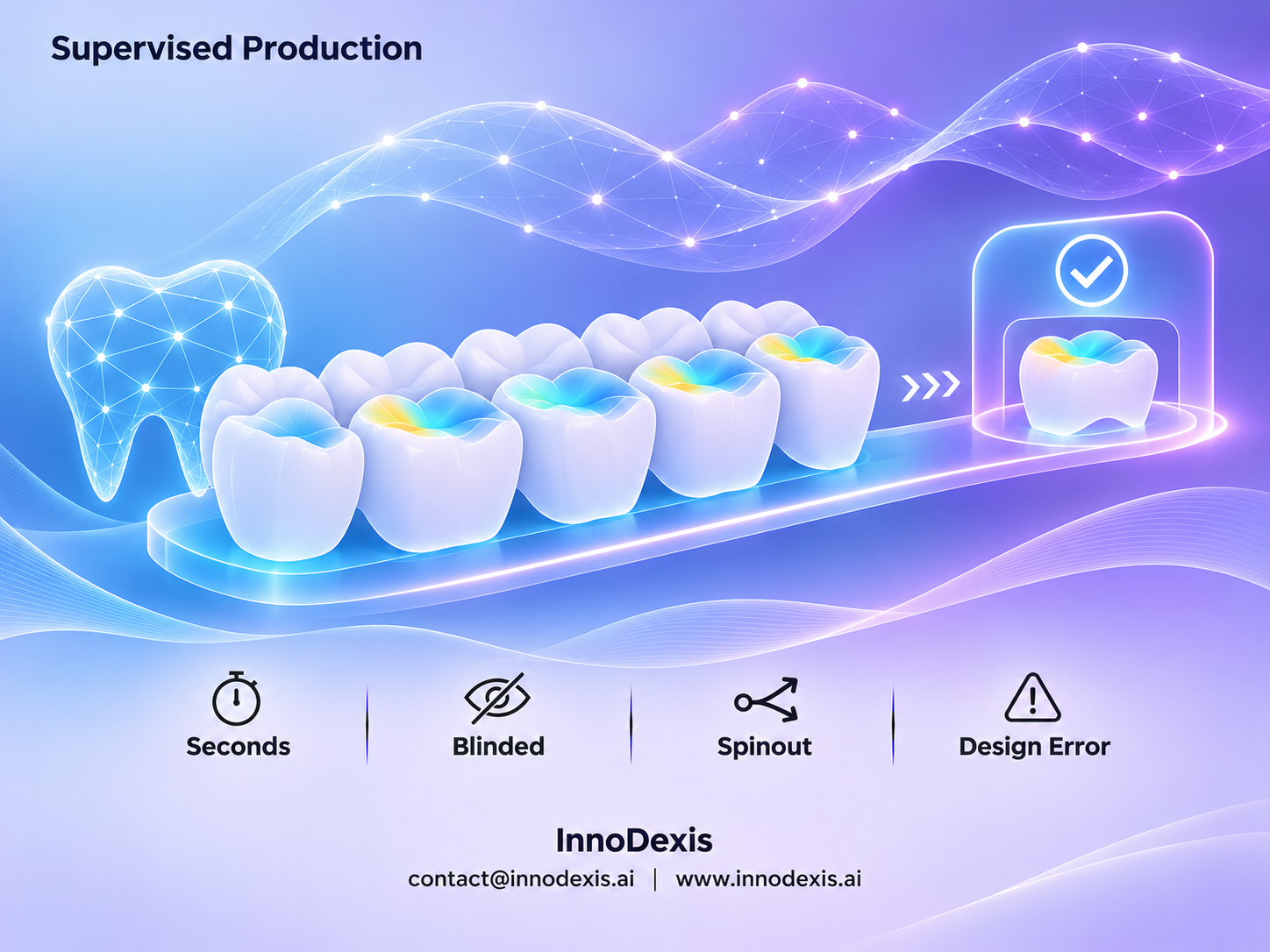
InnoDexis has published its latest Innovation Intelligence Report covering AI-driven dental manufacturing, analyzing one innovation from the University of Hong Kong (HKU), published on 20 November 2026. The report reveals that DentalGEN, a controllable generative AI framework built on a multi-view diffusion model, generates complete, manufacture-ready 3D crowns in under 60 seconds per case, reducing active design time by more than 90% and design error by 70% compared with previous generative AI models, with clinical performance comparable to experienced dental technicians.
Key Findings
DentalGEN reduced active crown design time by more than 90%. It generates complete 3D crown geometry and biomimetic colour maps in under 60 seconds per case on a standard graphics processing unit, and it supports parallel generation of multiple cases at once, which is what makes high-throughput dental laboratory operations possible.
Design error fell by 70% compared with previous generative AI models. The model builds in neighbouring teeth, opposing bite relationships, finish lines and surrounding tooth colour, and is described as the first large-scale controllable generative AI framework for automated dental crown restoration.
In a blinded clinical assessment using World Dental Federation (FDI) criteria, there was no statistically significant difference in the average clinical score between DentalGEN crowns and crowns designed by experienced human dental technicians. DentalGEN outperformed human-designed crowns in selected tooth positions.
The framework was built on a multicenter, cross-domain dataset of 26,614 dental samples from 7880 patients. Collaborating institutions include ShanghaiTech University, Shanghai Jiao Tong University, Wuhan University, The Hong Kong University of Science and Technology and Texas A&M University, and the work is supported by the General Research Fund of the Research Grants Council of the Hong Kong SAR.
DentalGEN is at the clinical proof-of-concept stage with medium commercial readiness. A spinout startup has been formed under the SPIN programme at the Hong Kong-Shenzhen Innovation and Technology Park (HSITP), and software deployment in commercial dental laboratories is estimated at 1 to 3 years.
Strategic Insight and Trend Analysis
The dominant trend in this research is the shift of dental design from manual creation to supervised, automated production. DentalGEN replaces manual CAD crown adjustment and shade matching with sub-minute batch generation, moving technicians into supervisory roles and restructuring laboratory work toward high-efficiency supervisory production. James Kit Hon Tsoi, Assistant Dean (Innovation) at the HKU Faculty of Dentistry, describes it as a clinically proven stepping stone toward Industry 4.0 in dentistry.
The significance is both operational and structural. Automation addresses global shortages of specialised dental personnel and the needs of ageing populations, and it connects to a regional manufacturing base: the Greater Bay Area supplies 30-35% of global medical and dental device manufacturing. Bridging AI generation directly with prosthodontic CAD/CAM workflows is what turns a design tool into a manufacturing capability. The multicenter evidence base, drawn from 7880 patients, gives that claim more weight than a single-site demonstration.
The boundaries are clear. Full single-visit scan-design-print restoration depends on external advances in multi-material 3D printing, and errors in multi-view feature alignment may arise on non-standard or severely degraded prepared tooth geometry. Adoption inertia among laboratories accustomed to legacy CAD software and competition from established dental CAD companies integrating proprietary AI features are the main commercial threats.
Technical risk for single crown design is low given the clinical validation, while commercial execution risk is moderate, centred on regulatory clearance and adoption by laboratory workflows.
Global and Industry Implications
For corporates and R&D teams, DentalGEN is directly deployable to dental laboratories, CAD/CAM software vendors and dental device manufacturers. It works with CAD/CAM systems and multi-material 3D printing technologies, and the next opportunities are multi-unit bridges, complete dentures and titanium bone meshes.
For investors and capital allocators, the profile combines clinical validation with a dedicated spinout startup under the SPIN programme at HSITP and a 1 to 3 year path to software deployment. The risks are specific: regulatory clearance, adoption by laboratory workflows, and established dental CAD companies adding AI. Longer timelines apply to fully integrated 3D print workflows.
For policymakers and national innovation bodies, the work shows publicly funded research, through the General Research Fund of the Research Grants Council, translating into a spinout within the Greater Bay Area. Medical device software approval from regional regulatory authorities will be needed for clinical restorative production, and the shortage of skilled dental personnel is the stated workforce driver. The Greater Bay Area's 30-35% share of global medical and dental device manufacturing frames the regional stakes.
InnoDexis Statement
"DentalGEN shows generative AI moving dental design from manual creation to supervised production, and its next test is regulatory clearance, laboratory adoption and the multi-material printing needed for single-visit restorations," noted InnoDexis in its latest intelligence report.
Conclusion
The next milestones to watch are the expansion of the framework to multi-unit bridges, complete dentures and titanium bone meshes, the generation of multi-material texture maps compatible with emerging direct clinical 3D printing systems, and commercial translation through the SPIN programme spinout. Software deployment in commercial dental laboratories is estimated at 1 to 3 years. InnoDexis will continue to track AI-driven medical devices, smart manufacturing and digital health as this field develops. The complete Generative AI Dental Crown Design Innovation Intelligence Report is available to InnoDexis subscribers and enterprise clients.
About InnoDexis
InnoDexis is a real-time innovation intelligence platform connecting scientific discovery to commercial opportunity. Powered by InnoGraph, its proprietary innovation knowledge graph, the platform maps technologies across the entire lifecycle, from early-stage research (TRL 1) to market deployment (TRL 9), connecting researchers, institutions, startups, companies, products and emerging opportunities.
Covering 40+ specialised industry segments and 360 technology areas, InnoDexis delivers innovation tracking, research discovery, product and startup intelligence, investment insights, and AI-powered reports. Its mission is to bridge the gap between scientific discovery and real-world impact.
InnoDexis — From Lab to Market: Real-Time Innovation Intelligence.