Generative AI Advances from Data Creation to Scientific Discovery as Hybrid Models Detect Rare Solar Events
A system developed at Southwest Research Institute demonstrates how AI-generated patterns can be used to identify real-world signals in complex scientific datasets.
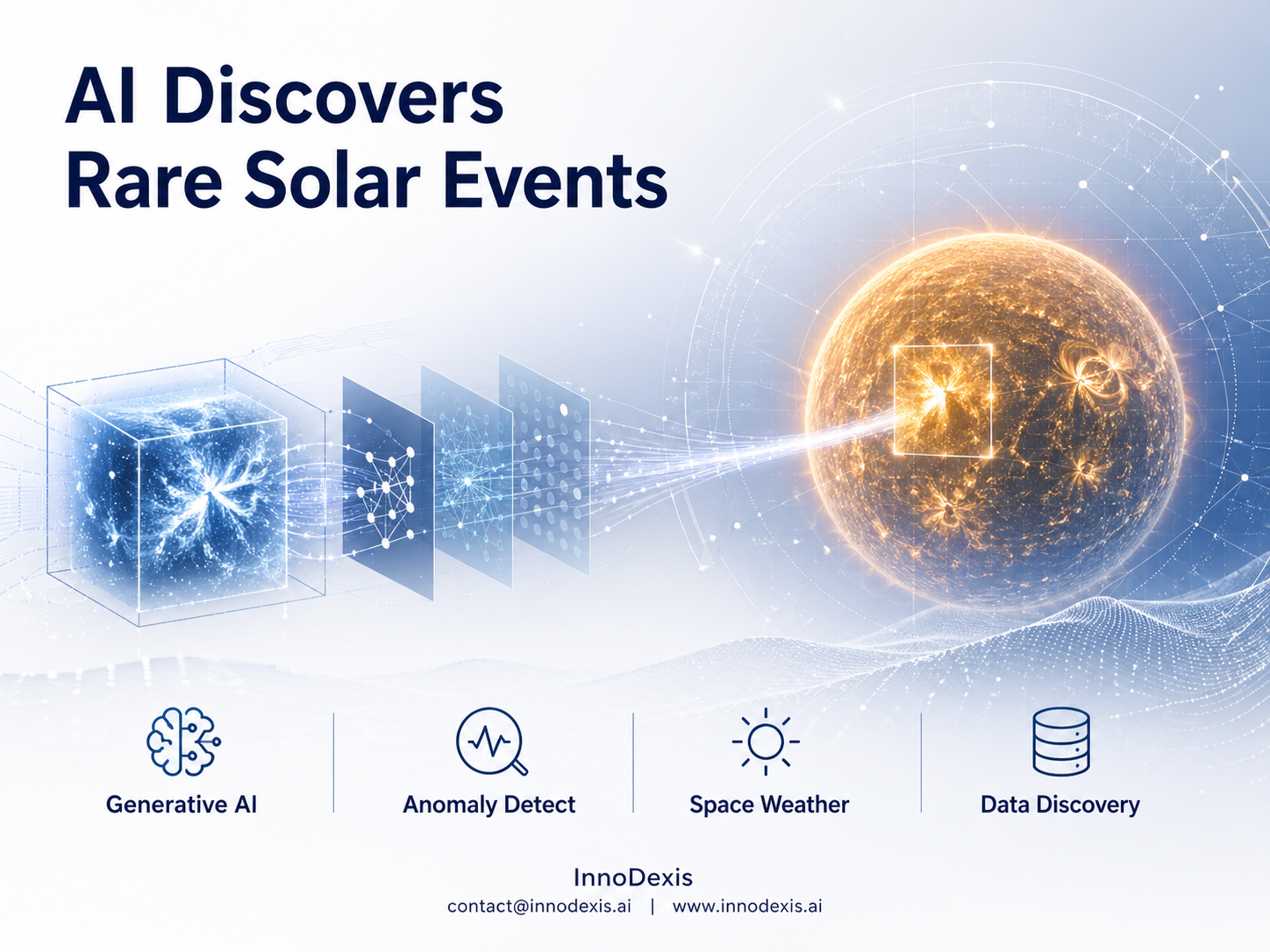
InnoDexis has published its latest Innovation Intelligence Report covering artificial intelligence in scientific discovery, analyzing emerging applications of generative and hybrid AI models in space science research. The report reveals that a system developed at Southwest Research Institute enables generative AI to create synthetic solar magnetic patterns and use them to search for corresponding signals in real observational data. This approach reflects a shift from data generation toward data-driven discovery, particularly in domains characterized by large, complex datasets.
Key Findings
A hybrid AI system has been developed that combines generative, supervised, and self-supervised learning models. This multi-layered approach enables the system to both generate synthetic data and interpret real-world datasets, expanding the functional role of AI beyond single-model applications.
The concept of “synthetic-as-query” introduces a new method for data exploration. AI-generated solar magnetic patches are used as search inputs to probe real observational datasets, allowing the system to identify patterns that match or resemble the generated signals.
The system demonstrates the ability to detect rare and anomalous solar events. These include irregular or unexpected active regions that may not be easily identifiable through conventional analysis, indicating potential applications in identifying low-frequency, high-impact phenomena.
The approach eliminates the need for manual data labeling. By leveraging self-supervised and generative learning techniques, the system reduces reliance on human-annotated datasets, addressing a major constraint in large-scale scientific data analysis.
Applications are directly relevant to space weather monitoring. The ability to identify subtle or emerging solar activity patterns may contribute to improved forecasting models, particularly in contexts where early detection of anomalies is critical.
Strategic Insight and Trend Analysis
The findings indicate a structural evolution in how artificial intelligence is applied to scientific research. Rather than functioning solely as a tool for generating synthetic content or augmenting datasets, generative AI is being positioned as an active discovery mechanism. The integration of generative outputs into search and validation workflows suggests a transition toward AI systems that can interrogate reality rather than simulate it.
The “synthetic-as-query” paradigm represents a shift in analytical methodology. Instead of relying exclusively on observed data patterns, researchers can generate hypothetical or modeled scenarios and test their presence within real-world datasets. This approach expands the search space and enables the identification of signals that may not be apparent through traditional observational techniques.
The absence of manual labeling requirements further enhances scalability. As scientific datasets continue to grow in size and complexity, the ability to process and interpret data without extensive human intervention becomes increasingly important. Hybrid learning architectures that integrate multiple training paradigms are likely to play a central role in this transition.
This development also suggests a redefinition of generative AI’s role within the broader AI ecosystem. Moving beyond content generation, generative models are being integrated into workflows that support hypothesis testing, anomaly detection, and pattern validation. The data indicates that AI is evolving toward functioning as a scientific instrument capable of uncovering previously unobserved phenomena.
Global and Industry Implications
For corporates and R&D teams, the findings highlight the potential to apply generative AI as a discovery tool in domains with large, unstructured datasets. Industries such as aerospace, energy, and advanced materials may benefit from similar approaches to anomaly detection and pattern identification.
For investors and capital allocators, the emergence of hybrid AI systems that integrate multiple learning paradigms suggests opportunities in platforms that enable scientific discovery rather than solely content generation. Technologies that reduce dependency on labeled data may offer scalable advantages.
For policymakers and national innovation bodies, the application of AI in space weather forecasting underscores its relevance for infrastructure resilience. Improved detection of solar anomalies may contribute to protecting communication networks, power grids, and satellite systems from disruption.
InnoDexis Statement
The integration of generative and hybrid AI models into discovery workflows indicates a transition from simulation-driven analysis to systems capable of identifying and validating real-world phenomena within complex datasets,” noted InnoDexis in its latest intelligence report.
Conclusion
The application of generative AI at Southwest Research Institute reflects a broader shift in artificial intelligence from data generation toward scientific discovery. As hybrid learning systems continue to evolve, their ability to interrogate large-scale datasets without manual labeling may redefine research methodologies across disciplines. Monitoring how these approaches are adopted in areas such as space weather forecasting and anomaly detection will be critical in understanding their long-term impact. The complete Artificial Intelligence in Scientific Discovery Report is available to InnoDexis subscribers and enterprise clients.
About InnoDexis
InnoDexis is a global Innovation Intelligence platform that tracks, analyzes, and interprets breakthrough innovations, prototypes, and emerging technologies across industries and countries. Its intelligence helps corporates, investors, and policymakers understand the true structure and direction of global innovation. Learn more at innodexis.ai.