Gamma Radiation Grafting Turns Brittle Bioplastic PHB Into P3HB-HEAA Superstructure Hydrogel for Medical Use in University of Queensland Study
University of Queensland researchers grafted N-hydroxyethyl acrylamide onto poly(3-hydroxybutyrate) using gamma radiation, producing a hydrogel that is tougher than its base bioplastic and highly water-absorbent, with biodegradability still to be confirmed.
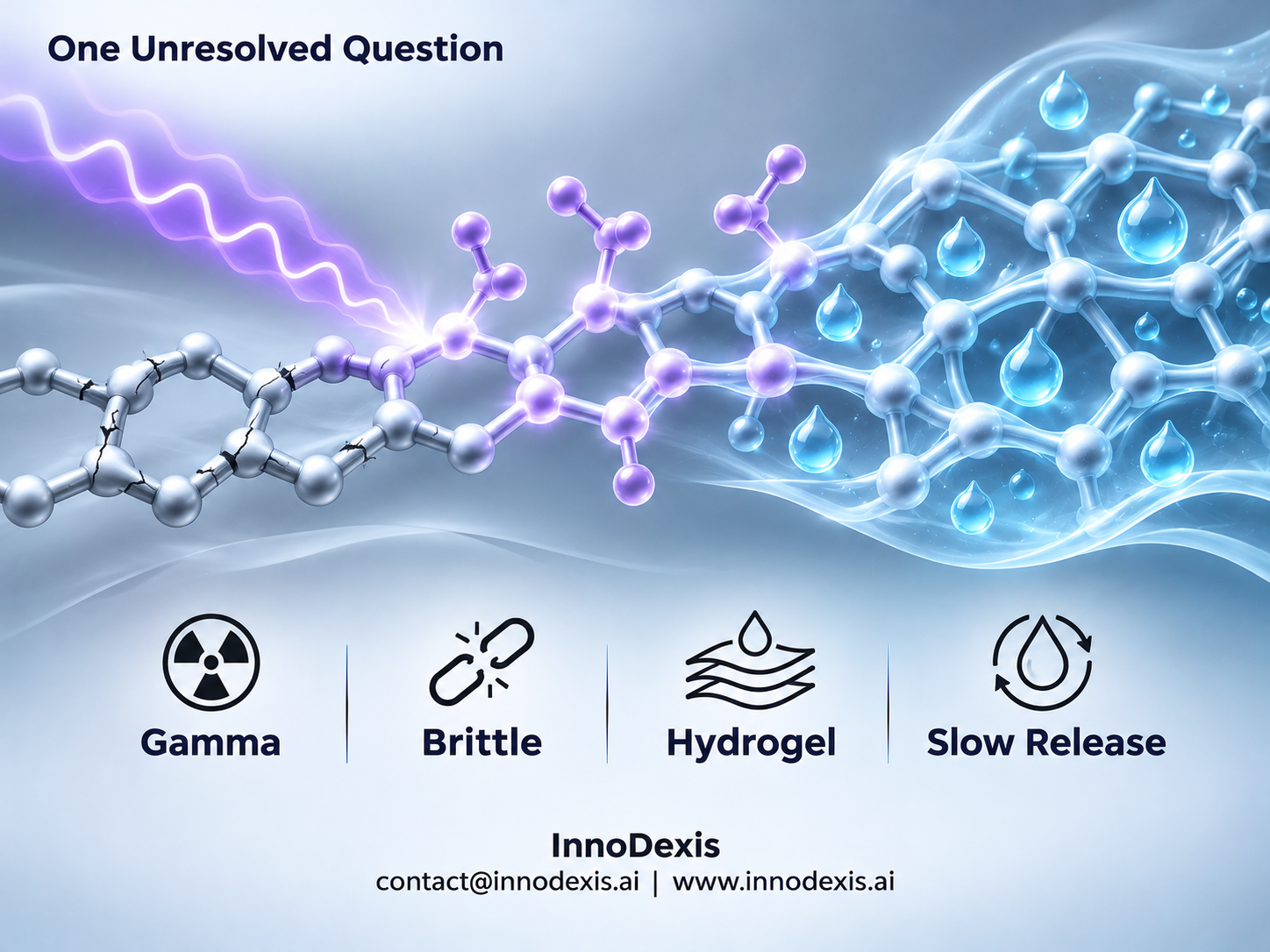
InnoDexis has published its latest Innovation Intelligence Report covering biomaterials and sustainable plastics, analyzing one innovation from the University of Queensland in Australia, published on 11 November 2026. The report reveals that biomaterials engineers used gamma radiation to graft N-hydroxyethyl acrylamide onto the brittle bioplastic poly(3-hydroxybutyrate), producing the P3HB-HEAA superstructure hydrogel, which is tougher than its base material while retaining high water absorption capacity, with applications identified in tissue engineering, wound healing and drug delivery, though its biodegradability is not yet confirmed.
Key Findings
Gamma irradiation-based free radical grafting of N-hydroxyethyl acrylamide onto poly(3-hydroxybutyrate) produced the P3HB-HEAA superstructure hydrogel. The method addresses the brittleness that makes untreated poly(3-hydroxybutyrate) unsuitable for commercial deployment, which is the core technical result of the work. The approach is a chemical modification route that overcomes the inherent mechanical brittleness of the bio-derived polymer, rather than a switch to a synthetic alternative.
The hydrogel is simultaneously tougher than the materials it started from and highly water-absorbent. Combining structural strength with high water absorption is what separates P3HB-HEAA from the brittle base bioplastic and widens the range of settings in which it could be used.
The identified applications are tissue engineering, surgical recovery aids, wound healing, slow-release drug delivery, hygiene products, medical lubricants and specialty coatings. The base polymer is bio-derived and biodegradable, which is why the material is positioned as a sustainable alternative to petroleum-based polymers.
Whether the grafted material keeps the biodegradability of its source polymer is the primary open question. Modification with N-hydroxyethyl acrylamide might reduce or eliminate it, and the researchers state that further investigation is needed. If biodegradability carries over, it would confirm the method as a viable route to new hydrogel-like superstructures.
The work is at a preclinical, early lab-stage with low commercial readiness. It requires commercial-scale gamma irradiation lines for grafting onto pre-formed bioplastic, and 5 to 10 years are expected before clinical or commercial application. The findings are published in a peer-reviewed journal.
Strategic Insight and Trend Analysis
The dominant trend in this research is the chemical modification of natural polymers to make sustainable bioplastics usable. Cole Walchle, the PhD student at the UQ School of Chemical Engineering who led the work, notes that many naturally derived plastics are not yet ready for industrial use, and that there is scope to adjust them to create new sustainable products. The work modifies an existing bio-derived polymer rather than replacing it, which keeps the sustainable origin of the starting material.
The significance is the potential reach of the approach. If proven scalable and fully biodegradable, the strategy could broaden the industrial utility of natural bioplastics and offer alternatives to synthetic, non-degradable petroleum-based polymers in medical and consumer care products. Applying the gamma grafting method to other brittle biopolymers is identified as an opportunity.
The value, however, rests on one unresolved question. Proof of biodegradability is the key value driver for market deployment, and the grafting itself carries risks: radiation-induced degradation of the base polymer backbone, and the possibility that the added chemistry removes biodegradability. Controlling grafting density and uniform crosslinking while keeping biodegradability is a stated scientific challenge.
The economics and regulation add further limits. Gamma irradiation facilities bring high production costs compared with conventional hydrogel production, and established synthetic hydrogels are cheaper. Novel modified biomaterials face regulatory hurdles for internal surgical use, so the path from proof of concept to product depends on biodegradation, toxicology and cost evidence arriving together.
Global and Industry Implications
For corporates and R&D teams, the technology could be transferred to medical biomaterial suppliers, drug delivery companies and personal care manufacturers through licensing or joint development. Personal care and hygiene products, specialty coatings and medical lubricants are among the named product areas. Practical next steps are biocompatibility and cell-adhesion studies for tissue engineering use and long-term biodegradation assays in simulated physiological and environmental conditions.
For investors and capital allocators, the stage is early and the timeline long, at 5 to 10 years. Investors and corporate partners should watch for biodegradation and toxicology data on P3HB-HEAA, since proof of biodegradability is the main value driver. Licensing bioplastic modification technologies to medical device and drug delivery firms is the identified route to market. The cost of gamma irradiation and lower-cost synthetic hydrogels are the main commercial threats.
For policymakers and national innovation bodies, applications in surgical and tissue engineering use will need medical device approval from bodies such as the FDA and the TGA. Stringent testing is required for novel bio-derived hydrogels intended for implants, so regulatory frameworks for modified biomaterials will shape how quickly sustainable alternatives reach patients.
InnoDexis Statement
“Chemical modification is turning brittle natural bioplastics into usable materials, but the value of P3HB-HEAA now rests on one unresolved question: whether biodegradability survives the grafting process,” noted InnoDexis in its latest intelligence report.
Conclusion
The next milestones to watch are long-term biodegradation assays on P3HB-HEAA, biocompatibility and cell-adhesion studies for tissue engineering, and in vivo biocompatibility and controlled drug release studies. Control of grafting density and the economics of commercial-scale gamma irradiation will determine whether the method can move beyond the laboratory. The results will also show whether the method extends to other brittle natural polymers. InnoDexis will continue to track bioplastic modification, sustainable plastics and biomaterials for medical use as this field develops. The complete Bioplastic Hydrogel Gamma Grafting Innovation Intelligence Report is available to InnoDexis subscribers and enterprise clients.
About InnoDexis
InnoDexis is a real-time innovation intelligence platform connecting scientific discovery to commercial opportunity. Powered by InnoGraph, its proprietary innovation knowledge graph, the platform maps technologies across the entire lifecycle, from early-stage research (TRL 1) to market deployment (TRL 9), connecting researchers, institutions, startups, companies, products and emerging opportunities.
Covering 40+ specialised industry segments and 360 technology areas, InnoDexis delivers innovation tracking, research discovery, product and startup intelligence, investment insights, and AI-powered reports. Its mission is to bridge the gap between scientific discovery and real-world impact.
InnoDexis — From Lab to Market: Real-Time Innovation Intelligence.