Finland Advances Regenerative Orthopedics as 3D-Printed Ceramic Bone Scaffolds Demonstrate Patient-Specific Tissue Repair Potential
New research from Tampere University suggests biomimetic ceramic implants may enable future orthopedic treatments to shift from passive bone replacement toward active tissue regeneration.
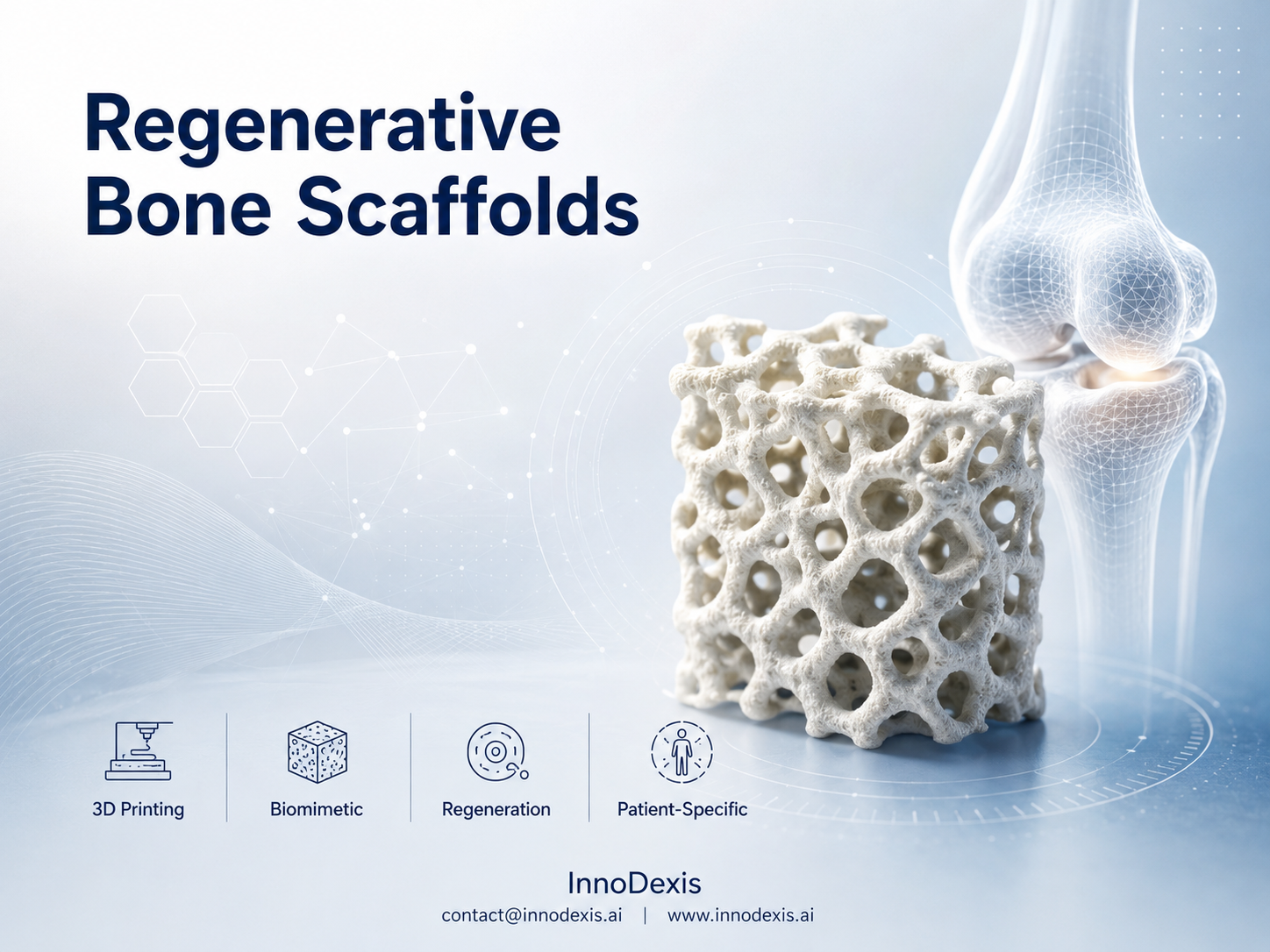
InnoDexis has published its latest Innovation Intelligence Report covering regenerative orthopedics and biomaterials engineering, analyzing emerging developments in 3D-printed bone repair systems and patient-specific implant technologies. The report reveals that researchers at Tampere University developed ceramic scaffolds capable of supporting natural bone regeneration while maintaining structural durability and biological compatibility. Using hydroxyapatite, a mineral naturally found in human skeletal tissue, the implants were engineered to mimic bone architecture and promote tissue formation directly inside the body. The findings highlight how additive manufacturing and regenerative medicine are increasingly converging to reshape future orthopedic repair strategies.
Key Findings
The report identifies the development of biomimetic ceramic scaffolds as a significant advancement in regenerative orthopedic engineering. Rather than functioning solely as structural replacements, the implants were designed to support the body’s natural bone-forming processes. This approach reflects a broader transition toward regenerative implant systems that actively participate in tissue healing and biological integration.
Researchers identified an optimal scaffold configuration featuring approximately 400 micrometre pores and roughly 45% porosity. This structure enabled the implants to balance two critical requirements in orthopedic engineering: mechanical strength and biological compatibility. The findings suggest that scaffold geometry itself plays a central role in determining regenerative performance and tissue integration outcomes.
Another key finding involved the successful interaction between bone-forming cells and the ceramic scaffold architecture. Researchers observed that cells were able to enter the implant structure and generate new tissue internally. This demonstrated that the scaffold could function as a regenerative framework capable of supporting cellular activity and tissue development within the implant environment.
The report also highlights the growing importance of patient-specific manufacturing capabilities. Each implant can be tailored to match an individual patient’s bone defect, reflecting the increasing role of additive manufacturing in personalized medical device production. This customization capability may improve implant integration and functional recovery in complex orthopedic procedures.
Surface engineering emerged as another important factor influencing regenerative outcomes. Researchers found that excessively high processing temperatures reduced cell attachment performance on implant surfaces. This indicates that manufacturing conditions themselves can directly influence biological functionality, reinforcing the importance of precision material processing in regenerative medicine applications.
Collectively, the findings suggest that future orthopedic implants may increasingly combine structural engineering, biomaterial science, and biological regeneration into integrated therapeutic systems rather than serving as passive replacement devices alone.
Strategic Insight and Trend Analysis
The broader trend emerging from the report is the gradual transformation of orthopedic implants from inert structural components into biologically interactive regenerative platforms. This shift reflects a larger evolution occurring across regenerative medicine, where engineered materials are increasingly designed to guide and support natural healing processes rather than simply replace damaged tissue.
Traditional bone grafting procedures often depend on donor tissue, secondary surgical interventions, or biologically active growth factors that can introduce manufacturing, scalability, and clinical complexity challenges. The Tampere University findings suggest that biomimetic ceramic scaffolds may provide an alternative pathway by combining mechanical support with regenerative functionality inside a single implant system.
The use of hydroxyapatite is particularly significant because it closely mirrors the mineral composition of natural bone tissue. This biomimetic approach reflects a growing design philosophy in advanced healthcare engineering: developing materials that replicate natural biological structures to improve compatibility, integration, and regenerative performance. Rather than forcing the body to adapt to synthetic implants, future systems may increasingly be engineered around biological processes themselves.
The findings also reinforce the expanding role of additive manufacturing in precision medicine. 3D printing technologies enable implants to be customized according to patient-specific anatomical requirements while maintaining controlled pore structures and material properties. This convergence of manufacturing precision and regenerative biology could become increasingly important for orthopedic, dental, craniofacial, and reconstructive medical applications.
More broadly, the report indicates that regenerative biomaterials are evolving into a strategic intersection between healthcare, advanced manufacturing, and materials science. Future competitive advantage in orthopedic innovation may increasingly depend on the ability to engineer implants that simultaneously optimize mechanics, cellular interaction, and regenerative functionality.
Global and Industry Implications
For corporates and R&D teams, the findings highlight growing opportunities in regenerative implant technologies, biomaterials engineering, and additive manufacturing platforms. Medical device developers may increasingly prioritize biologically interactive implant systems capable of supporting tissue regeneration alongside structural repair.
For investors and capital allocators, the research signals continued momentum in regenerative medicine and personalized healthcare manufacturing. Companies developing scalable biomimetic materials, advanced ceramic processing systems, and patient-specific implant technologies may attract increasing strategic attention as healthcare systems pursue more adaptive and regenerative treatment models.
For policymakers and national innovation bodies, the findings reinforce the strategic importance of supporting advanced biomaterials research, medical manufacturing infrastructure, and translational regenerative medicine programs. Countries investing in precision healthcare technologies may increasingly view regenerative orthopedic systems as part of broader next-generation healthcare and biomedical innovation strategies.
InnoDexis Statement
“The transition from passive implant replacement toward biologically regenerative scaffold systems may represent an important structural shift in the future design of orthopedic and regenerative medicine technologies,” noted InnoDexis in its latest intelligence report.
Conclusion
The Tampere University findings suggest that future orthopedic repair systems may increasingly be designed around regeneration rather than replacement alone. As biomaterials science, additive manufacturing, and regenerative medicine continue converging, implants could evolve into active biological platforms capable of guiding tissue formation directly within the body. The ability to engineer patient-specific scaffolds that balance structural durability with regenerative compatibility may become increasingly important for next-generation orthopedic treatments. InnoDexis will continue monitoring developments in regenerative biomaterials, precision manufacturing, and advanced medical engineering shaping the future of healthcare innovation. The complete Regenerative Orthopedic Biomaterials Intelligence Report is available to InnoDexis subscribers and enterprise clients.
About InnoDexis
InnoDexis is a global Innovation Intelligence platform that tracks, analyzes, and interprets breakthrough innovations, prototypes, and emerging technologies across industries and countries. Its intelligence helps corporates, investors, and policymakers understand the true structure and direction of global innovation. Learn more at innodexis.ai.