e-OPRA Bionic Arm Fuses Bone, Muscle, and Nerve Signals in First US Implant Backed by $8.7M NINDS Award
Shirley Ryan AbilityLab and Northwestern Medicine completed the first US implantation of the e-OPRA system, combining a titanium bone anchor, implanted muscle sensors, and nerve cuff electrodes to eliminate the external socket entirely.
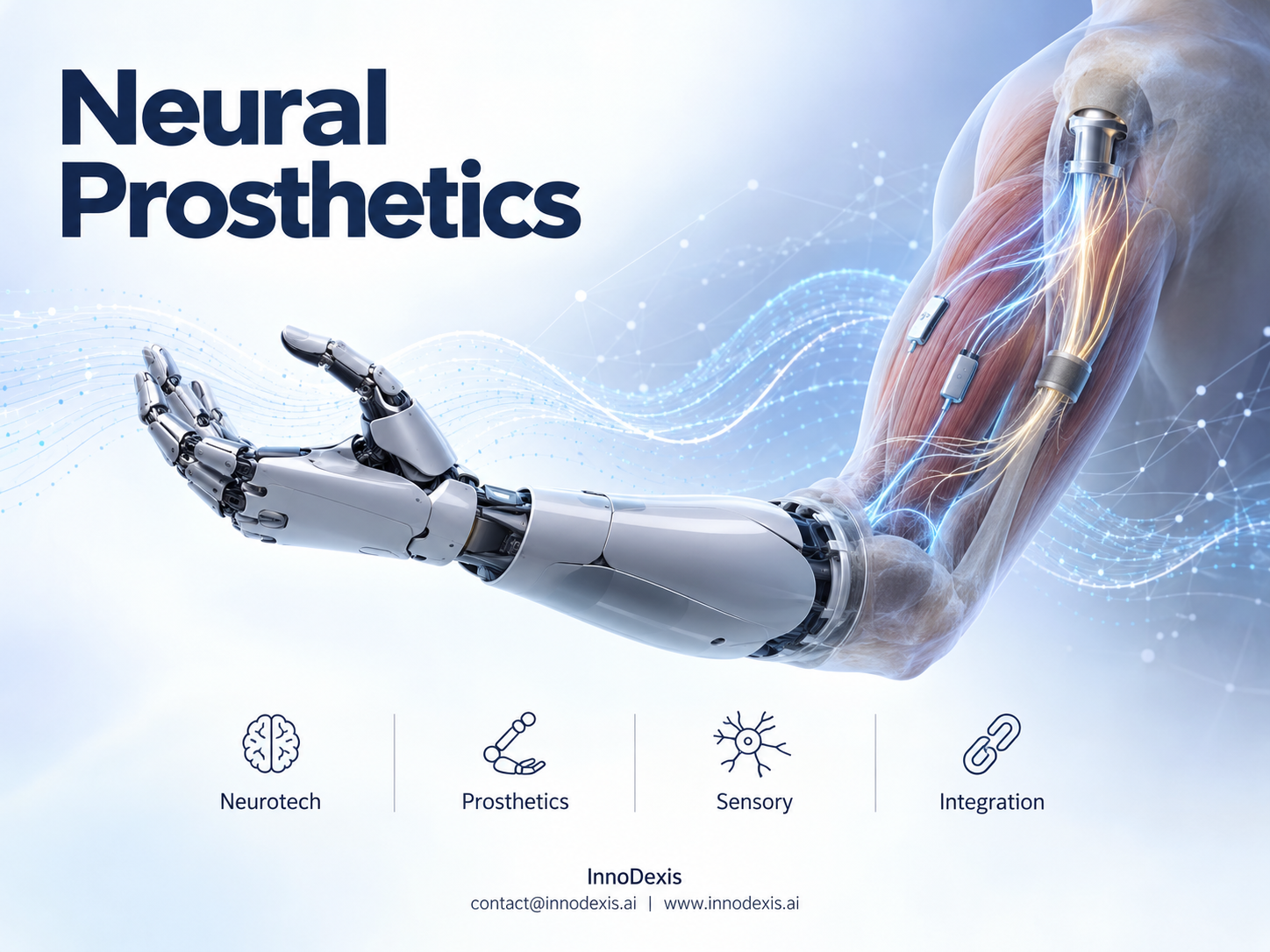
InnoDexis has published its latest Innovation Intelligence Report covering neuroprosthetics and osseointegration, analyzing the first United States implantation of the e-OPRA system, performed by Shirley Ryan AbilityLab and Northwestern Medicine on July 15, 2026. The report reveals that the procedure combined a titanium bone anchor with implanted muscle sensors and nerve cuff electrodes in a single patient, eliminating the external socket interface that has historically limited upper-limb prosthetic fit and signal reliability, as part of an 8-participant, 5-year FDA Investigational Device Exemption clinical study backed by an $8.7 million award from the National Institute of Neurological Disorders and Stroke.
Key Findings
The e-OPRA system combines three previously separate technologies — a titanium bone anchor, implanted muscle sensors, and nerve cuff electrodes — into a single integrated interface. This marks the first US case combining skeletal anchoring, muscle reinnervation, and nerve-based feedback in one patient, removing the external hardware that has historically bridged the gap between the body and the prosthesis.
The implantation procedure was completed in an 8-hour surgery on July 15, 2026, establishing a concrete clinical and procedural benchmark for future implantations under the study. This timing detail provides a verifiable reference point for the pace and complexity of the surgical approach.
Eight participants are enrolled in a 5-year FDA Investigational Device Exemption clinical study, indicating a structured, regulator-monitored pathway for evaluating the system's safety and performance over an extended observation period rather than a single-case demonstration.
The study is backed by an $8.7 million award from the National Institute of Neurological Disorders and Stroke, reflecting a substantial federal research commitment to advancing bone-anchored neural interface technology for upper-limb prosthetics.
Signal transmission through the implanted system demonstrated resistance to sweat, skin motion, and swelling — conditions that have historically disrupted the signal quality of surface-electrode-based prosthetic systems throughout the day. This directly addresses a core limitation that has constrained conventional socket-based prosthetics for decades.
Implanted nerve cuffs provide real-time sensory feedback directly to the missing hand, a capability not available in conventional socket-based systems that rely solely on external electrodes and lack a direct neural feedback pathway.
Strategic Insight and Trend Analysis
The dominant trend emerging from this dataset is the structural elimination of the mechanical interface — the external socket — that has defined the limitations of upper-limb prosthetics for decades. Surface electrode systems have long been constrained by a fundamental physical problem: skin conditions change throughout the day due to sweat, motion, and swelling, degrading signal quality in ways that are difficult to fully engineer around at the interface level. The e-OPRA system does not attempt to improve the external interface; it removes the need for one entirely by anchoring directly to bone and reading signals from muscle and nerve tissue internally.
This represents a categorical shift rather than an incremental improvement. Previous advances in upper-limb prosthetics have generally focused on refining socket fit, electrode sensitivity, or signal processing algorithms — improvements within the existing paradigm of external attachment. By contrast, combining skeletal anchoring, muscle reinnervation, and nerve-based feedback in a single patient establishes a fundamentally different clinical framework, one where the prosthesis becomes structurally and neurologically integrated with the body rather than mechanically attached to it.
The five-year FDA Investigational Device Exemption study design signals that this is being evaluated as a potential new standard of care rather than a one-off demonstration case. If consistent outcomes are observed across all eight enrolled participants, the dataset suggests this could accelerate commercial availability of bone-anchored neuroprosthetic systems beyond 2030, positioning this clinical framework as a reference point for how upper-limb neuroprosthetics are designed and evaluated going forward.
Global and Industry Implications
For corporates and R&D teams in medical device development, the e-OPRA system's integration of skeletal anchoring, muscle sensing, and nerve-based feedback establishes a clinical framework worth monitoring closely, as it may define next-generation design requirements for upper-limb neuroprosthetic systems beyond conventional socket-based architectures.
For investors and capital allocators, the $8.7 million NINDS-backed study and its five-year FDA Investigational Device Exemption structure indicate a regulator-supported pathway toward potential commercial availability, offering a defined, monitorable timeline for evaluating the technology's progression toward broader clinical and market adoption.
For policymakers and national innovation bodies, the federal funding commitment through the National Institute of Neurological Disorders and Stroke demonstrates the strategic value of sustained public investment in neuroprosthetic research, particularly for technologies with the potential to redefine standards of care for upper-limb amputees.
InnoDexis Statement
"The e-OPRA implantation establishes a clinical framework combining skeletal anchoring, muscle reinnervation, and nerve-based feedback in one patient, removing the external interface that has structurally limited upper-limb prosthetics for decades," noted InnoDexis in its latest intelligence report.
Conclusion
As the five-year FDA Investigational Device Exemption study progresses across its eight enrolled participants, consistent outcomes could establish bone-anchored, neurally integrated prosthetics as a new standard of care for upper-limb amputees, with the dataset indicating potential commercial availability beyond 2030. InnoDexis will continue to monitor developments in osseointegration, neuroprosthetics, and the broader shift away from socket-based prosthetic interfaces. The complete Neuroprosthetics Innovation Intelligence Report is available to InnoDexis subscribers and enterprise clients.
About InnoDexis
InnoDexis is a global Innovation Intelligence platform that tracks, analyzes, and interprets breakthrough innovations, prototypes, and emerging technologies across industries and countries. Its intelligence helps corporates, investors, and policymakers understand the true structure and direction of global innovation. Learn more at innodexis.ai.