Crushed Shell Hash Buffers Ocean Acidification, Largely Erasing the Genetic Stress Signal in Pacific Littleneck Clams in UC Davis 90-Day Study
UC Davis researchers found that mixing crushed shells into beach sand produced larger clam shells on average, with gene expression in acidified water largely indistinguishable from that in non-acidified water.
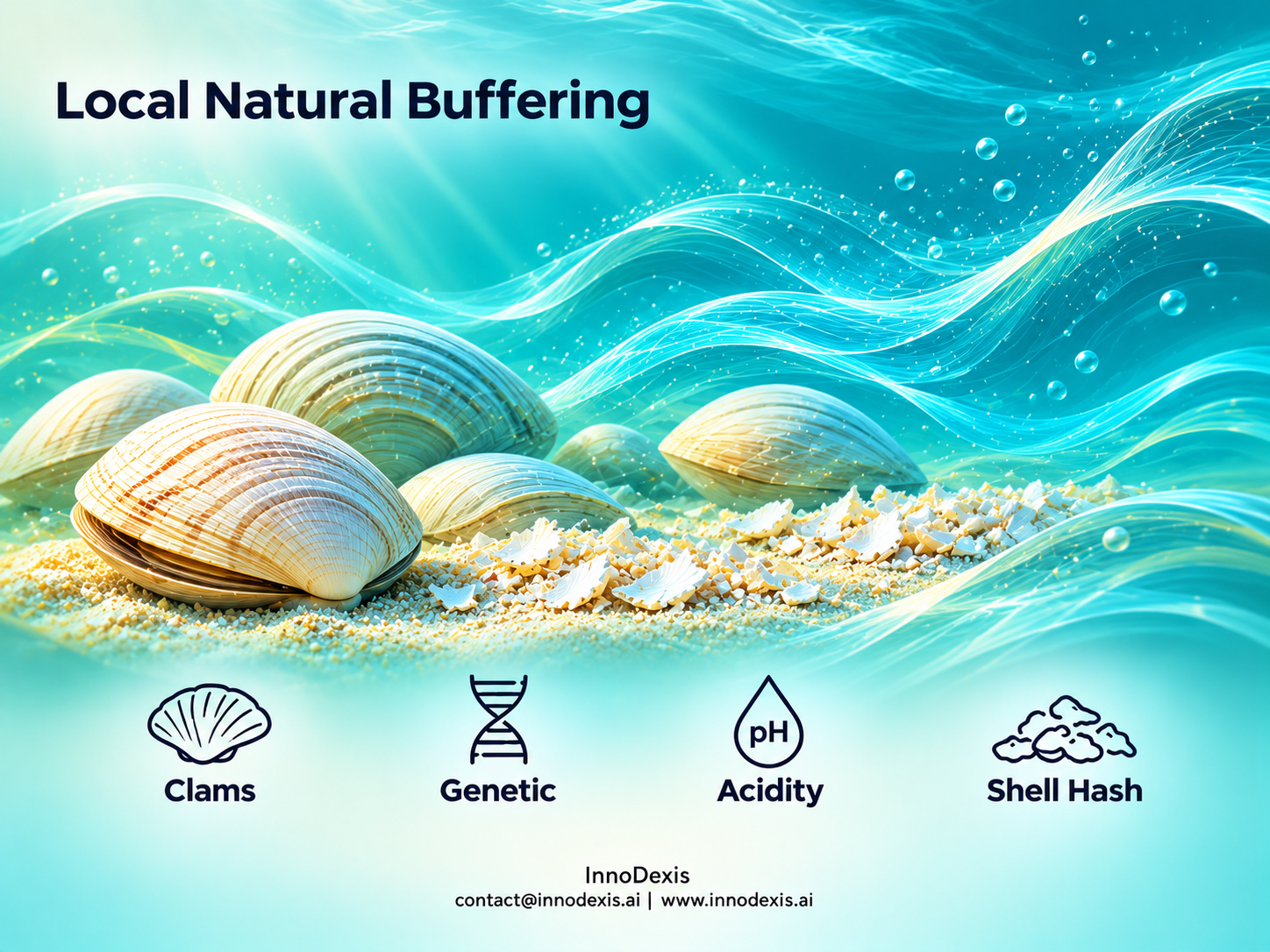
InnoDexis has published its latest Innovation Intelligence Report covering ocean acidification mitigation in shellfish aquaculture, analyzing one innovation from the United States, published on 30 October 2026. The report reveals that University of California, Davis (UC Davis) researchers showed that mixing crushed shells, known as shell hash, into coastal beach sand buffers pore water chemistry, producing larger shell growth in baby Pacific littleneck clams and largely removing the genetic acidification signal over a 90-day experiment, in what the research describes as the first genetic analysis of the approach.
Key Findings
Clams grew larger shells on average when shell hash was present. Over a 90-day experiment, shell hash altered the pore water chemistry between sand particles and reduced overall acidity, which is the mechanism behind the growth benefit and the basis for the rest of the findings.
Gene expression profiles of clams raised in acidified seawater with shell hash were largely indistinguishable from those raised in non-acidified water. The genetic acidification signal was dramatically minimized, and the work is described as the first proof at a genetic level that shell hash reduces the ocean acidification signal in marine organisms.
The experiment compared four conditions: seawater with sediment, acidified seawater with sediment, and each of those with shell hash added. Acidity, salinity, temperature and dissolved oxygen were sampled three times a week, and gene sequencing and expression profiling measured the biological response, which makes the result more than a growth observation.
The study validates traditional Indigenous ecological knowledge with modern molecular biology. UC Santa Cruz researcher Tsim Schneider notes that evidence of past shell hash use in California clam beds could help western science support communities interested in reawakening dormant cultural knowledge and coastal stewardship practices.
Commercial readiness is rated medium. The approach is validated in controlled laboratory mesocosm settings and ready for field trials in clam beds, with adoption in commercial aquaculture hatcheries and tribal coastal stewardship projects estimated at 1 to 2 years.
Strategic Insight and Trend Analysis
The dominant trend in this research is a move from chemical or large-scale responses to ocean acidification toward local, natural buffering that is backed by molecular evidence. The intervention manipulates pore water chemistry around the clams rather than modifying open-ocean chemistry, and it uses crushed shell, a natural waste product, in place of chemical water treatments.
This matters because the evidence now reaches the gene level. David Gold of UC Davis notes this was the first time the question was studied from a genetic perspective, and the removal of the negative genetic changes seen in acidified water shows the benefit is physiological as well as physical. Validating shell hash as a local buffer gives shellfish hatcheries and coastal managers a low-cost, scalable method, and it could displace synthetic chemical pH buffering agents in aquaculture and coastal remediation projects.
The limits are clear. The effect is restricted to interstitial pore water rather than open ocean water, dissolution rates vary with local water flow and initial salinity, and accelerating ocean acidification could exceed the local buffering capacity of shell hash. Research gaps include long-term field testing across diverse coastal sediments and wave action, effectiveness in other calcifying marine species, and the best particle size and application density for different hydrological conditions.
The strategic question is therefore whether a laboratory result on baby clams holds in active intertidal beds, where a simple, low-technical-risk intervention will meet real hydrology, permitting and sourcing constraints.
Global and Industry Implications
For corporates and R&D teams in aquaculture and environmental management, the direct applications are commercial oyster and clam hatchery sediment treatment, tribal coastal restoration projects and intertidal shellfish farm remediation. Supply chains will be needed to collect, clean and crush shell waste from seafood processing, and sourcing consistent, bio-secure shell hash at scale is the main operational challenge.
For investors and capital allocators, the profile is low cost, natural and locally sustainable, with high scalability because crushed shell is abundant and easily integrated into existing coastal management and shellfish farming operations. Adoption is estimated at 1 to 2 years. Research support listed includes California Sea Grant and the Russell J. and Dorothy S. Bilinski Fellowship, and partnerships between institutions, hatcheries and Indigenous communities are the identified opportunity.
For policymakers and national innovation bodies, placing shell material in public intertidal zones involves permitting regulations and approval from local and state environmental protection agencies. The work also points to co-design with Indigenous tribes as a route for coastal restoration projects, supporting Indigenous science and the reactivation of dormant cultural knowledge.
InnoDexis Statement
“Buffering pore water with a natural waste product moves ocean acidification response from open-ocean intervention to site-level management, and field trials across sediments and waves decide whether the genetic evidence reaches coastal practice,” noted InnoDexis in its latest intelligence report.
Conclusion
The next milestones to watch are pilot field projects with local tribes and shellfish farmers, field trials in active intertidal clam beds, and testing of shell hash in other calcifying marine species. Optimization of particle size and application density, and the permitting path for placing shell material in public intertidal zones, will shape how quickly the method moves beyond controlled mesocosm settings. InnoDexis will continue to track ocean acidification mitigation, shellfish aquaculture and Indigenous science integration as this field develops. The complete Ocean Acidification Shell Hash Innovation Intelligence Report is available to InnoDexis subscribers and enterprise clients.
About InnoDexis
InnoDexis is a real-time innovation intelligence platform connecting scientific discovery to commercial opportunity. Powered by InnoGraph, its proprietary innovation knowledge graph, the platform maps technologies across the entire lifecycle, from early-stage research (TRL 1) to market deployment (TRL 9), connecting researchers, institutions, startups, companies, products and emerging opportunities.
Covering 40+ specialised industry segments and 360 technology areas, InnoDexis delivers innovation tracking, research discovery, product and startup intelligence, investment insights, and AI-powered reports. Its mission is to bridge the gap between scientific discovery and real-world impact.
InnoDexis — From Lab to Market: Real-Time Innovation Intelligence.