CRIMSON-1 Carries Singapore’s First Perovskite Solar Cell and Edge AI Into Orbit Aboard a S$210 Million Space Access Programme Mission
Nanyang Technological University’s CRIMSON-1 satellite is validating both a flexible perovskite solar cell and onboard edge AI computing in orbit for the first time, testing two unproven technologies on a single mission.
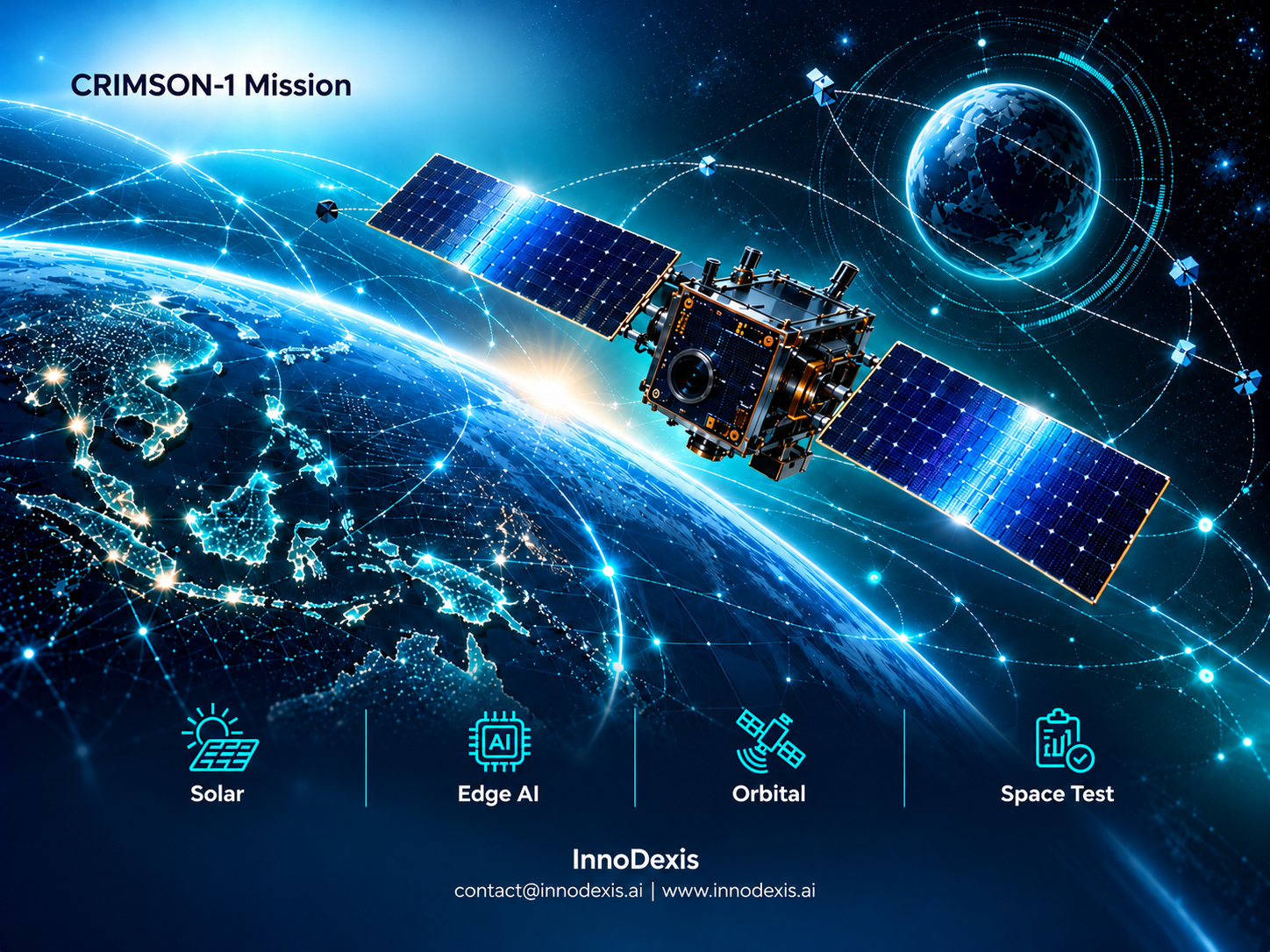
InnoDexis has published its latest Innovation Intelligence Report covering space technology and advanced materials, analyzing the CRIMSON-1 satellite mission launched by Nanyang Technological University aboard a SpaceX Falcon 9 on 1 October. The report reveals that CRIMSON-1 is the first Singapore-made solar module ever deployed in orbit, carrying a flexible perovskite solar cell on ultrathin glass alongside onboard edge AI computing, with both technologies being validated in orbit together for the first time under Singapore’s S$210 million national Space Access Programme.
Key Findings
CRIMSON-1 carries the first Singapore-made solar module ever deployed in orbit, and the first flexible perovskite solar cell on ultrathin glass to fly in space. Perovskite solar technology promises lighter and more efficient power generation than conventional silicon cells, but until this mission it had never been proven to survive the mechanical stress of launch or the radiation environment of orbit.
The satellite also carries onboard edge AI computing, enabling data to be filtered before transmission rather than relaying raw data to ground stations. This capability directly addresses the bandwidth constraint that limits dense satellite constellations, where the volume of raw data generated can exceed available downlink capacity.
Both the perovskite solar cell and the edge AI system are being validated in orbit together for the first time, meaning a single mission failure point now carries two previously unproven technologies rather than one. This consolidated validation approach accelerates the overall testing timeline but concentrates technical risk within a single flight.
The mission is backed by Singapore’s S$210 million national Space Access Programme, reflecting a national-level funding commitment to validating homegrown space hardware rather than relying solely on imported or licensed components.
CRIMSON-1 is the 14th satellite launched by NTU’s Satellite Research Centre, extending an established track record of satellite development. Crucially, the mission moves both technologies from ground-tested claims with no space validation to live orbital data on power output, durability, and thermal performance, allowing engineers to design around measured performance rather than vendor projections.
Strategic Insight and Trend Analysis
The defining strategic signal from the CRIMSON-1 mission is the decision to validate two unproven technologies simultaneously rather than sequentially. By combining a flexible perovskite solar cell with onboard edge AI computing on a single flight, the mission compresses what would typically be two separate validation programmes into one, accelerating the pace at which both technologies can be assessed under real orbital conditions.
This consolidation also reflects a shift in how Singapore is positioning its homegrown technology base. Rather than treating perovskite solar research and edge AI computing as domestic academic output, the mission structure signals an intent to establish both as exportable, flight-proven infrastructure components that can be adopted by external aerospace customers once validated.
The transition from ground-tested claims to live orbital data carries particular significance for perovskite solar technology specifically. Because perovskite cells have never previously been proven to survive the combined mechanical stress of launch and the radiation environment of orbit, CRIMSON-1’s in-flight performance data will directly determine whether the technology can be considered viable for broader satellite applications, independent of any laboratory-based projections.
If CRIMSON-1 succeeds, the mission also establishes a template effect: Singfilm Solar’s NUS spin-off would gain flight-proven validation that could be referenced by future commercial hardware programmes, extending the mission’s significance beyond this single satellite to the broader commercialisation pathway for Singapore-developed space materials.
Global and Industry Implications
For corporates and R&D teams, CRIMSON-1’s in-orbit performance data on power output, durability, and thermal behaviour will allow satellite hardware designers to evaluate perovskite solar cells and edge AI computing against measured results rather than vendor projections, informing component selection decisions for future satellite programmes. The onboard edge AI’s data-filtering capability is also directly relevant to teams designing dense satellite constellations constrained by downlink bandwidth.
For investors and capital allocators, the mission represents an early validation milestone for Singfilm Solar’s NUS spin-off and for Singapore’s broader space materials sector; successful flight performance would establish a flight-proven reference point that could de-risk future investment in perovskite-based space hardware. Because both technologies share a single mission failure point, however, the validation outcome carries concentrated technical risk that should be weighed accordingly.
For policymakers and national innovation bodies, the S$210 million Space Access Programme funding behind CRIMSON-1 illustrates a deliberate national strategy of using flight missions to convert domestic research in materials science and AI into exportable, flight-validated infrastructure rather than confining these capabilities to academic output. As the 14th satellite launched by NTU’s Satellite Research Centre, CRIMSON-1 also reflects a sustained institutional track record supporting this strategy.
InnoDexis Statement
“CRIMSON-1’s decision to validate perovskite solar and edge AI computing together marks a shift from ground-tested claims to measured orbital performance, positioning Singapore’s homegrown space materials as exportable, flight-proven infrastructure,” noted InnoDexis in its latest intelligence report.
Conclusion
CRIMSON-1’s orbital performance data will determine whether perovskite solar and edge AI computing can move from validated prototypes to standard components across future satellite missions. As flight data on power output, durability, and thermal performance accumulates, aerospace suppliers reliant on conventional silicon architecture will face growing pressure to assess whether lighter, more efficient alternatives are now flight-proven. InnoDexis will continue to monitor CRIMSON-1’s performance data and its implications for Singapore’s space materials and AI commercialisation pathway. The complete Space Technology Innovation Intelligence Report is available to InnoDexis subscribers and enterprise clients.
About InnoDexis
InnoDexis is a real-time innovation intelligence platform connecting scientific discovery to commercial opportunity. Powered by InnoGraph, its proprietary innovation knowledge graph, the platform maps technologies across the entire lifecycle, from early-stage research (TRL 1) to market deployment (TRL 9), connecting researchers, institutions, startups, companies, products and emerging opportunities.
Covering 40+ specialised industry segments and 360 technology areas, InnoDexis delivers innovation tracking, research discovery, product and startup intelligence, investment insights, and AI-powered reports. Its mission is to bridge the gap between scientific discovery and real-world impact.
InnoDexis — From Lab to Market: Real-Time Innovation Intelligence.