Climate-Driven Microbial Risks Gain Attention as Free-Living Amoebae Challenge Water Infrastructure Resilience
Research linked to Shenyang Agricultural University indicates that climate change and aging water systems may increase the public health risks associated with free-living amoebae.
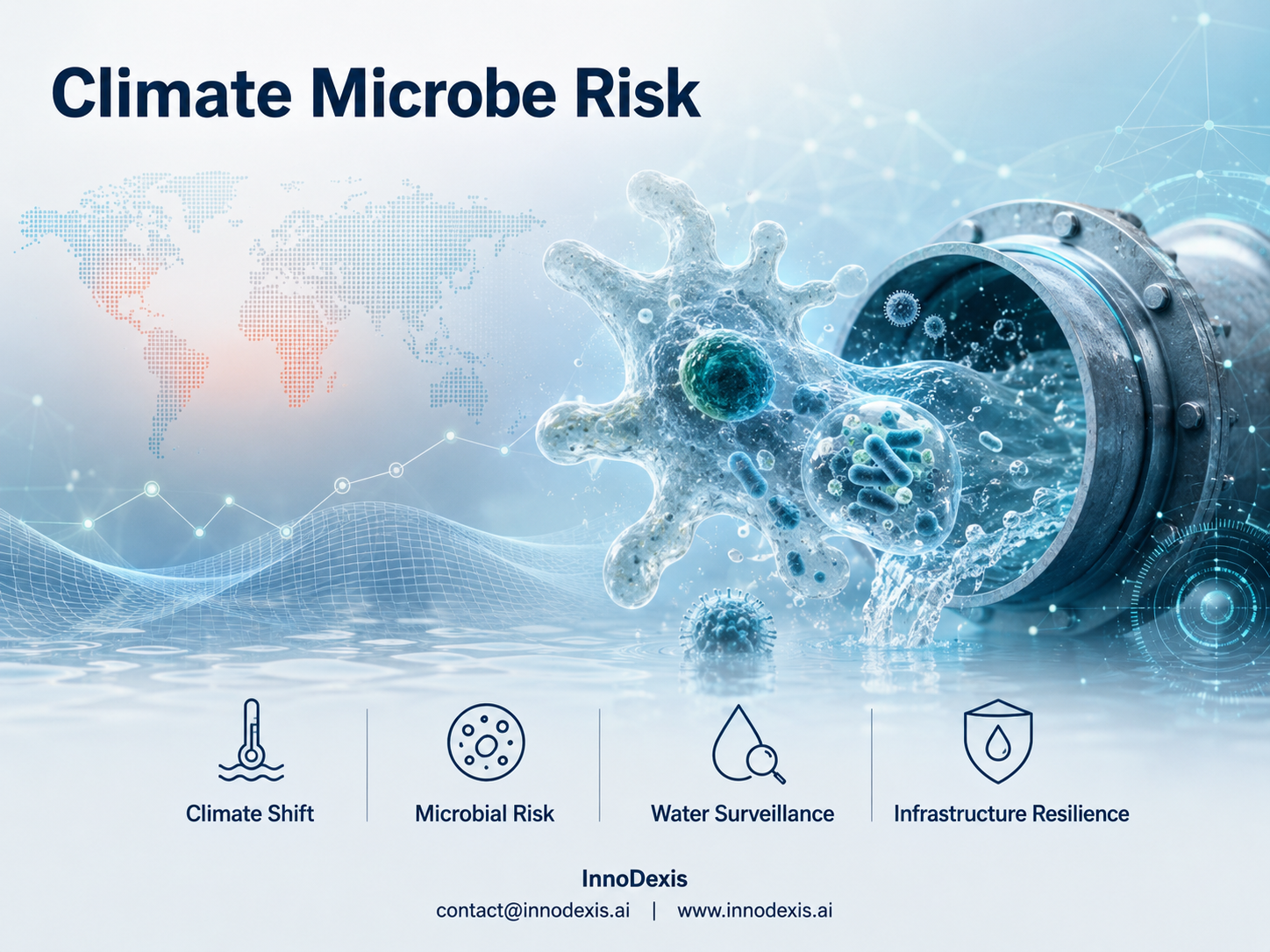
InnoDexis has published its latest Innovation Intelligence Report covering climate-linked microbial health risks, analyzing emerging research connected to Shenyang Agricultural University. The report reveals that free-living amoebae may represent an increasingly important public health challenge as rising temperatures and infrastructure stress alter microbial ecosystems within water systems. The findings indicate that existing surveillance and purification frameworks may not be fully equipped to detect or mitigate these organisms, raising broader questions about water resilience, climate adaptation, and health security.
Key Findings
Research associated with Shenyang Agricultural University highlights the resilience of free-living amoebae under conditions that commonly limit microbial survival. The organisms are capable of surviving both elevated temperatures and chlorine treatment, suggesting that standard water purification methods may not fully eliminate them from public systems.
Some free-living amoebae function as “Trojan horses” by shielding harmful bacteria and viruses within their cellular structures. This interaction creates conditions where pathogenic organisms may persist despite treatment efforts, complicating traditional approaches to waterborne disease prevention.
Rising global temperatures may expand the viable geographic range of these organisms. Climate-driven environmental shifts could increase the prevalence of microbial ecosystems favorable to amoebae survival, particularly in regions experiencing warming water systems and infrastructure stress.
Existing water surveillance systems may not effectively detect free-living amoebae or the pathogens they can harbor. Current monitoring frameworks are largely designed around known contaminants and historically stable environmental conditions, potentially leaving gaps in early detection capabilities.
The findings indicate that microbial resilience is becoming increasingly relevant to infrastructure planning. Water systems originally engineered around conventional contamination models may face growing pressure as environmental conditions alter microbial behavior and transmission dynamics.
Strategic Insight and Trend Analysis
The collective findings suggest that water safety is evolving from a localized infrastructure concern into a broader climate adaptation and health security challenge. Traditional water management systems were developed around predictable contamination risks and stable environmental assumptions. However, climate-linked microbial shifts introduce variables that may not align with existing treatment and surveillance frameworks.
The resilience of free-living amoebae to chlorine treatment and elevated temperatures reflects a broader trend in environmental health: microorganisms are adapting to changing ecosystems faster than infrastructure systems are evolving. This dynamic creates the potential for emerging health risks that arise not from isolated pathogens alone, but from interactions between climate conditions, microbial ecosystems, and aging urban infrastructure.
The “Trojan horse” role played by some amoebae further complicates this challenge by introducing indirect pathways for bacterial and viral persistence. This indicates that future public health monitoring may need to move beyond single-pathogen detection toward ecosystem-level microbial analysis.
The findings also point toward increasing convergence between climate science, infrastructure resilience, and public health policy. Water systems may no longer be evaluated solely on treatment capacity, but also on their ability to adapt to evolving biological conditions driven by environmental change. This shift positions microbial resilience as a strategic component of long-term urban and national resilience planning.
Global and Industry Implications
For corporates and R&D teams, the findings highlight growing demand for advanced water monitoring technologies, adaptive purification systems, and microbial detection platforms. Organizations operating in environmental technology and public infrastructure may increasingly focus on climate-resilient treatment capabilities.
For investors and capital allocators, the convergence of climate adaptation and public health infrastructure presents opportunities in water resilience technologies and environmental biosurveillance systems. Solutions capable of addressing emerging microbial risks may become strategically important as governments modernize aging infrastructure.
For policymakers and national innovation bodies, the findings indicate that water security strategies may need to expand beyond conventional contamination models. Integrating climate adaptation, microbial surveillance, and infrastructure modernization could become central to future public health resilience planning.
InnoDexis Statement
“The findings indicate that future public health risks may increasingly emerge from interactions between climate dynamics, microbial ecosystems, and infrastructure limitations rather than from isolated pathogens alone,” noted InnoDexis in its latest intelligence report.
Conclusion
The emerging research connected to Shenyang Agricultural University highlights how climate change may reshape the relationship between water infrastructure and public health. As microbial ecosystems evolve under rising temperatures and environmental stress, existing surveillance and treatment frameworks could face growing limitations. Monitoring how governments, utilities, and health systems respond to these adaptive microbial risks will be critical in assessing long-term resilience strategies. The complete Climate and Water Resilience Intelligence Report is available to InnoDexis subscribers and enterprise clients.
About InnoDexis
InnoDexis is a global Innovation Intelligence platform that tracks, analyzes, and interprets breakthrough innovations, prototypes, and emerging technologies across industries and countries. Its intelligence helps corporates, investors, and policymakers understand the true structure and direction of global innovation. Learn more at innodexis.ai.