Climate Change Could Reshape Global Cocoa Production as 20% of Colombia’s Growing Areas Face Suitability Risks by 2050
New research suggests rising temperatures and rainfall variability may shift cocoa cultivation toward higher elevations while accelerating climate-resilient agricultural strategies.
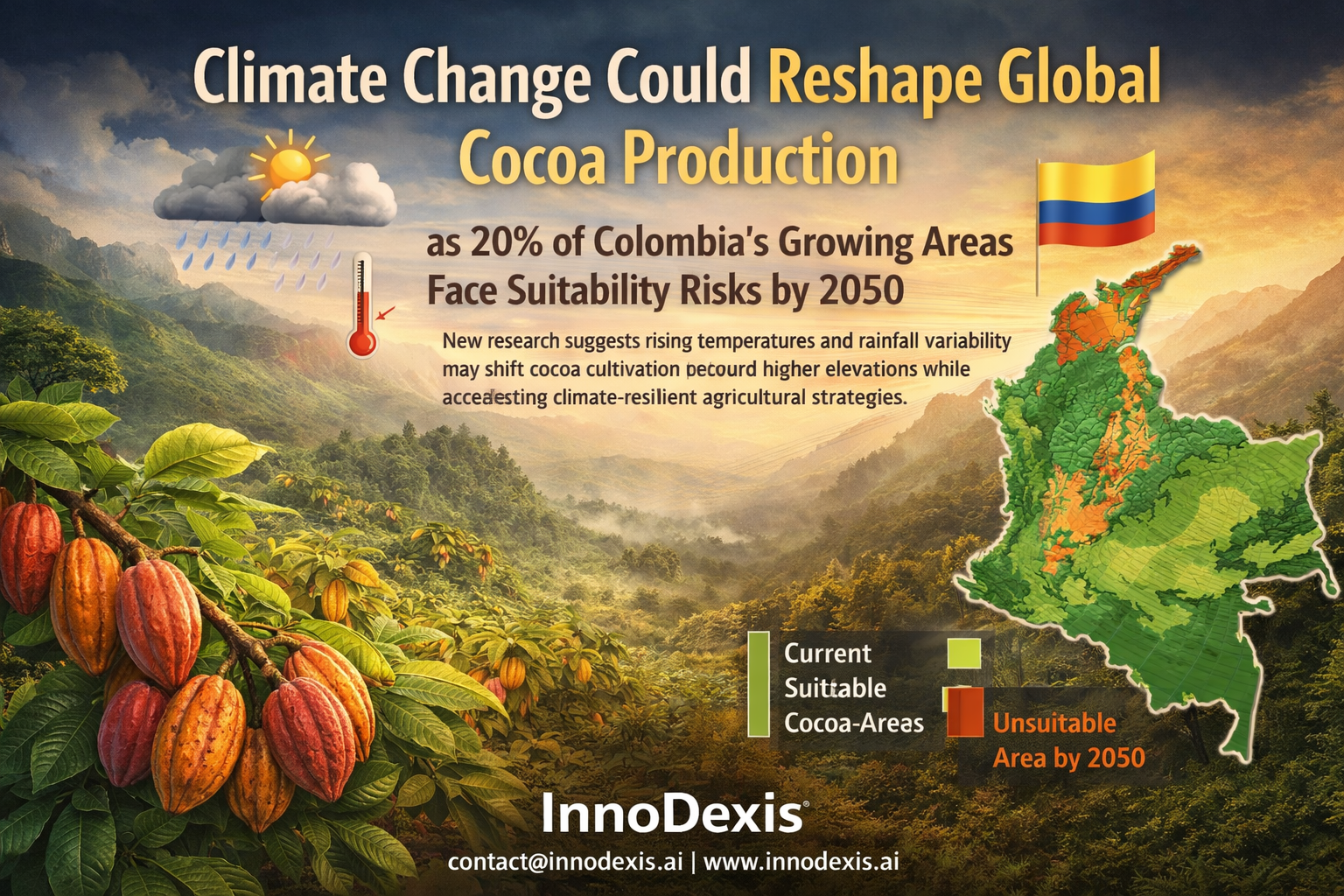
InnoDexis has published its latest Innovation Intelligence analysis covering climate impacts on agricultural production, examining new research led by the Alliance of Bioversity International and the International Center for Tropical Agriculture (CIAT). The analysis focuses on projected changes in cocoa cultivation suitability across Colombia as global temperatures rise and rainfall patterns become increasingly variable. The report reveals that nearly 20% of Colombia’s current cocoa-growing areas could become unsuitable by 2050 due to climate-related pressures, highlighting potential shifts in agricultural geography and adaptation strategies within tropical farming systems.
Key Findings
The study indicates that rising temperatures and increasingly erratic rainfall patterns are likely to reduce the suitability of cocoa cultivation in several of Colombia’s current production regions. Approximately one-fifth of existing cocoa-growing areas may face conditions that no longer support optimal crop growth by mid-century. These changes are expected to affect productivity, particularly in lower-elevation regions where heat stress and moisture variability are projected to intensify.
Low-lying cocoa-producing regions are identified as the most vulnerable. As temperatures rise, crop development cycles may be disrupted, and environmental stress on plants may increase. These conditions could affect yields and place additional pressure on farmers whose livelihoods depend on cocoa cultivation as a primary source of income.
The research highlights several adaptation pathways that could mitigate climate-related risks to cocoa production. One potential strategy involves shifting cocoa cultivation to higher-altitude areas where temperature conditions may remain within suitable ranges for the crop. This transition could enable continued production even as environmental conditions change in traditional growing zones.
Another adaptation strategy focuses on genetic diversity within cocoa species. Researchers emphasize the importance of wild cocoa varieties as a source of traits that may enhance resilience to climate stress. Breeding programs incorporating this genetic diversity could enable the development of new varieties capable of withstanding higher temperatures and irregular rainfall patterns.
Agroforestry systems represent an additional pathway for climate adaptation. Integrating cocoa cultivation with tree cover can regulate local temperature conditions, maintain soil moisture, and create microclimates that improve crop resilience. Such systems may become increasingly important as farmers seek to maintain productivity under changing environmental conditions.
The analysis also suggests that climate change may create new opportunities for cocoa cultivation in regions that are currently less suitable for the crop. Higher-altitude zones may gradually become viable production areas as temperature patterns evolve, potentially shifting the geographic distribution of cocoa farming within Colombia.
Strategic Insight and Trend Analysis
The findings point to a broader structural trend in global agriculture. Climate change is not only expected to influence crop productivity but may also alter the geographic distribution of agricultural production. Crops that rely on specific climatic conditions—including cocoa, coffee, and tea—may increasingly migrate toward regions where environmental conditions remain favorable.
This phenomenon represents a transformation in how agricultural systems respond to climate dynamics. Instead of a uniform decline in crop productivity, the global farming landscape may experience spatial redistribution, with some regions losing suitability while others gain new opportunities for cultivation.
Such shifts could reshape long-established agricultural supply chains. Countries and regions that have historically dominated the production of certain crops may face increasing environmental constraints, while emerging production zones may gain strategic importance in global commodity markets.
The transition may also accelerate innovation within agricultural systems. Climate-resilient crop varieties, adaptive farming practices, and environmental monitoring technologies are likely to become central components of agricultural development strategies. These tools may enable farmers and producers to adapt more effectively to evolving climate conditions.
Global and Industry Implications
For corporates and R&D teams, shifting crop suitability patterns may influence long-term agricultural sourcing strategies. Companies operating within global food supply chains may need to diversify sourcing regions and invest in climate-resilient agricultural technologies to maintain supply stability.
For investors and capital allocators, the potential redistribution of crop production may create opportunities in agricultural innovation sectors such as climate-resilient seeds, agroforestry systems, and climate analytics technologies that support adaptive farming practices.
For policymakers and national agricultural agencies, the research highlights the importance of forward-looking land-use planning and agricultural policy frameworks. Preparing for shifts in crop suitability may require updated regional development strategies, investment in agricultural research, and support for farmers adapting to changing environmental conditions.
InnoDexis Statement
“Climate signals emerging from agricultural research suggest that global farming systems may increasingly reorganize geographically as environmental conditions evolve,” noted InnoDexis in its latest intelligence analysis.
Conclusion
The projected changes in cocoa-growing conditions in Colombia illustrate how climate dynamics could reshape agricultural systems over the coming decades. While some existing production regions may face increasing environmental pressure, new cultivation zones may emerge as climate conditions evolve.
Understanding these shifts will be critical for governments, agribusiness companies, and farmers as they plan for the future of global food systems. Monitoring climate signals and agricultural innovation trends will remain essential to anticipating how farming patterns, supply chains, and commodity markets may transform in response to environmental change.
The complete Climate and Agriculture Innovation Intelligence analysis is available to InnoDexis subscribers and enterprise clients.
About Innodexis
InnoDexis is a global Innovation Intelligence platform that tracks, analyzes, and interprets breakthrough innovations, prototypes, and emerging technologies across industries and countries. Its intelligence helps corporates, investors, and policymakers understand the true structure and direction of global innovation. Learn more at innodexis.ai.