China Advances Multimodal AI as Structural Image Understanding Improves Without Model Scaling
A new framework demonstrates measurable gains in image–text alignment by enhancing relational reasoning rather than increasing model size.
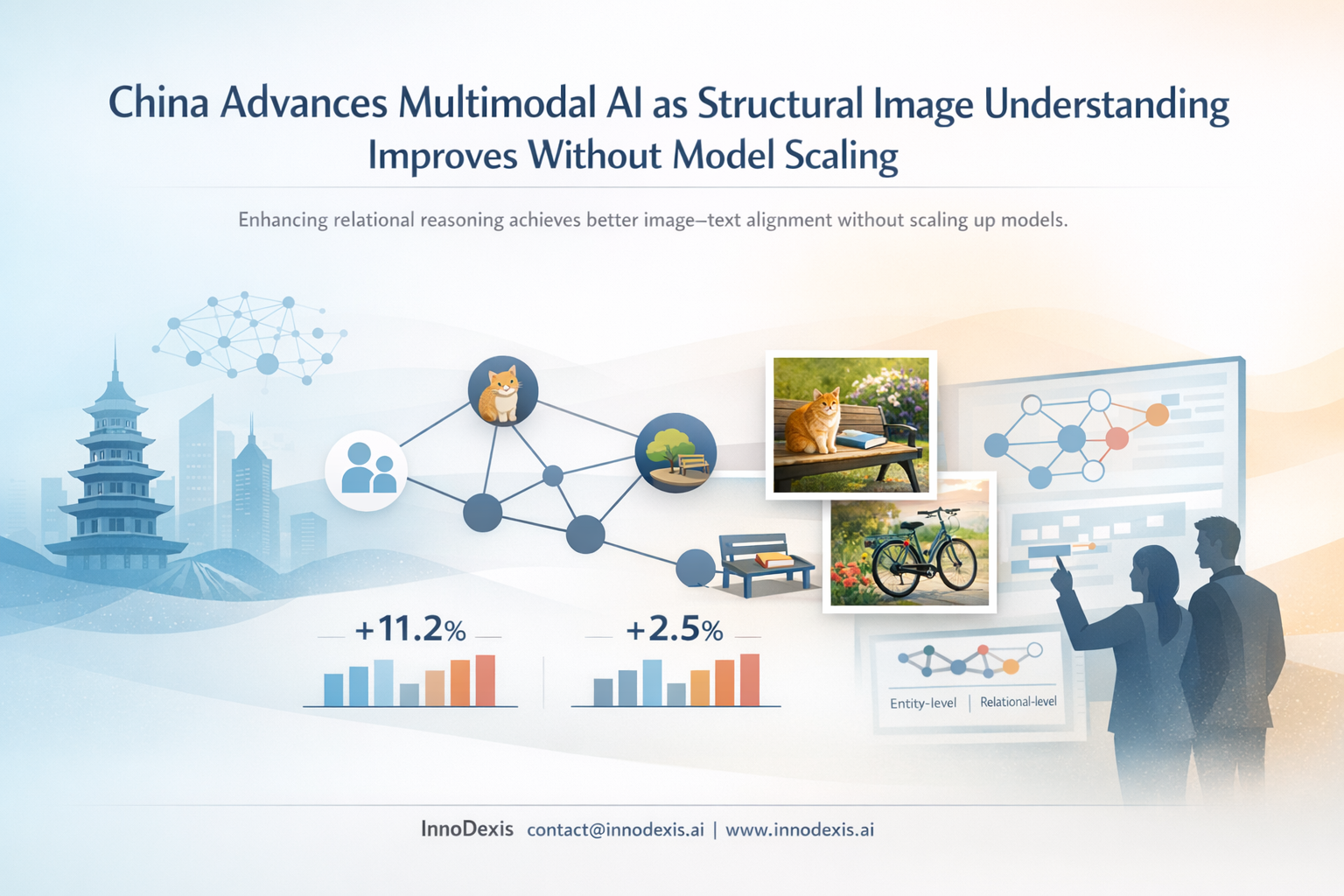
InnoDexis has published its latest Innovation Intelligence Report covering artificial intelligence and computer vision, analyzing recent advancements in multimodal AI frameworks. The report highlights a development from Harbin Institute of Technology, where researchers introduced MSG-CLIP, a framework designed to improve image–text alignment without increasing model size. The analysis reveals that structural understanding—capturing relationships between objects rather than isolated recognition—can deliver measurable performance improvements, indicating a shift in how AI systems are being optimized for real-world applications.
Key Findings
A new multimodal AI framework, MSG-CLIP, has been developed to address limitations in conventional contrastive language–image pretraining models. The framework introduces structural alignment capabilities that move beyond object-level recognition to capture relationships between entities within images. This represents a shift in how visual data is interpreted in AI systems.
The framework incorporates scene graph alignment, enabling models to understand how objects relate to each other rather than simply identifying them. This relational mapping allows AI systems to process contextual dependencies, which are critical for tasks requiring deeper semantic interpretation.
MSG-CLIP applies a dual-precision matching mechanism, combining entity-level alignment with relational, triple-level matching. This approach ensures that both individual objects and their interactions are considered simultaneously, improving the coherence between visual and textual representations.
Measured performance improvements were observed across benchmark datasets, including a +11.2% increase on VG-Attribution and a +2.5% increase on VG-Relation. These gains demonstrate that architectural enhancements can deliver quantifiable improvements without increasing computational scale.
The framework directly addresses a known limitation in contrastive language–image pretraining, where structural understanding has remained comparatively weak. By integrating relational reasoning into the alignment process, the model improves its ability to interpret complex visual scenes.
Strategic Insight and Trend Analysis
The emergence of MSG-CLIP reflects a broader transition in artificial intelligence development from scale-driven performance gains toward architecture-driven efficiency. As model sizes increase, the marginal returns on performance improvements have shown signs of diminishing relative to computational cost. The reported gains achieved without expanding model parameters indicate a shift in optimization priorities.
The ability to capture relationships within visual data introduces a new layer of semantic depth in multimodal systems. Traditional models have primarily focused on object detection and classification, which limits their effectiveness in scenarios where context determines meaning. By incorporating relational reasoning, AI systems can better interpret interactions, dependencies, and structured environments.
This development aligns with a growing emphasis on efficiency and precision in AI design. Rather than relying solely on larger datasets and increased computational resources, the focus is moving toward improving how models process and represent information internally. The integration of scene graph alignment and dual-precision matching suggests that future advancements may increasingly depend on structural modeling techniques.
The findings also indicate that multimodal AI is evolving from perception-based systems toward reasoning-capable architectures. The ability to understand relationships within images represents a foundational step toward more advanced cognitive functions, including contextual reasoning and decision support. This transition is particularly relevant for applications that require accurate interpretation of complex environments.
Global and Industry Implications
For corporates and R&D teams, the findings suggest that performance improvements in AI systems can be achieved through architectural innovation rather than increased computational investment. This has implications for cost optimization, system scalability, and deployment efficiency across industries such as healthcare, autonomous systems, and visual analytics.
For investors and capital allocators, the shift toward efficiency-driven AI development highlights opportunities in technologies that enhance model performance without relying on scale. Frameworks that improve alignment, reasoning, and contextual understanding may represent a distinct category of investment beyond large-model infrastructure.
For policymakers and national innovation bodies, the development underscores the importance of supporting research that advances foundational AI capabilities. As efficiency and architectural innovation become more central to progress, funding strategies may increasingly focus on enabling breakthroughs in model design rather than solely supporting computational expansion.
InnoDexis Statement
“The progression from object recognition to relational understanding marks a structural shift in AI capability development, where performance gains are increasingly driven by how models interpret context rather than how large they are,” noted InnoDexis in its latest intelligence report.
Conclusion
The development of MSG-CLIP highlights a measurable shift in artificial intelligence toward structural and relational understanding within multimodal systems. By improving image–text alignment without increasing model size, the framework demonstrates that architectural innovation can deliver tangible performance gains. As AI systems are deployed in increasingly complex real-world environments, the ability to interpret relationships rather than isolated elements is expected to become a defining capability. The complete Multimodal AI Innovation Intelligence Report is available to InnoDexis subscribers and enterprise clients.
About InnoDexis
InnoDexis is a global Innovation Intelligence platform that tracks, analyzes, and interprets breakthrough innovations, prototypes, and emerging technologies across industries and countries. Its intelligence helps corporates, investors, and policymakers understand the true structure and direction of global innovation. Learn more at innodexis.ai.