Cellular Size Regulation Mechanisms Identified as PEX11 Protein Controls Organelle Growth
Findings from Rice University reveal that organelle size is actively regulated through internal mechanisms, redefining how cellular growth control is understood.
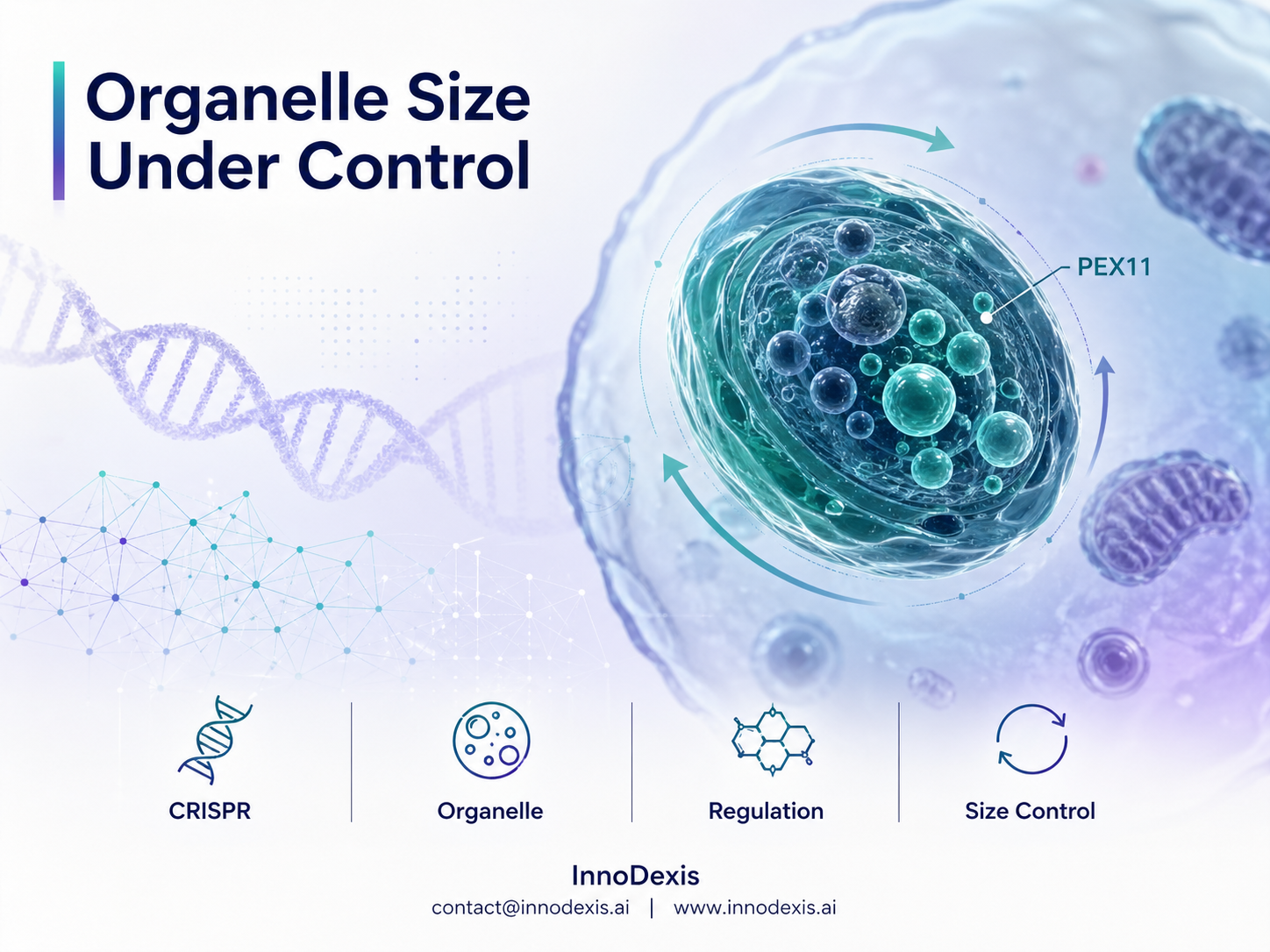
InnoDexis has published its latest Innovation Intelligence Report covering cellular and molecular biology, analyzing recent research findings from Rice University. The report reveals that the PEX11 protein plays a central role not only in organelle division but also in regulating organelle size. This discovery highlights a previously underexplored control layer in cellular growth, where structural and functional balance is maintained through internal biological mechanisms rather than division processes alone.
Key Findings
Research conducted at Rice University demonstrates that the PEX11 protein is directly involved in regulating the size of peroxisomes, rather than solely facilitating their division. This indicates that cellular growth control extends beyond replication to include active size governance.
CRISPR-based gene editing was used to disable combinations of PEX11 genes, allowing researchers to isolate and identify their functional roles. This approach enabled precise observation of how individual and combined gene disruptions affect organelle behavior.
In the absence of PEX11, peroxisomes were observed to grow abnormally large, indicating a breakdown in size regulation mechanisms. This finding provides direct evidence that organelle growth is actively constrained under normal biological conditions.
Internal vesicle formation within peroxisomes was identified as the mechanism through which size regulation is maintained. This suggests that organelles possess intrinsic structural processes that modulate their own growth dynamics.
Functional restoration using yeast-derived PEX11 proteins demonstrated cross-species conservation of this regulatory mechanism. The ability to recover normal function across species indicates that size control may represent a fundamental biological principle.
Strategic Insight and Trend Analysis
The findings from Rice University indicate a shift in how cellular growth is conceptualized. Rather than viewing growth as a process governed primarily by division cycles, the data suggests that cells employ integrated regulatory systems that balance size, structure, and function simultaneously.
The identification of PEX11 as a size-regulating factor introduces a new dimension to cellular control systems. Internal vesicle formation as a mechanism for maintaining organelle size points to structural feedback processes operating alongside genetic regulation. This implies that cells may rely on both molecular signaling and physical architecture to maintain stability.
The use of CRISPR to isolate gene function further demonstrates the increasing precision with which biological control systems can be mapped. By linking gene-level interventions to observable structural outcomes, the research highlights how experimental approaches are enabling deeper understanding of cellular dynamics.
The cross-species functionality of PEX11 suggests that size regulation mechanisms are evolutionarily conserved. This conservation indicates that similar control systems may operate in higher organisms, including human cells, potentially extending the relevance of these findings beyond model organisms.
Collectively, the data reflects a broader trend in life sciences toward understanding biological systems as integrated networks of regulation rather than linear pathways. Growth, in this context, emerges as a controlled equilibrium rather than a unidirectional expansion process.
Global and Industry Implications
For corporates and R&D teams, the identification of intrinsic size regulation mechanisms may influence approaches to synthetic biology and cellular engineering. Designing systems that account for both functional output and structural balance could improve predictability and stability in engineered biological systems.
For investors and capital allocators, the findings highlight emerging opportunities in foundational cell biology and enabling technologies such as CRISPR-based functional mapping. Innovations that deepen control over cellular behavior may form the basis for next-generation biotechnology platforms.
For policymakers and national innovation bodies, the research underscores the importance of supporting fundamental biological science. Advances in understanding core cellular mechanisms can have downstream implications for healthcare, biotechnology, and bioengineering innovation ecosystems.
InnoDexis Statement
The identification of organelle-level size regulation mechanisms suggests that cellular growth is governed by integrated structural and functional feedback systems, extending beyond traditional models of division-based control,” noted InnoDexis in its latest intelligence report.
Conclusion
The discovery of PEX11’s role in regulating organelle size introduces a new perspective on cellular growth and stability. As research continues to explore how structural feedback and genetic regulation interact, the understanding of cellular dysfunction and disease mechanisms may evolve accordingly. Monitoring how these insights translate into applied biotechnology and medical research will be critical in the coming years. The complete Cellular Biology Innovation Intelligence Report is available to InnoDexis subscribers and enterprise clients.
About InnoDexis
InnoDexis is a global Innovation Intelligence platform that tracks, analyzes, and interprets breakthrough innovations, prototypes, and emerging technologies across industries and countries. Its intelligence helps corporates, investors, and policymakers understand the true structure and direction of global innovation. Learn more at innodexis.ai.