CDK1 Activity Signals CDK4/6 Inhibitor Resistance in ER+ Breast Cancer as Garvan Institute Biosensor Study Spans 400+ Patient Biopsies
Garvan Institute researchers used a fluorescent biosensor mouse model and more than 400 patient biopsies to show that active CDK1 signals continued cell proliferation during targeted therapy
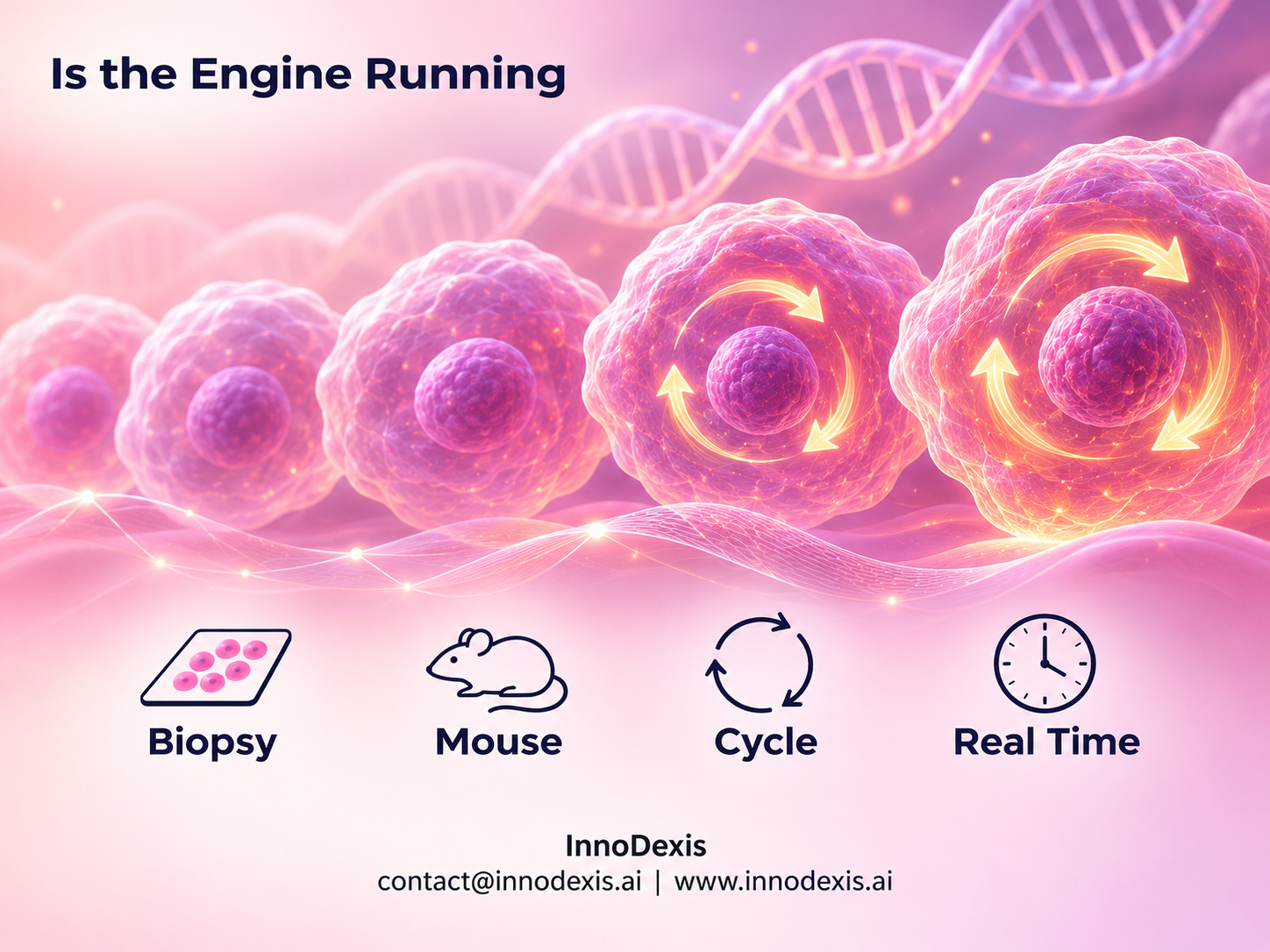
InnoDexis has published its latest Innovation Intelligence Report covering breast cancer drug resistance and biomarker discovery, analyzing one innovation from the Garvan Institute of Medical Research in Australia, with collaborators in the United Kingdom, published on 30 October 2026. The report reveals that tracking the activity of the CDK1 protein serves as a biomarker to predict and monitor resistance to CDK4/6 inhibitors in ER+ breast cancer, supported by a fluorescent biosensor mouse model, 10-month resistance modeling and more than 400 patient biopsy samples.
Key Findings
Active CDK1 signals continued cell proliferation during targeted therapy, and it serves as an operational biomarker for when ER+ breast cancers bypass CDK4/6 inhibitors. Higher CDK1 activity was associated with reduced sensitivity to these inhibitors, which gives the finding a direct link to treatment decisions.
A fluorescent biosensor mouse model delivered the first visualization of dynamic CDK1 protein activity driving resistance in live tumor models. It tracks what a protein is doing in real time rather than how much of it is present, which standard assays based on static protein levels cannot show. The model also lets researchers track the cell cycle being activated during treatment.
More than 400 patient biopsy samples were analyzed, and higher CDK1 activity was linked to worse patient outcomes, greater cancer invasiveness and drug resistance. These patient observations are retrospective and need confirmation in prospective clinical trials.
Long-term cell culture resistance models, run for 10 months, captured the reactivation of cell cycle mechanisms in resistant cells, and these models are where CDK1 was seen switching back on. The approach gives predictive insight into both initial non-response and acquired resistance, which makes it relevant at more than one point in a patient’s treatment.
The work is at a preclinical stage with low commercial readiness. No commercial CDK1 inhibitor exists for clinical use, and 5 to 10 years are estimated for prospective diagnostic validation and early-phase trial development of potential CDK1 inhibitors.
Strategic Insight and Trend Analysis
The dominant trend in this research is a shift in what counts as a biomarker for treatment resistance: from how much of a protein is present to whether it is actively working. Standard diagnostic assays evaluate static protein expression, whereas this approach measures the real-time activation state of a cell cycle kinase. That distinction is what allows resistance to be seen as it emerges.
The mechanism makes the signal credible. Liz Caldon of the Garvan Institute describes CDK1 as the engine a cell needs to divide. CDK4/6 inhibitors jam the ignition, some cancer cells find a way around it, and checking whether the CDK1 engine is running shows whether the drugs are still holding the cancer back. A strong mechanistic link between CDK1 activation and targeted therapy resistance has been established.
The same finding opens two tracks with different timelines. A diagnostic based on CDK1 transcript or protein activity can scale across clinical pathology labs if the biosensor findings are adapted to platforms such as immunohistochemistry or RNA-based assays. A therapeutic track needs novel drug discovery, and the main risk is selectively inhibiting CDK1 without systemic toxicity, given its role in normal cell division.
The boundaries are clear. The evidence is preclinical and retrospective, CDK1 activity may fail to predict clinical outcome independently in prospective trials, and alternative resistance mechanisms may operate independently of CDK1. If it holds, biomarker-guided options could replace empirical therapy switching in second-line ER+ breast cancer.
Global and Industry Implications
For corporates and R&D teams in oncology drug discovery and diagnostics, the findings support companion diagnostic design for CDK4/6 inhibitor therapy and initiation of medicinal chemistry programs targeting CDK1 kinase activity. Partnerships with clinical research groups are needed to validate CDK1 activity in prospective cohorts of patients receiving CDK4/6 inhibitors.
For investors and capital allocators, CDK1 is positioned as a driver of CDK4/6 inhibitor resistance and an emerging drug target in solid tumors worth monitoring. The risks are specific: a 5 to 10 year horizon, high cost and time to bring CDK1-targeted drugs to market, a saturated field of second-line cancer therapies, and a complex approval process for combined companion diagnostic and novel drug regimens.
For policymakers and national innovation bodies, the research shows an Australia and United Kingdom partnership across the Garvan Institute, the University of Manchester, UNSW Sydney and clinical partners. Approval from the FDA or an equivalent regulator will be needed for companion diagnostics and any CDK1 inhibitor trials, so access to prospective clinical trial groups is the enabling factor.
InnoDexis Statement
“Measuring whether CDK1 is active rather than present turns resistance to targeted therapy into a trackable signal, and prospective validation and safe CDK1 targeting will decide how far it reaches patients,” noted InnoDexis in its latest intelligence report.
Conclusion
The next milestones to watch are validation of CDK1 activity trends in prospective clinical cohorts of patients receiving CDK4/6 inhibitors, translation of biosensor tracking into routine pathology testing, and screening of selective CDK1 inhibitors that avoid toxic effects in healthy dividing cells. Whether CDK1 activity can predict outcome independently in human trials will determine how far the approach advances. InnoDexis will continue to track drug resistance mechanisms, biomarker discovery and precision oncology as this field develops. The complete CDK1 Breast Cancer Therapy Resistance Innovation Intelligence Report is available to InnoDexis subscribers and enterprise clients.
About InnoDexis
InnoDexis is a real-time innovation intelligence platform connecting scientific discovery to commercial opportunity. Powered by InnoGraph, its proprietary innovation knowledge graph, the platform maps technologies across the entire lifecycle, from early-stage research (TRL 1) to market deployment (TRL 9), connecting researchers, institutions, startups, companies, products and emerging opportunities.
Covering 40+ specialised industry segments and 360 technology areas, InnoDexis delivers innovation tracking, research discovery, product and startup intelligence, investment insights, and AI-powered reports. Its mission is to bridge the gap between scientific discovery and real-world impact.
InnoDexis — From Lab to Market: Real-Time Innovation Intelligence.