Canada’s Abandoned Oil and Gas Wells Show Methane Emissions Up to 1,000× Higher Than Expected
New evidence indicates microbial activity in non-producing wells is driving significant methane emissions, revealing a persistent and under accounted source of climate impact.
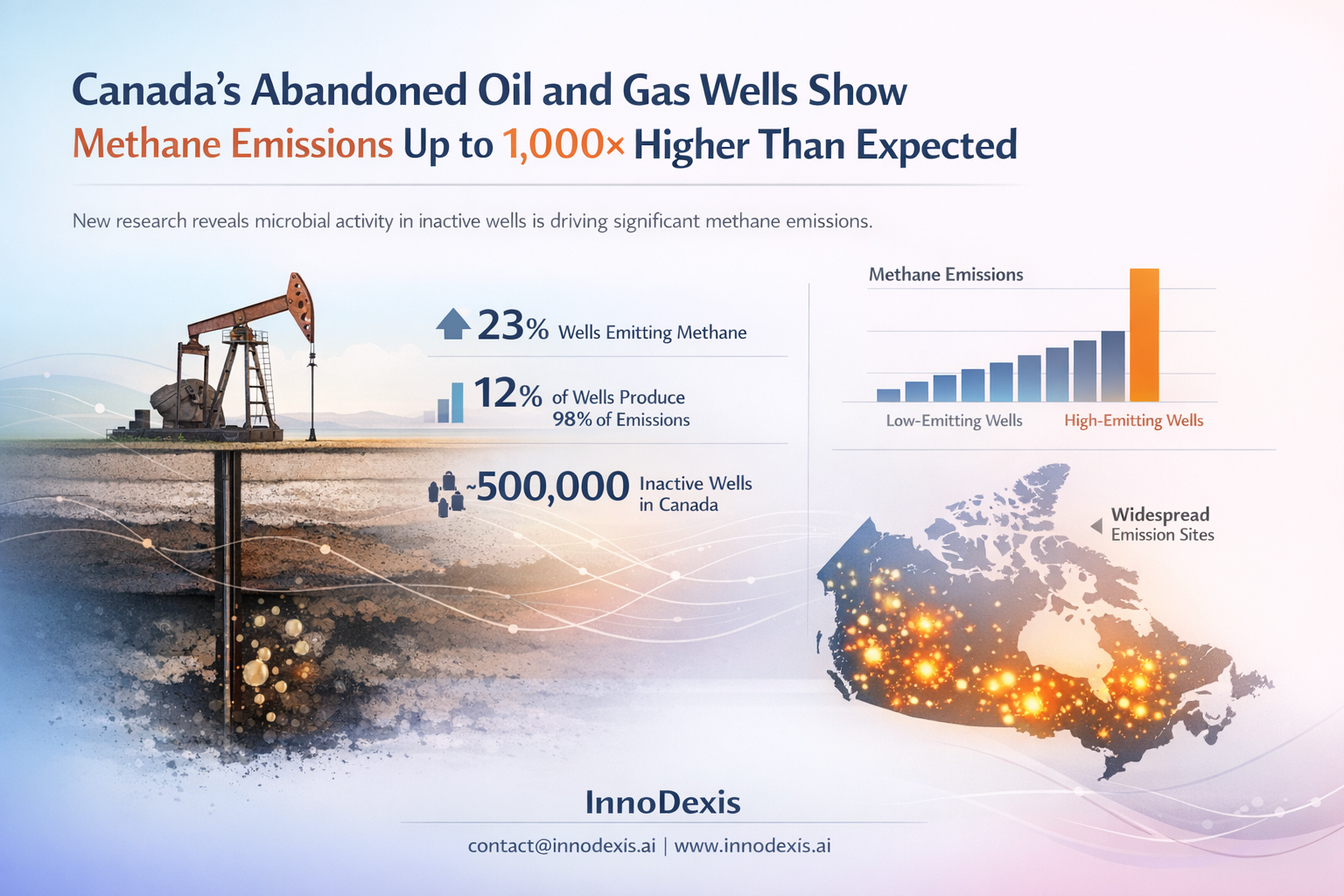
InnoDexis has published its latest Innovation Intelligence Report covering methane emissions from abandoned and non-producing oil and gas wells, analyzing 401 sampled wells in Canada. The report reveals that emissions from these inactive assets are significantly higher than previously estimated, driven not by industrial leakage but by microbial activity deep underground. With methane detected in a substantial share of wells and emission intensity concentrated among a small subset, the findings highlight a distributed and long-term emissions source embedded within legacy energy infrastructure.
Key Findings
Methane emissions were detected in 23% of the 401 sampled wells, confirming that nearly one-quarter of inactive oil and gas wells are actively releasing methane. This indicates that emissions persist even in the absence of ongoing industrial operations, challenging assumptions about post-closure environmental stability.
An additional 50% of wells showed trace levels of methane, suggesting that microbial methane generation may be more widespread than direct emission measurements alone indicate. This expands the potential scale of the issue beyond wells currently classified as active emitters.
The emissions profile is highly concentrated, with the top 12% of wells responsible for 98% of total methane output. This skewed distribution suggests that a relatively small subset of high-emitting wells disproportionately drives overall environmental impact.
Approximately 500,000 non-producing wells exist in Canada, representing a large and largely unmonitored infrastructure base. The scale of these assets indicates that even low-probability emission activity can translate into significant aggregate climate impact.
The source of methane emissions is attributed to microbial activity rather than conventional industrial leakage. This distinction highlights a biological mechanism operating within subsurface environments, extending the lifecycle of emissions beyond operational timelines.
Strategic Insight and Trend Analysis
The findings point to a structural shift in how methane emissions from the energy sector are understood. Traditionally, emissions accounting has focused on active production sites, where leaks and operational inefficiencies are primary targets for mitigation. However, the presence of microbial methane generation in inactive wells introduces a persistent emissions pathway independent of ongoing industrial activity.
The combination of widespread trace detection and highly concentrated emission intensity suggests a dual-layer risk profile. On one level, emissions are broadly distributed across a large infrastructure base. On another, a small subset of wells contributes disproportionately to total output. This dynamic complicates monitoring and mitigation strategies, as both broad surveillance and targeted intervention are required.
The scale of non-producing wells in Canada indicates that legacy infrastructure represents a long-term emissions system rather than a residual one. Once wells transition out of production, they do not necessarily transition out of environmental relevance. Instead, biological processes may sustain emissions over extended periods, creating a delayed and compounding climate impact.
This pattern suggests that methane emissions from abandoned wells are not an anomaly but a structural feature of legacy energy systems. As more wells reach end-of-life status globally, the cumulative effect of microbial emissions may become increasingly material in national and global emissions inventories.
Global and Industry Implications
For corporates and R&D teams, the findings highlight the need to expand monitoring technologies and remediation strategies beyond active assets. Identifying and addressing high-emitting wells within large inactive portfolios may become a priority for emissions management and compliance.
For investors and capital allocators, the data signals potential exposure to long-term environmental liabilities associated with legacy infrastructure. Asset valuation and risk assessment frameworks may need to incorporate post-operational emissions dynamics more explicitly.
For policymakers and national innovation bodies, the scale and persistence of emissions from non-producing wells suggest that existing regulatory frameworks may not fully capture lifecycle emissions. Integrating end-of-life infrastructure into climate policy and emissions accounting could become increasingly relevant.
InnoDexis Statement
“The data indicates that methane emissions from inactive wells are not residual but structurally persistent, suggesting that legacy infrastructure must be integrated into long-term emissions accounting and mitigation strategies,” noted InnoDexis in its latest intelligence report.
Conclusion
The analysis of methane emissions from abandoned and non-producing wells in Canada reveals a distributed and enduring source of greenhouse gas output driven by microbial processes. With emissions concentrated in a small subset of wells yet potentially present across a broad infrastructure base, the findings point to a gap in current monitoring and policy approaches. As climate strategies evolve, the role of legacy assets may become increasingly central to emissions reduction efforts. The complete Methane Emissions from Non-Producing Wells Report is available to InnoDexis subscribers and enterprise clients.
About InnoDexis
InnoDexis is a global Innovation Intelligence platform that tracks, analyzes, and interprets breakthrough innovations, prototypes, and emerging technologies across industries and countries. Its intelligence helps corporates, investors, and policymakers understand the true structure and direction of global innovation. Learn more at innodexis.ai.