Canada Advances Climate-Resilient Agriculture Research as $48M Investment Prioritizes Data-Driven Crop Intelligence
A new research ecosystem signals a shift from traditional farming toward predictive, infrastructure-led agricultural innovation.
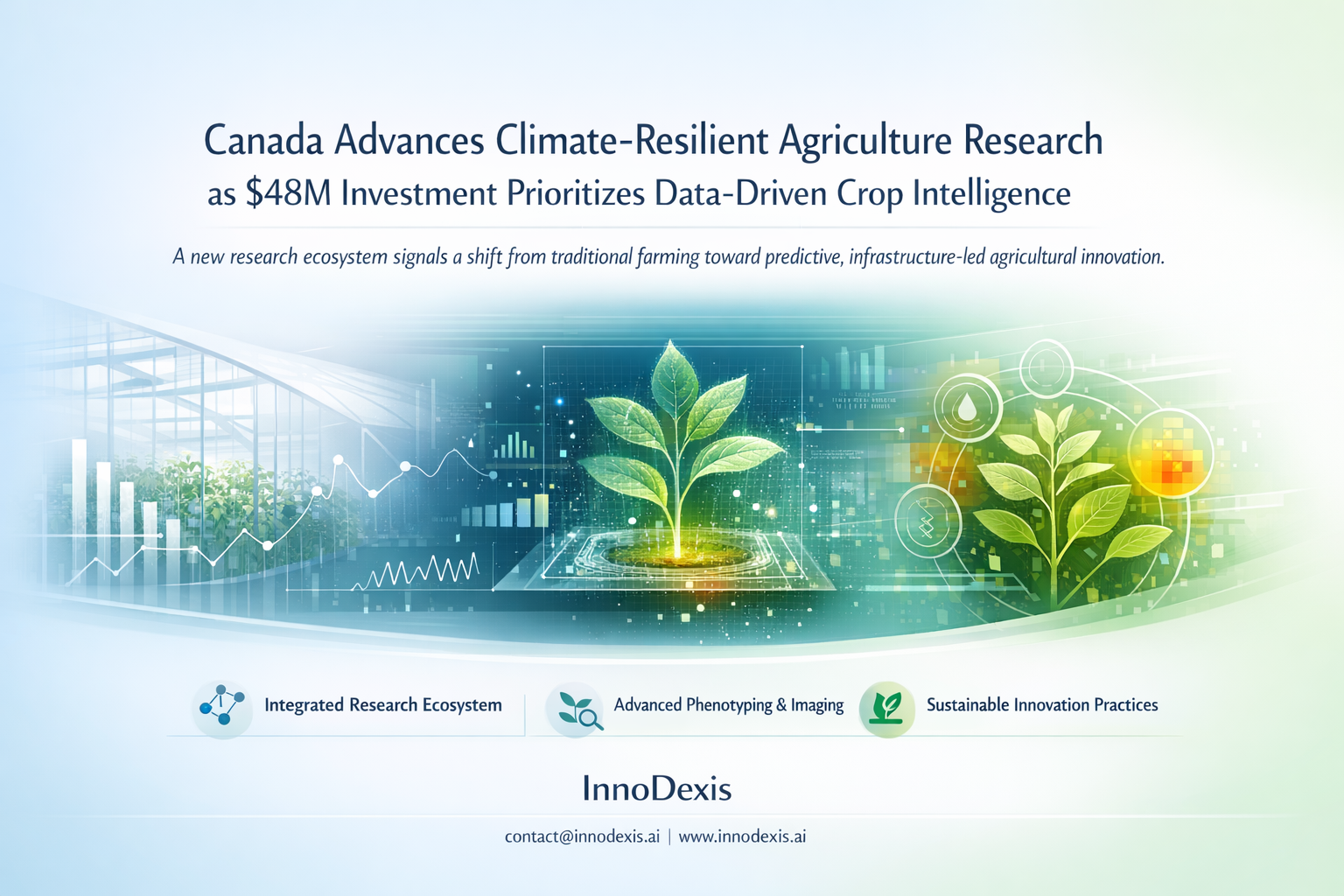
InnoDexis has published its latest Innovation Intelligence Report covering climate-resilient agriculture, analyzing a major $48 million research infrastructure investment in Canada during early 2026. The report reveals that agricultural innovation is increasingly shifting from land-based productivity toward intelligence-driven systems that decode crop responses to environmental stress. Centered at McGill University and supported by collaborative research infrastructure, the initiative highlights how controlled environments, phenotyping platforms, and advanced imaging are redefining how crops are studied, adapted, and scaled under climate variability.
Key Findings
A $48 million investment has been directed toward building an integrated agricultural research ecosystem, indicating a strategic shift from traditional farming inputs to scientific infrastructure. The initiative prioritizes intelligence generation over land expansion, focusing on how crops respond to changing environmental conditions.
A 7-bay controlled greenhouse facility forms a core component of the infrastructure, incorporating tissue culture laboratories and integrated teaching spaces. This setup enables controlled experimentation across multiple crop conditions while aligning research and academic training within a single environment.
The Eastern Canadian Plant Phenotyping Platform is designed to enable trait discovery for climate adaptation. By systematically measuring plant responses under varying conditions, the platform supports the identification of traits linked to resilience, productivity, and environmental tolerance.
A Multi-scale Imaging Facility has been established to provide advanced imaging capabilities tailored specifically for agricultural research. This infrastructure enables high-resolution observation of plant structure and function across different biological scales, supporting data-rich analysis of crop behavior.
Sustainability has been embedded into the infrastructure design, including LED lighting systems, rainwater capture mechanisms, and energy-efficient operations. These features reflect an alignment between research objectives and environmental resource management.
The initiative is developed in collaboration with Université de Sherbrooke, indicating a multi-institutional approach to agricultural innovation. This collaboration integrates expertise across biology, imaging, and data science, reinforcing the system-level orientation of the research ecosystem.
Strategic Insight and Trend Analysis
The investment reflects a broader transition in agriculture from land-centric productivity models to intelligence-driven systems. Rather than focusing on increasing acreage or yield through conventional means, the infrastructure is designed to decode plant responses under controlled and variable conditions, enabling predictive understanding of crop performance.
The presence of controlled greenhouse environments, phenotyping platforms, and advanced imaging systems indicates that agriculture is increasingly adopting methodologies associated with data-intensive sciences. This shift allows for the generation of structured datasets that can inform decision-making beyond seasonal observation cycles.
The integration of multi-scale imaging and phenotyping suggests that crop development is being approached as a measurable and model-driven process. By capturing detailed biological responses, researchers can move toward predictive frameworks that anticipate how crops will behave under specific climate stressors.
Collaboration between institutions further reinforces the convergence of disciplines within agricultural research. Biology, engineering, and data analytics are being combined to create systems capable of analyzing complex environmental interactions at scale.
The data indicates that agriculture is evolving into a systems science, where infrastructure plays a central role in enabling discovery and application. This transition reflects a shift from reactive farming practices toward predictive and adaptive agricultural models.
Global and Industry Implications
For corporates and R&D teams, the development highlights the importance of investing in research infrastructure that generates actionable crop intelligence. Access to phenotyping data and controlled experimentation environments may become critical for developing climate-resilient agricultural products and solutions.
For investors and capital allocators, the shift toward infrastructure-led innovation suggests emerging opportunities in platforms that enable data generation, analysis, and application in agriculture. Investments may increasingly focus on systems that bridge research outputs with scalable agricultural deployment.
For policymakers and national innovation bodies, the initiative demonstrates the role of coordinated funding in advancing climate-resilient agriculture. Infrastructure that integrates sustainability and research capabilities may become a strategic priority for ensuring long-term food system stability under environmental change.
InnoDexis Statement
“The evolution of agriculture toward data-driven and infrastructure-led systems indicates that future competitiveness will depend on the ability to decode and predict plant responses under climate variability,” noted InnoDexis in its latest intelligence report.
Conclusion
The $48 million investment in agricultural research infrastructure reflects a structural shift in how food systems are studied and developed. By combining controlled environments, phenotyping platforms, and advanced imaging, the initiative positions agriculture within a predictive and data-centric framework. As climate variability continues to influence crop viability, the ability to generate and interpret plant intelligence may define future agricultural advantage. The complete Climate-Resilient Agriculture Innovation Intelligence Report is available to InnoDexis subscribers and enterprise clients.
About InnoDexis
InnoDexis is a global Innovation Intelligence platform that tracks, analyzes, and interprets breakthrough innovations, prototypes, and emerging technologies across industries and countries. Its intelligence helps corporates, investors, and policymakers understand the true structure and direction of global innovation. Learn more at innodexis.ai.