Brain Fear Memory Model Reframed as Astrocytes Demonstrate Causal Role in Encoding and Extinction
New findings from the United States show astrocytes are not passive support cells but active regulators of fear memory strength.
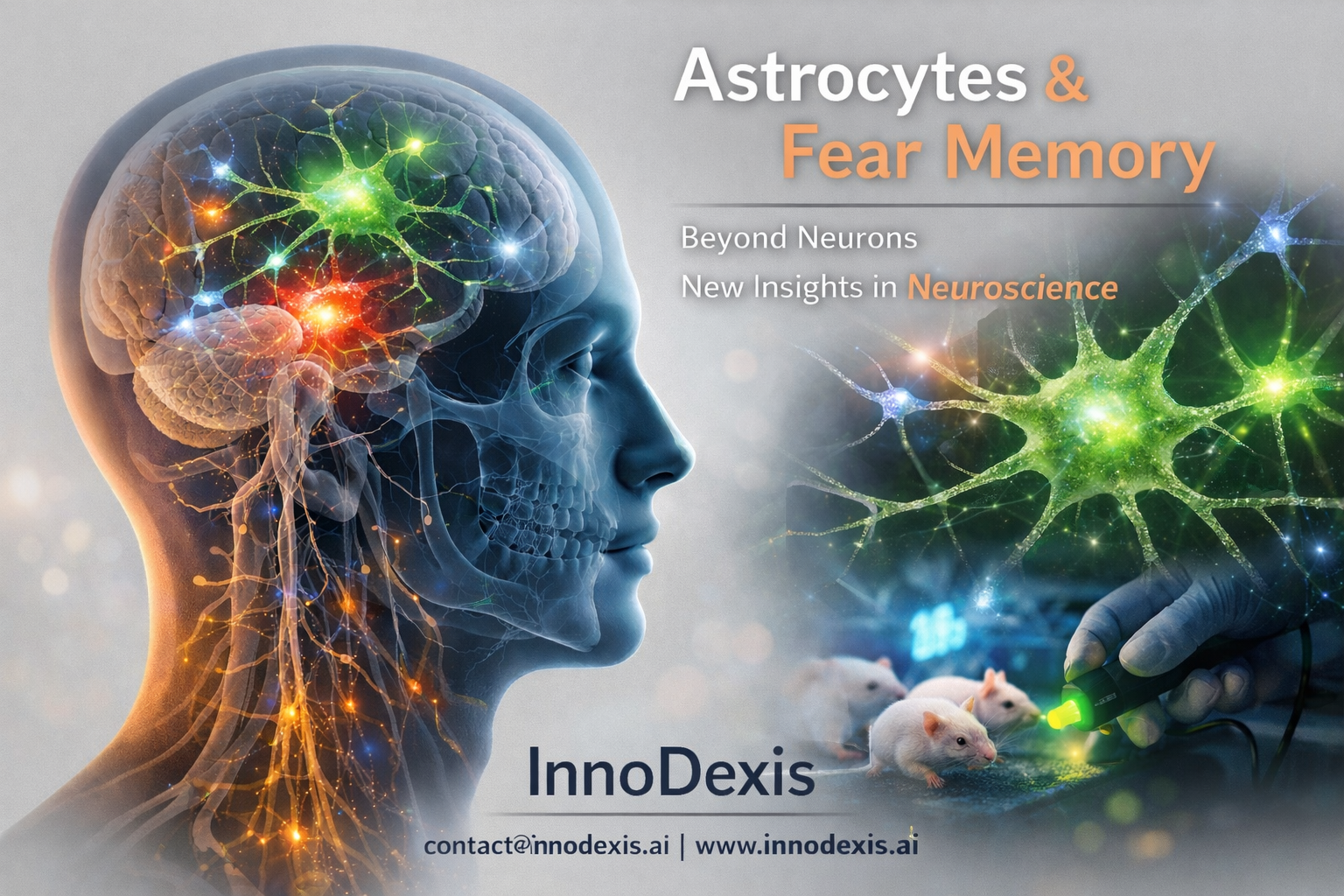
InnoDexis has published its latest Innovation Intelligence Report covering advances in neuroscience and fear memory research, analyzing a newly reported experimental breakthrough in the United States during February 2026. The report reveals that astrocytes — historically classified as neural support cells — play a direct and causal role in encoding, maintaining, and extinguishing fear memories. Conducted by researchers at the University of Arizona and disclosed, the findings challenge the long-standing neuron-centric framework that has shaped both academic neuroscience and neuropsychiatric drug development.
KEY FINDINGS
The study establishes that astrocytes encode and maintain neural fear signaling alongside neurons. Rather than serving solely metabolic or structural functions, astrocytes were shown to actively participate in the neural processes that govern fear memory formation. This positions astrocytes as functional contributors within fear circuits rather than passive cellular infrastructure.
Researchers demonstrated that fear memories are not produced by neurons alone. Experimental results showed that astrocytes play an active and causal role in the modulation of fear responses. This finding directly challenges the dominant neuron-exclusive model that has defined fear memory research for decades.
Direct manipulation of astrocyte activity altered fear memory strength. Increasing astrocyte signaling intensified fear memory expression, while suppressing astrocyte activity weakened it. This establishes a functional link between astrocyte activity levels and measurable behavioral outcomes related to fear conditioning.
The research utilized real-time fluorescent activity sensors in a mouse model to observe astrocyte signaling during fear memory processes. This live monitoring approach provided direct evidence of astrocyte involvement during encoding and extinction phases, reinforcing the causal relationship between astrocyte signaling and fear behavior.
The study further indicates that future investigation will extend to broader fear circuitry, including the prefrontal cortex and the periaqueductal gray. These regions are central to emotional regulation and defensive responses, suggesting that astrocyte involvement may be distributed across multiple nodes of fear processing networks.
STRATEGIC INSIGHT AND TREND ANALYSIS
Collectively, the findings signal a structural shift in the biological model of memory formation. For decades, neuroscience has centered neurons as the primary drivers of cognitive and emotional processing. The demonstration that astrocytes encode, maintain, and modulate fear memory introduces a multi-cellular framework in which glial cells act as active computational participants rather than passive supporters.
This shift has implications beyond academic theory. If astrocytes causally influence fear memory strength, then therapeutic strategies targeting neuronal firing patterns alone may overlook critical regulatory mechanisms. The data suggest that fear memory formation is distributed across cellular types, implying that emotional memory is governed by coordinated neuron–astrocyte signaling networks.
The use of real-time fluorescent sensors in a live animal model further underscores the methodological advancement. Direct visualization of astrocyte activity during fear encoding provides empirical grounding to what was previously speculative. By linking observable astrocyte dynamics to measurable changes in fear behavior, the research strengthens the argument for revising prevailing neurobiological models.
The dominant trend emerging from this analysis is the expansion of functional neuroscience beyond neurons. Glial biology, historically underprioritized in translational research, is moving toward the center of memory and psychiatric investigation. If subsequent studies validate astrocyte involvement across additional regions such as the prefrontal cortex and periaqueductal gray, the structural architecture of fear circuitry may require reclassification.
From an innovation intelligence perspective, this represents an early indicator of a broader rebalancing in neurobiological research priorities. The shift from neuron-exclusive models to integrated cellular frameworks may influence both experimental design and therapeutic development pipelines.
GLOBAL AND INDUSTRY IMPLICATIONS
For corporates and R&D teams, particularly within pharmaceutical and neurotechnology sectors, the findings suggest the need to reassess neuron-centric therapeutic pipelines. Target discovery strategies that exclude astrocyte signaling pathways may overlook mechanistic drivers of fear-related disorders. Integrating glial biology into screening and drug design could redefine development priorities in psychiatric therapeutics.
For investors and capital allocators, the data highlight emerging white space in glial-targeted neuroscience innovation. Companies advancing astrocyte modulation platforms, neuroimaging technologies, or cell-specific therapeutic delivery systems may represent differentiated positioning within mental health biotechnology portfolios.
For policymakers and national innovation bodies, the research underscores the importance of supporting foundational neuroscience that challenges established models. Funding frameworks that encourage cross-disciplinary exploration of neural circuitry and glial function may accelerate translational progress in PTSD, anxiety disorders, and phobia-related interventions.
INNODEXIS STATEMENT
“The data indicate that fear memory architecture is not neuron-exclusive but structurally dependent on coordinated astrocyte activity, suggesting that future therapeutic strategies must account for multi-cellular circuit dynamics,” noted InnoDexis in its latest intelligence report.
CONCLUSION
The redefinition of astrocytes from support cells to active regulators of fear memory marks a pivotal development in contemporary neuroscience. As further studies expand investigation into additional brain regions, including the prefrontal cortex and periaqueductal gray, the structural understanding of fear circuitry is likely to evolve. For industry and research stakeholders, the key question is no longer whether astrocytes participate in memory processes, but how extensively they shape them. The complete Brain Fear Memory Innovation Intelligence Report is available to InnoDexis subscribers and enterprise clients.
ABOUT INNODEXIS
InnoDexis is a global Innovation Intelligence platform that tracks, analyzes, and interprets breakthrough innovations, prototypes, and emerging technologies across industries and countries. Its intelligence helps corporates, investors, and policymakers understand the true structure and direction of global innovation. Learn more at innodexis.ai.