Blood-Based Detection of Glioblastoma Advances as Machine Learning and Extracellular Vesicles Enable Noninvasive Diagnosis
Research from the University of Sussex indicates a shift toward blood-based, data-driven diagnostics for brain cancer detection and monitoring.
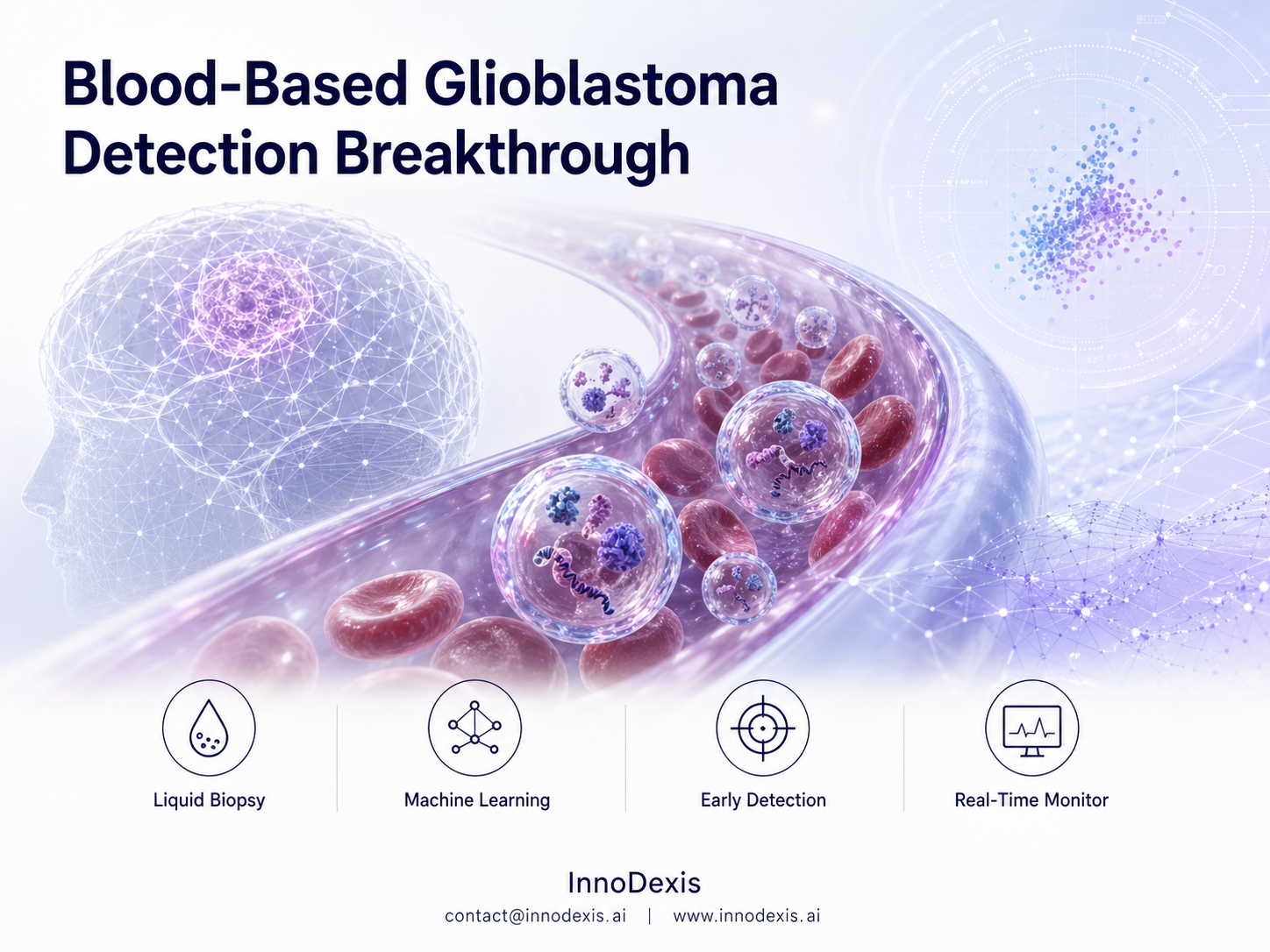
InnoDexis has published its latest Innovation Intelligence Report covering oncology diagnostics, analyzing recent research developments in glioblastoma detection. The report reveals that a blood-based diagnostic approach developed at the University of Sussex enables noninvasive identification of one of the most aggressive brain cancers using extracellular vesicles and machine learning. The findings indicate that diagnostic pathways for brain tumors may be transitioning away from invasive procedures toward faster, data-driven methods capable of supporting earlier detection and clinical decision-making.
Key Findings
Researchers at the University of Sussex have developed a blood test targeting glioblastoma detection using small extracellular vesicles (sEVs). These vesicles carry measurable biological signals that can be analyzed without requiring surgical intervention, offering a noninvasive diagnostic pathway for brain tumors.
The diagnostic method leverages sEV “chemical fingerprints,” including proteins and microRNAs, to enable high-accuracy tumor detection. These molecular signatures provide a structured dataset that can be analyzed to identify the presence of cancer-related activity in the bloodstream.
Machine learning models are used to differentiate glioma subtypes and distinguish them from other brain tumors. This capability introduces a level of classification precision that supports more targeted diagnostic and treatment planning decisions.
The blood-based testing process delivers results within days rather than weeks, indicating a significant reduction in diagnostic timelines. Faster turnaround times may allow clinicians to initiate treatment strategies earlier in the disease progression cycle.
The approach also demonstrates potential for real-time monitoring of treatment response. By analyzing changes in extracellular vesicle profiles over time, clinicians may be able to assess how tumors respond to therapy without repeated invasive procedures.
Strategic Insight and Trend Analysis
The findings from the University of Sussex reflect a broader transition in oncology diagnostics from procedure-based detection to data-driven biological analysis. Traditional brain tumor diagnosis relies on imaging techniques combined with invasive biopsies, which introduce procedural risks and extend decision timelines. The emergence of blood-based diagnostics suggests a structural shift toward safer and more continuous diagnostic models.
The use of extracellular vesicles as a diagnostic signal represents a growing area of interest in liquid biopsy research. By capturing proteins and microRNAs circulating in the blood, these methods enable indirect observation of tumor biology without requiring direct tissue access. When combined with machine learning, this data becomes actionable, allowing for classification and prediction at a level not achievable through conventional diagnostic tools alone.
This convergence of biology and computational analysis indicates that diagnostics is evolving into a continuous data interpretation process rather than a single clinical event. The ability to detect, classify, and monitor cancer through blood samples introduces the potential for earlier intervention, iterative treatment adjustments, and improved patient management.
The shift also suggests a redefinition of diagnostic entry points in oncology. Instead of diagnosis occurring after symptom escalation and imaging confirmation, blood-based testing may enable earlier detection stages where treatment outcomes can be more significantly influenced. This positions liquid biopsy approaches as a foundational layer in future cancer care pathways.
Global and Industry Implications
For corporates and R&D teams, the development of blood-based glioblastoma diagnostics indicates an opportunity to expand capabilities in liquid biopsy platforms, biomarker discovery, and machine learning integration. Organizations may need to align expertise across diagnostics, data science, and clinical validation to develop scalable solutions.
For investors and capital allocators, the findings highlight the potential of noninvasive diagnostic technologies that combine biological data with computational models. Platforms capable of early detection and continuous monitoring may represent a distinct category within oncology innovation.
For policymakers and national innovation bodies, the emergence of blood-based diagnostics underscores the importance of supporting regulatory pathways for noninvasive testing and ensuring frameworks can accommodate data-driven diagnostic tools. Accelerating validation and adoption may influence national healthcare outcomes.
InnoDexis Statement
The development of blood-based glioblastoma detection illustrates a broader shift toward data-driven oncology diagnostics, where biological signals and computational analysis combine to enable earlier, safer, and more adaptive clinical decision-making,” noted InnoDexis in its latest intelligence report.
Conclusion
The research emerging from the University of Sussex signals a transition in how brain cancers such as glioblastoma may be detected and monitored. As extracellular vesicle analysis and machine learning continue to advance, diagnostic models are moving toward noninvasive, rapid, and continuously updated systems. Monitoring how these technologies are validated and integrated into clinical practice will be critical in shaping the future of oncology diagnostics. The complete Oncology Diagnostics Innovation Intelligence Report is available to InnoDexis subscribers and enterprise clients.
About InnoDexis
InnoDexis is a global Innovation Intelligence platform that tracks, analyzes, and interprets breakthrough innovations, prototypes, and emerging technologies across industries and countries. Its intelligence helps corporates, investors, and policymakers understand the true structure and direction of global innovation. Learn more at innodexis.ai.