Black Hole Splitting May Be Possible Near Maximum Rotation Rate, University of Southern Denmark Model Shows, With Fermi-LAT as a Test Path
A theoretical study from the University of Southern Denmark and collaborators finds that rapidly rotating black holes, or black holes under extra-dimensional theories, may overcome the thermodynamic barriers that normally prevent a split into two.
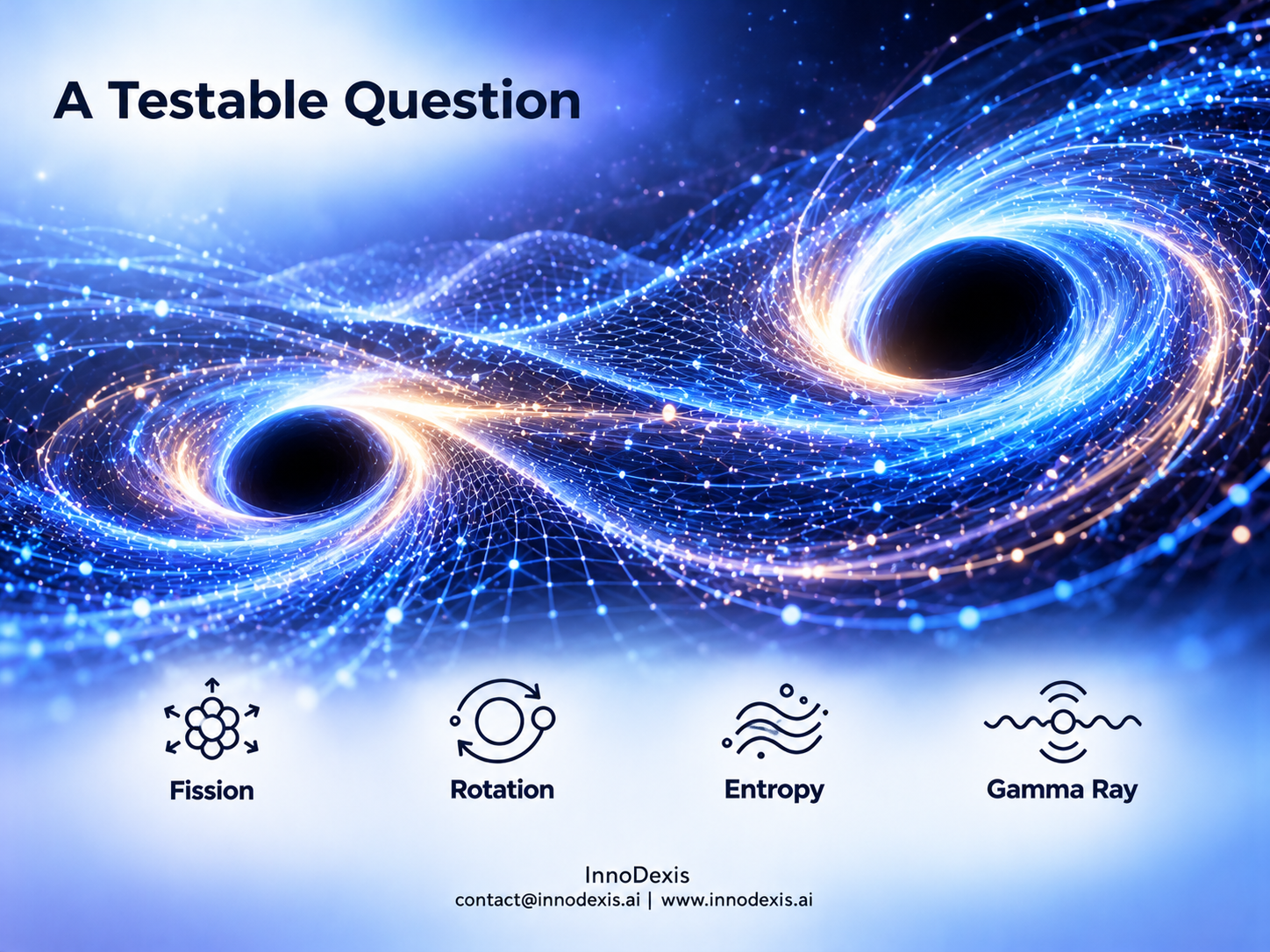
InnoDexis has published its latest Innovation Intelligence Report covering black hole physics and quantum gravity, analyzing one theoretical study from the University of Southern Denmark, with collaborators across Denmark, Italy and France, published in Phys. Rev. D on 22 October 2026. The report reveals that black holes rotating near their maximum possible rate, or evaluated under extra-dimensional space theories, may overcome the thermodynamic barriers against splitting into two smaller black holes, with a possible observational test using gamma-ray telescopes such as Fermi-LAT.
Key Findings
Maximum rotation rate emerges as a potential loophole for black hole splitting. The study finds that black holes rotating near their maximum possible rate, or evaluated under extra-dimensional space theories, may overcome the thermodynamic barriers that normally prevent a single black hole from dividing, which sets out the conditions under which a split could be allowed.
The analysis applies pair-of-pants topologies to black hole horizon evolution, with a thermodynamic evaluation of the entropy constraints involved. The work asks which physical laws normally prevent a split and whether certain circumstances may allow one, and it focuses on black hole fission rather than the standard fusion and merger paradigm.
Splitting alone is not enough, because the two resulting black holes must also be able to separate rather than immediately fall back together. When this requirement is included, the window for splitting largely closes again, except possibly for black holes rotating close to their maximum possible rate. This narrows the result to a specific condition.
No probability for a split can yet be given. It depends on how gravity behaves beyond Einstein’s theory, which the researchers are working to quantify. Small primordial black holes are expected to be more prone to splitting than much larger astrophysical black holes, and the study lacks quantitative probability estimates.
Gamma-ray telescopes such as Fermi-LAT could search for signals from tiny black-hole fragments that might form during mergers, offering an indirect way to detect a split. This gives the theory a concrete observational target on existing telescope hardware.
Strategic Insight and Trend Analysis
The dominant trend in this research is the move of black hole fission from a thermodynamic prohibition toward a conditional, testable question. The standard paradigm centres on fusion and merger. This work asks when the reverse could happen, and identifies maximum rotation and extra-dimensional space theories as the cases where thermodynamic barriers might be overcome.
The significance is theoretical and observational at once. The study bridges macroscopic general relativity with beyond-Einstein theories of gravity, and it contributes to quantum gravity and theoretical astrophysics. If tiny primordial fragments were detected, the result could confirm frameworks beyond general relativity and alter understanding of early-universe physics, and it could challenge standard astrophysical models of black hole evolution.
The evidence also carries firm limits. The model relies on physics beyond Einstein’s general theory of relativity that cannot currently be easily tested without indirect observational evidence, and it assumes gravity behaves in ways that may not hold experimentally. Observational constraints may rule out pair-of-pants topologies entirely. The researchers also note that the window for splitting largely closes once the two black holes must separate, so the result applies to a narrow set of cases.
Collectively, the work provides a map of where splitting might be allowed and a route to falsification through gamma-ray searches. Theoretical and observational research is expected to continue over the next 5 to 10 years, with quantitative probability models for splitting under non-Einsteinian gravity as the next theoretical step.
Global and Industry Implications
For corporates and R&D teams, direct industry transfer is not applicable to this work. Its relevance lies in knowledge that contributes to fundamental physics and to astronomical observational methods, with Academic Research, Space & Defense and Scientific Computing named as the related industries. It could inform observation protocols for observatories such as Fermi-LAT, and observational teams operating gamma-ray telescopes are the identified audience.
For investors and capital allocators, no commercial applications or direct market are identified, and the likelihood of commercial transition is low. The path forward is further academic publication and astronomical observation, so this is a signal for the science base rather than for near-term capital deployment.
For policymakers and national innovation bodies, the study identifies concrete observational targets for existing telescope hardware. It suggests that funding and observational research should target high-energy astrophysical surveys looking for gamma-ray signals from primordial black hole fragments. The collaboration between institutions in Italy, Denmark and France also shows how joint theoretical work can be linked to observational programmes.
InnoDexis Statement
“Black hole fission turns a thermodynamic barrier into a testable question, because the conditions that might permit splitting also define the gamma-ray signatures that existing telescopes could confirm or rule out,” noted InnoDexis in its latest intelligence report.
Conclusion
The next milestones to watch are quantitative models of black hole splitting probabilities under non-Einsteinian gravity, and analysis of Fermi-LAT data for the predicted signal profiles. Whether two black holes formed by a split can separate without immediately falling back together remains a central open question. Theoretical and observational work is expected to continue over the next 5 to 10 years. InnoDexis will continue to track quantum gravity, theoretical astrophysics and observational searches for primordial black hole fragments. The complete Black Hole Splitting and Quantum Gravity Innovation Intelligence Report is available to InnoDexis subscribers and enterprise clients.
About InnoDexis
InnoDexis is a real-time innovation intelligence platform connecting scientific discovery to commercial opportunity. Powered by InnoGraph, its proprietary innovation knowledge graph, the platform maps technologies across the entire lifecycle, from early-stage research (TRL 1) to market deployment (TRL 9), connecting researchers, institutions, startups, companies, products and emerging opportunities.
Covering 40+ specialised industry segments and 360 technology areas, InnoDexis delivers innovation tracking, research discovery, product and startup intelligence, investment insights, and AI-powered reports. Its mission is to bridge the gap between scientific discovery and real-world impact.
InnoDexis — From Lab to Market: Real-Time Innovation Intelligence.