Bio-Inspired Materials Demonstrate Self-Assembling, Reusable Properties Under Non-Toxic Conditions
A biomaterial engineered using mussel adhesion and plant-based nanostructures shows reversible assembly and full reusability, indicating a shift toward regenerative material systems.
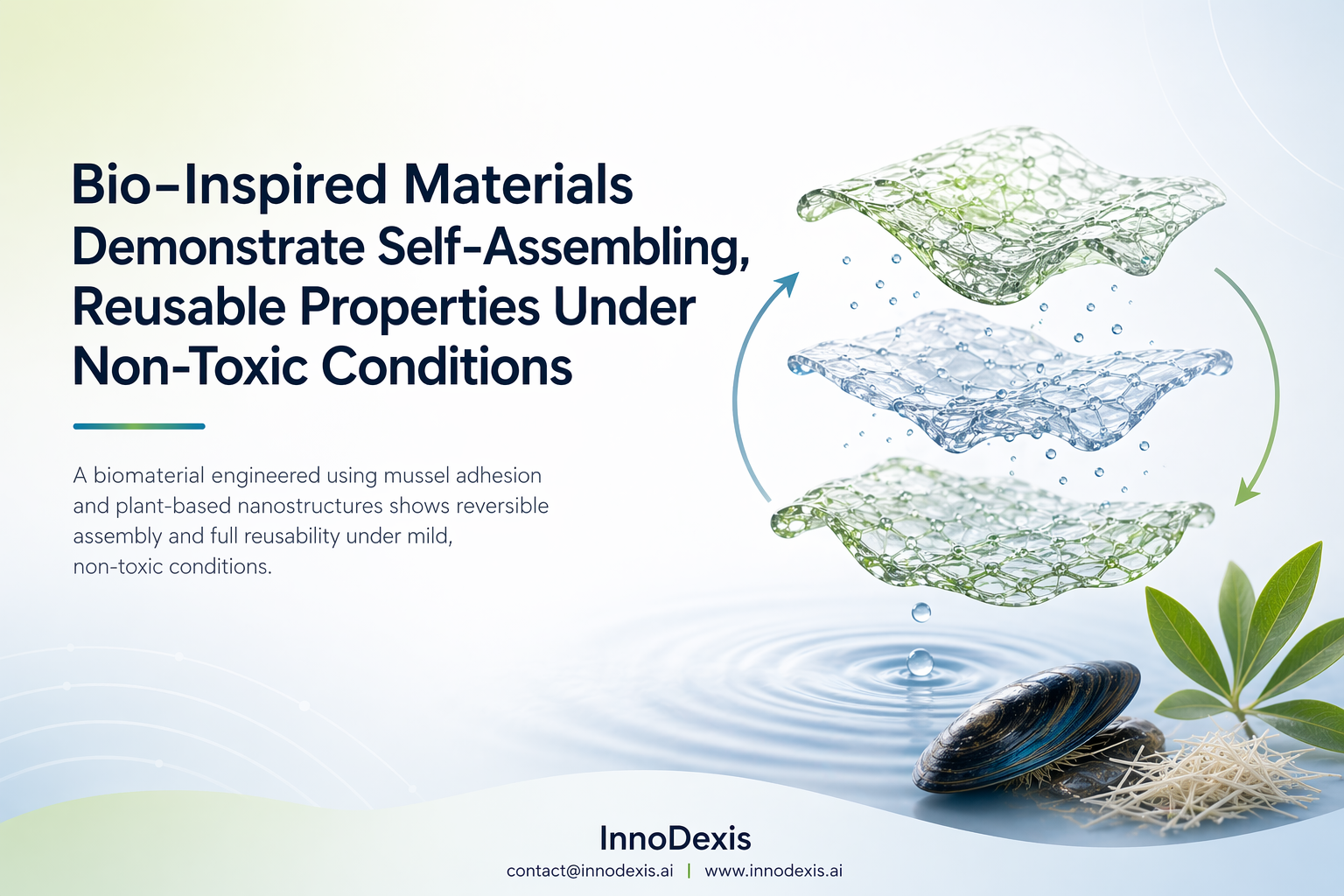
InnoDexis has published its latest Innovation Intelligence Report covering biomaterials and sustainable materials science, analyzing recent innovations in bio-inspired material engineering across academic research environments. The report reveals that a newly developed material demonstrates the ability to self-assemble, dissolve, and reassemble under mild, non-toxic conditions. Developed at McGill University, the material integrates biological design principles without relying on petrochemicals, indicating a shift toward regenerative and programmable material systems.
Key Findings
A bio-inspired material has been engineered to self-assemble through bottom-up fabrication using biomolecular condensates. This approach reflects a natural mechanism of organizing matter, enabling structured material formation without conventional industrial processing methods. The system operates under mild conditions, avoiding the need for high energy inputs or toxic chemical environments.
The material demonstrates full reversibility, with the ability to dissolve and reassemble repeatedly without loss of functional performance. This property distinguishes it from conventional synthetic materials, which typically degrade or lose integrity after recycling processes. The observed reusability introduces a structurally regenerative lifecycle at the material level.
Biocompatibility has been confirmed, with the material showing no toxicity to human cells. This characteristic extends its applicability beyond industrial use cases into medical and biological domains, including potential integration with living systems or tissue-related applications.
The design combines mussel-inspired adhesive mechanisms with plant-derived cellulose nanocrystals, forming a hybrid structure that leverages both biological adhesion and structural reinforcement. This integration reflects a cross-domain biomimetic approach, merging marine and plant-based biological strategies within a single material system.
The absence of petrochemical inputs in the material composition indicates a departure from traditional synthetic polymer production. By relying on biological building blocks and self-assembly processes, the material avoids generating persistent waste typically associated with plastics and industrial coatings.
Strategic Insight and Trend Analysis
The reported innovation signals a transition in materials science from incremental sustainability improvements toward fundamentally regenerative design frameworks. Rather than optimizing existing petrochemical-based systems for reduced harm, the material demonstrates an alternative paradigm in which waste generation is structurally minimized or eliminated.
The use of biomolecular condensates as a fabrication mechanism suggests a broader shift toward programming materials to organize themselves. This bottom-up approach contrasts with traditional top-down manufacturing, where materials are shaped through extraction, refinement, and assembly processes that often introduce inefficiencies and waste.
The integration of reversible assembly and biocompatibility indicates that materials are increasingly being designed to operate within dynamic environments, including biological systems. This expands the functional scope of materials from static components to adaptive systems capable of responding to environmental or operational changes.
The convergence of adhesion mechanisms inspired by mussels and structural elements derived from plant cellulose highlights a maturing phase of biomimicry. The data suggests a shift from using nature as a source of inspiration toward directly implementing biological processes as manufacturing logic.
Collectively, these developments point toward a structural redefinition of material lifecycles. If materials can be designed to assemble, disassemble, and reassemble without degradation, the traditional concept of product end-of-life may become less relevant within certain application domains.
Global and Industry Implications
For corporates and R&D teams, the emergence of self-assembling and fully reusable biomaterials introduces new design possibilities for products that require minimal waste management. Applications may extend across coatings, adhesives, and engineered surfaces, particularly where lifecycle performance is critical.
For investors and capital allocators, the data highlights an evolving category within advanced materials that aligns with circular economy principles at a structural level. The absence of petrochemical dependence and the presence of regenerative functionality may define new investment criteria in materials innovation.
For policymakers and national innovation bodies, the development of non-toxic, biocompatible materials supports regulatory and sustainability objectives. The ability to reduce persistent waste and enable safer material lifecycles may influence future standards in manufacturing, healthcare, and environmental policy.
InnoDexis Statement
“The emergence of self-assembling and reversible biomaterials reflects a structural shift from managing material waste to eliminating it through design, indicating that future manufacturing systems may increasingly replicate biological processes,” noted InnoDexis in its latest intelligence report.
Conclusion
The development of a bio-inspired material capable of reversible assembly under non-toxic conditions indicates a transition toward regenerative material systems. By integrating biological adhesion, plant-based nanostructures, and self-assembly mechanisms, the innovation reflects a departure from conventional synthetic material design. As applications expand across medical and industrial domains, the alignment between biological processes and manufacturing systems will be a key area to monitor. The complete Bio-Inspired Materials Innovation Intelligence Report is available to InnoDexis subscribers and enterprise clients.
About InnoDexis
InnoDexis is a global Innovation Intelligence platform that tracks, analyzes, and interprets breakthrough innovations, prototypes, and emerging technologies across industries and countries. Its intelligence helps corporates, investors, and policymakers understand the true structure and direction of global innovation. Learn more at innodexis.ai.