Beetle-Inspired BeetleBot Soft Robot Integrates LCE Muscle Actuation, Tactile Sensing and 4-Gesture Control for Confined-Space Inspection
KAIST, Caltech, NTU, and Sungkyunkwan University built BeetleBot, a soft robot that sends touch data to its operator while the operator’s finger movements control its movement and gripping.
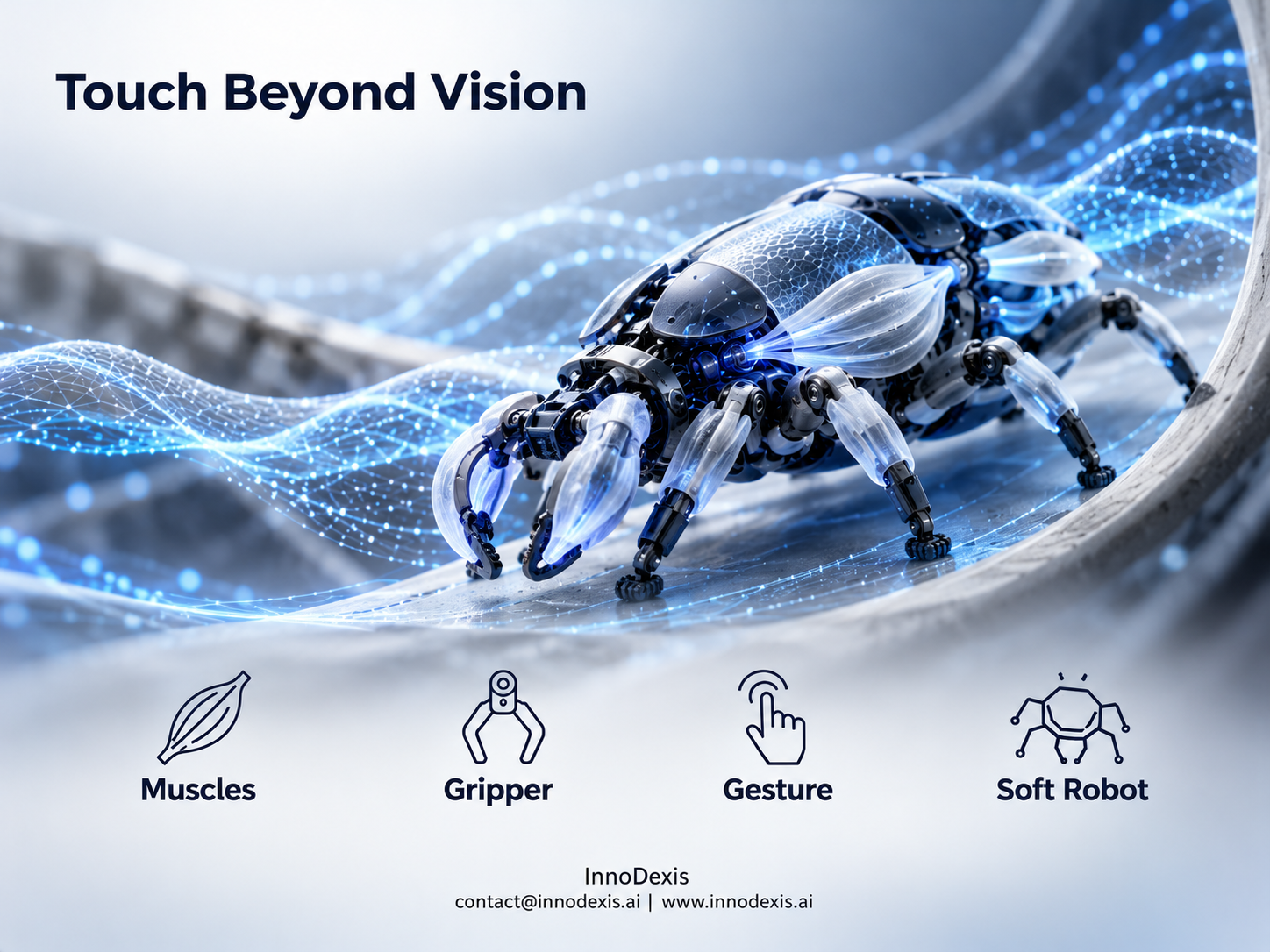
InnoDexis has published its latest Innovation Intelligence Report covering soft robotics and teleoperated inspection, analyzing a single innovation developed jointly by KAIST, Caltech, NTU, and Sungkyunkwan University. The report reveals that BeetleBot, a beetle-inspired soft robot, is the first integration of liquid crystal elastomer muscle actuation, multimodal sensing, and gesture control, delivering touch data to the operator while finger movements steer and grip the robot, and addressing a long-standing limitation in confined-space inspection. Soft robots have long struggled to combine movement, touch, and control in one small system, and this study targets that gap.
Key Findings
BeetleBot is the first integration of LCE muscle actuation, multimodal sensing, and gesture control in one soft robot. Soft robots have long struggled to combine movement, touch, and control in one small system, so this combination addresses the central design gap the study targets.
The robot uses 3D-printed liquid crystal elastomer muscles and a mandible-inspired gripper. This pairing links the actuation mechanism directly to a biologically inspired grasping structure, forming the physical basis for a gripper that can sense what it holds. The gripper is also where touch is sensed, so the grasping structure doubles as the sensing interface.
Four gesture commands drive both movement and gripping. A carbon-nanotube finger patch and a capacitive gripper sensor turn physical signals into control data, so finger movements flow to the robot while touch data flows back to the operator.
The untethered soft body carries an onboard camera and a sensing gripper. Confined-space inspection has relied on rigid cameras and tethered tools, so an untethered platform with built-in sensing departs from that established approach.
The operator gains a touch channel that vision-only tools never provided. Tactile sensing built into a soft body addresses a limitation that rigid robotics struggles with, adding a second sensory modality to remote inspection. Integrated sensing and actuation, rather than vision alone, is the basis on which the dataset says hazardous-space inspection could be reshaped.
Strategic Insight and Trend Analysis
The dominant trend in this dataset is the move from rigid, vision-only inspection tools toward soft, gesture-controlled robots with built-in sensing. BeetleBot does not improve a single component; it combines actuation, sensing, and control into one closed loop in which touch data reaches the operator and finger movements return to the robot.
This closed loop is the structural point. Inspection of confined and hazardous spaces has relied on rigid cameras and tethered tools that deliver sight but no touch. By giving the operator a touch channel through a capacitive gripper sensor and a carbon-nanotube finger patch, the system changes what a remote operator can know about an object being handled.
At an industry level, the significance is that sensing is built into the soft body itself rather than added to a rigid tool. This reframes the design target for inspection robots from seeing a confined space to feeling it as well, a capability vision-only tools did not offer.
The dataset also indicates that the significance extends beyond the robot itself. The architecture, not just the robot, may become a micro-robotics template, meaning the integration of LCE muscle actuation, multimodal sensing, and gesture control could be reused in other small soft systems rather than remaining a one-off demonstration.
Integrated sensing and actuation could reshape hazardous-space inspection, and the question the dataset leaves open is which hazardous-space tasks could shift to remote teleoperation first.
Global and Industry Implications
For corporates and R&D teams working in inspection and robotics, the dataset points to a shift from rigid, vision-only tools toward soft robots with built-in touch sensing. Teams evaluating confined-space inspection may need to assess gesture-controlled, untethered platforms alongside rigid cameras and tethered tools. The onboard camera combined with touch data means inspection output is no longer limited to images.
For investors and capital allocators, the first integration of LCE muscle actuation, multimodal sensing, and gesture control marks an early platform signal in soft robotics. Because the architecture may become a micro-robotics template, value may accrue to the integration approach as well as to any single robot. The dataset describes the work as a first integration, so it is best read as an early signal rather than a validated market.
For policymakers and national innovation bodies, the collaboration among KAIST, Caltech, NTU, and Sungkyunkwan University illustrates multi-institution research on teleoperated inspection, an area where hazardous-space tasks could shift to remote operation. Remote teleoperation with a touch channel is relevant wherever hazardous-space inspection is currently performed with rigid, tethered tools.
InnoDexis Statement
“BeetleBot’s closed loop, with touch data flowing to the operator and finger movements flowing back to the robot, signals a structural shift in soft robotics from vision-only inspection tools toward integrated sensing, actuation, and control,” noted InnoDexis in its latest intelligence report.
Conclusion
The next signals to watch are whether the architecture behind BeetleBot is adopted as a micro-robotics template and which hazardous-space tasks move to remote teleoperation first. If an operator can control grip by gesture and feel what the robot touches, the touch channel becomes the capability to track in soft robotic inspection tools. Integrated sensing and actuation is the development to monitor as hazardous-space inspection evolves. InnoDexis will continue to follow developments in soft robotics, bio-inspired engineering, and teleoperation. The complete Soft Robotics and Teleoperation Innovation Intelligence Report is available to InnoDexis subscribers and enterprise clients.
About InnoDexis
InnoDexis is a real-time innovation intelligence platform connecting scientific discovery to commercial opportunity. Powered by InnoGraph, its proprietary innovation knowledge graph, the platform maps technologies across the entire lifecycle, from early-stage research (TRL 1) to market deployment (TRL 9), connecting researchers, institutions, startups, companies, products and emerging opportunities.
Covering 40+ specialised industry segments and 360 technology areas, InnoDexis delivers innovation tracking, research discovery, product and startup intelligence, investment insights, and AI-powered reports. Its mission is to bridge the gap between scientific discovery and real-world impact.
InnoDexis — From Lab to Market: Real-Time Innovation Intelligence.