Battery-Free Smart Glasses Classify Facial Activity at 93.8% Accuracy on 4.1 Microwatts as Northwestern’s GlassTENG Turns Eyewear Into a Health Sensor
Northwestern University engineers have developed GlassTENG, smart glasses with paper-thin triboelectric nanogenerators that convert facial movements and pulses into electrical signals, enabling continuous health sensing without a battery.
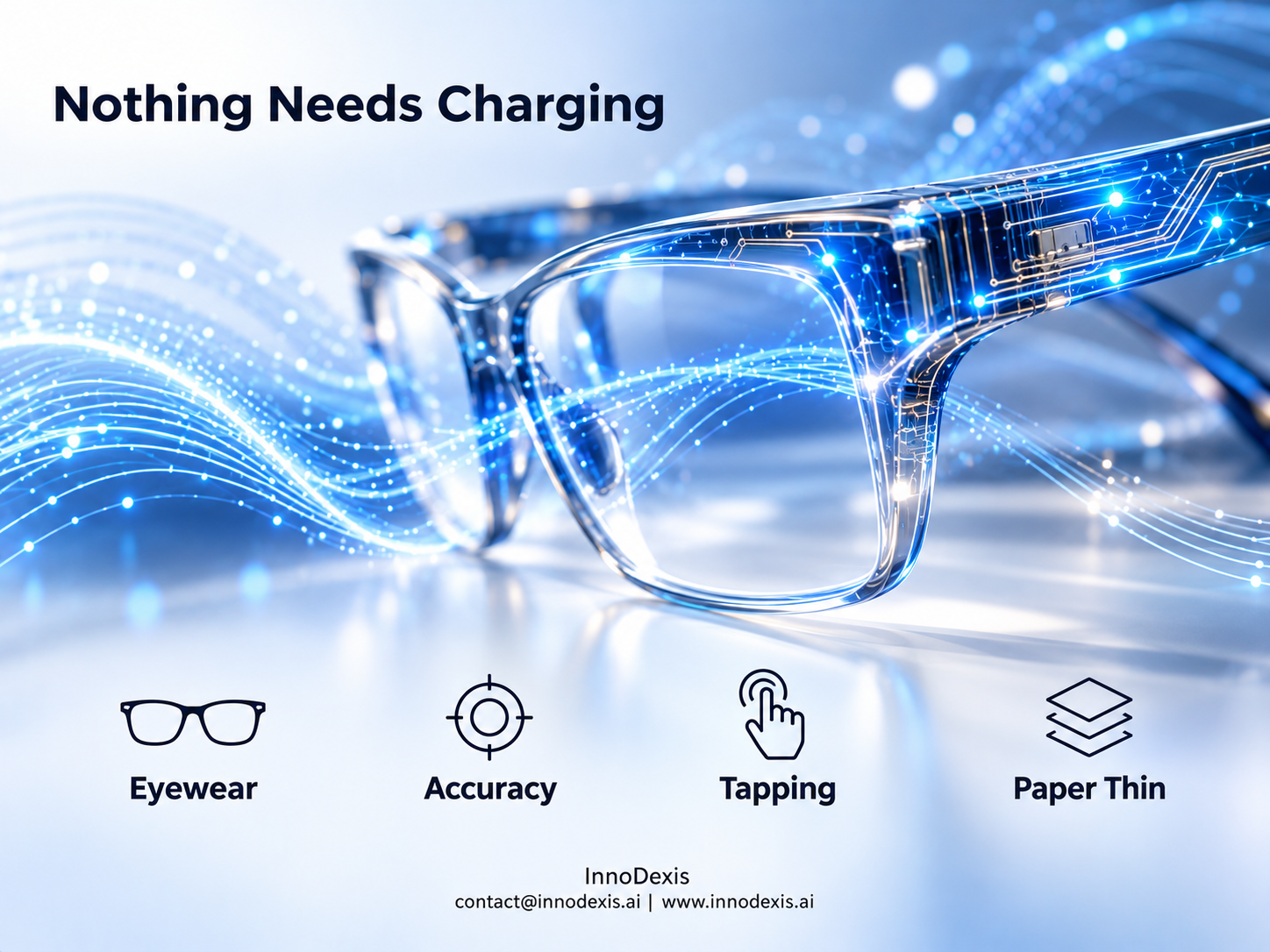
InnoDexis has published its latest Innovation Intelligence Report covering battery-free wearable health sensing, analyzing a single innovation developed by Northwestern University engineers led by Nivedita Arora. The report reveals that GlassTENG, smart glasses fitted with paper-thin triboelectric nanogenerators, converts facial movements and pulses into electrical signals, classifying facial activity with 93.8% overall accuracy while consuming 4.1 microwatts across three sensors. Because the movement itself generates the current that detects it, the design requires no battery, positioning eyewear, worn by half the global population, as a passive and continuous health sensor.
Key Findings
GlassTENG achieved 93.8% overall facial activity classification accuracy. This shows that the electrical signals generated by facial movements can be classified with high accuracy by sensors embedded in a glasses frame, which is the core technical requirement for using eyewear as a health sensor.
Total power consumption was 4.1 microwatts across three sensors. This low draw is central to the design, because the movement itself generates the current that detects it. The figure covers all three sensors combined, and the result is a sensing system that needs no battery and no charging routine.
Teeth tapping was detected with 99% accuracy. This shows that a specific, small facial movement can be identified with near-complete reliability from the eyewear, and it is the highest accuracy among the activities reported, ahead of the 96% for jaw clenching and the 93.8% overall figure.
Jaw clenching was detected with 96% accuracy. Together with teeth tapping, this indicates that the platform separates individual facial activities rather than registering movement in general, which is what makes the output usable as health data.
The sensors are paper-thin triboelectric nanogenerators that convert facial movements and pulses into electrical signals. Sensing therefore becomes a property of the frame rather than a task for the wearer, addressing the behaviour change that continuous monitoring otherwise requires.
Strategic Insight and Trend Analysis
The dominant trend in this dataset is the relocation of health sensing from a device the wearer must manage to an object the wearer already uses. Wrist-worn trackers need regular charging and daily compliance, and many users eventually abandon them. GlassTENG removes the charging requirement because the movement being measured is also the energy source. Sensing becomes a property of the frame, not a task for the wearer, so it continues without any action from the user.
This reframes where the barrier to continuous monitoring sits. The dataset states that the barrier has never been the sensor itself but the behaviour change required of the user. A battery-free sensor embedded in eyewear addresses that barrier directly: passive, continuous health monitoring becomes practical when nothing needs charging. This is the structural shift the data points to.
The scale of the opportunity is framed by the dataset’s starting observation that half the global population wears glasses, yet never as a continuous health sensor. The reported figures, 93.8% overall accuracy, 99% for teeth tapping and 96% for jaw clenching, at a combined 4.1 microwatts, indicate that classification performance and ultra-low power consumption can coexist in one design.
The wider implication is a question the dataset itself poses: if a blink can generate a detectable, classifiable signal, other involuntary movements could become usable health data. The shift is from battery-dependent, wrist-worn tracking toward battery-free sensing embedded in eyewear, with the frame, not the wearer, carrying the sensing burden.
Global and Industry Implications
For corporates and R&D teams in wearables and digital health, the findings point to battery-free sensing embedded in eyewear as an alternative to charge-dependent wrist-worn devices. A design in which sensing is a property of the frame removes the compliance burden that leads many users to abandon trackers, a constraint the dataset describes as the real barrier to continuous monitoring. Evaluation of eyewear-based sensing alongside wrist-worn products is a logical next step.
For investors and capital allocators, the dataset identifies the barrier to continuous monitoring as user behaviour rather than sensor capability. Technologies that remove that behavioural requirement, such as energy-harvesting sensors that need no charging, address the constraint directly, and eyewear reaches a population the dataset puts at half of all people.
For policymakers and national innovation bodies, the work illustrates bioelectronics and energy-harvesting research aimed at passive, continuous health monitoring. Support for such research targets the adherence problem that limits conventional wearable tracking, where regular charging and daily compliance lead many users to stop wearing their devices.
InnoDexis Statement
“GlassTENG shifts health sensing from a task the wearer performs to a property of the frame, showing that a battery-free sensor can classify facial activity at 93.8% accuracy on just 4.1 microwatts,” noted InnoDexis in its latest intelligence report.
Conclusion
The next question for battery-free wearable sensing is whether the approach extends beyond the facial activities reported here. The dataset itself asks which other involuntary movements could become usable health data if a blink can generate a detectable, classifiable signal. A development to watch is whether passive eyewear sensing can replace charge-dependent wrist-worn tracking in practice. InnoDexis will continue to track battery-free wearable sensing, bioelectronics and energy harvesting, and is the platform to follow for continued intelligence on this domain. The complete Battery-Free Wearable Sensing Innovation Intelligence Report is available to InnoDexis subscribers and enterprise clients.
About InnoDexis
InnoDexis is a real-time innovation intelligence platform connecting scientific discovery to commercial opportunity. Powered by InnoGraph, its proprietary innovation knowledge graph, the platform maps technologies across the entire lifecycle, from early-stage research (TRL 1) to market deployment (TRL 9), connecting researchers, institutions, startups, companies, products and emerging opportunities.
Covering 40+ specialised industry segments and 360 technology areas, InnoDexis delivers innovation tracking, research discovery, product and startup intelligence, investment insights, and AI-powered reports. Its mission is to bridge the gap between scientific discovery and real-world impact.
InnoDexis — From Lab to Market: Real-Time Innovation Intelligence.