Battery-Free Sensing Advances as Body Heat Powers Continuous EEG Monitoring in Real-World Conditions
A wireless EEG system demonstrated at Expo 2025 Osaka shows stable, self-powered operation using body–air temperature differences, indicating progress toward persistent, battery-independent sensing.
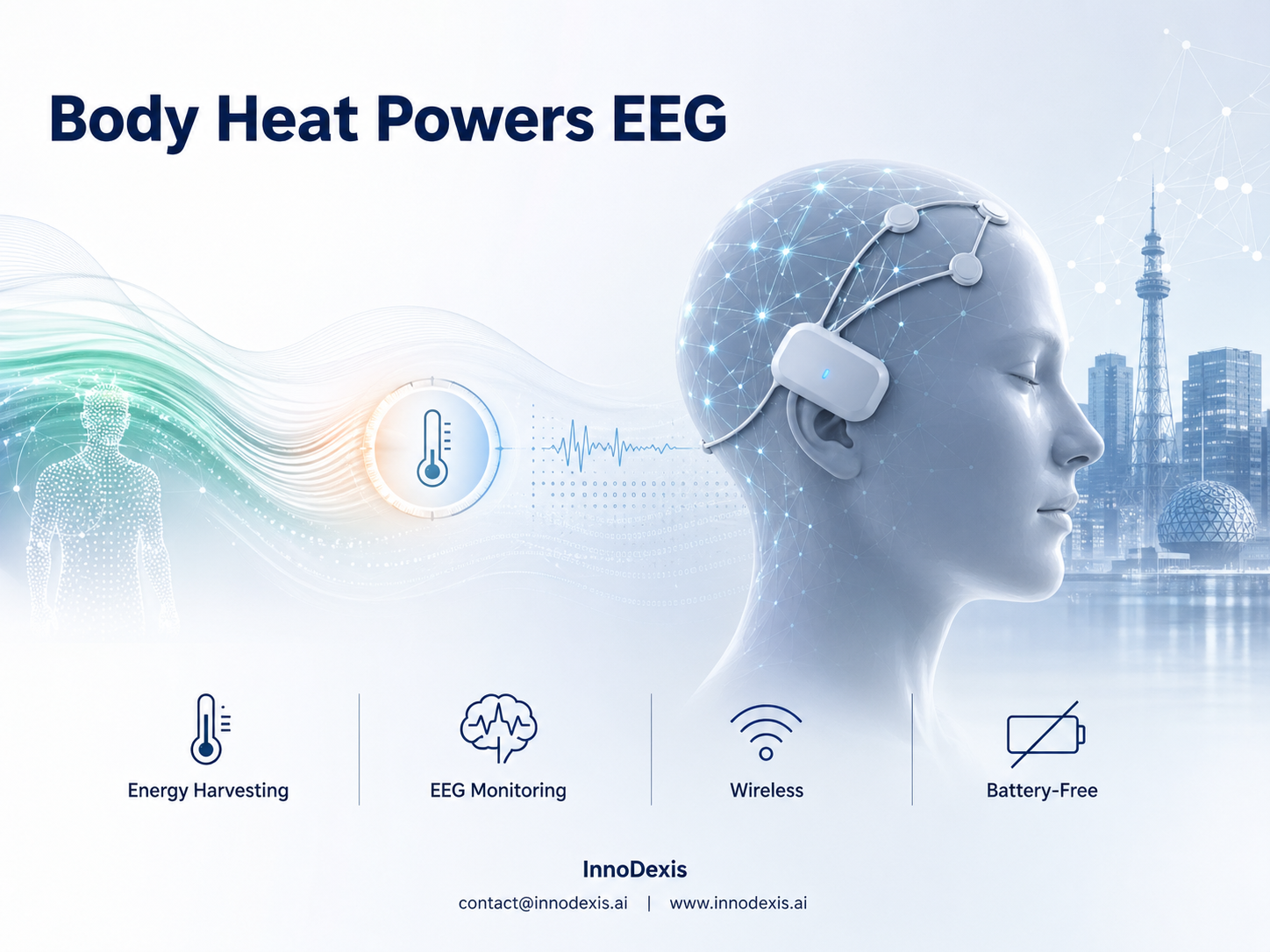
InnoDexis has published its latest Innovation Intelligence Report covering energy-harvesting sensor systems, analyzing a wireless EEG innovation developed at Osaka University and demonstrated at Expo 2025 Osaka. The report reveals that the system operates entirely without batteries or external charging, using temperature differences between the human body and surrounding air to generate power. Demonstrated under real-world outdoor conditions exceeding 32°C, the findings indicate the feasibility of continuous, battery-free physiological monitoring.
Key Findings
A wireless EEG system powered solely by body–air temperature gradients was successfully demonstrated at Expo 2025 Osaka. The system converts thermal differences between the human body and ambient air into usable electrical energy, enabling continuous operation without reliance on batteries or external charging infrastructure.
The energy harvesting mechanism represents a shift in power sourcing for wearable and sensing technologies. By leveraging naturally occurring temperature gradients, the system eliminates the need for stored energy, addressing one of the primary constraints in long-term sensor deployment.
Data transmission efficiency is enhanced through compressed sensing techniques. By reducing the volume of transmitted data, the system lowers energy demand while maintaining functional performance, allowing stable wireless communication within constrained power conditions.
Real-world validation under outdoor conditions exceeding 32°C demonstrates operational stability beyond controlled laboratory environments. This indicates that the system can maintain performance even when environmental temperature differences are reduced, a key limitation in thermoelectric energy harvesting.
The system enables continuous, battery-free EEG monitoring. The absence of batteries removes the need for maintenance cycles, replacement logistics, and associated material waste, supporting long-duration deployment scenarios in both clinical and non-clinical environments.
Strategic Insight and Trend Analysis
The demonstration at Expo 2025 Osaka reflects a broader transition in sensor technology from energy-dependent devices to self-sustaining systems. By eliminating the requirement for batteries, the innovation addresses a structural limitation that has historically constrained the scalability of distributed sensing networks.
The combination of thermoelectric energy harvesting and compressed data transmission suggests a convergence between power generation and data efficiency. Rather than optimizing sensors solely for performance, current developments are aligning system architecture around energy autonomy, where power availability defines operational design.
This shift has implications beyond wearable devices. Continuous, battery-free operation enables sensors to function without human intervention, supporting persistent monitoring across extended timeframes. As a result, sensing technologies can move from discrete usage scenarios to embedded infrastructure layers within healthcare systems, urban environments, and industrial settings.
The ability to operate in high-temperature outdoor conditions further expands the applicability of such systems. Traditional thermoelectric approaches are often limited by reduced temperature gradients in warm environments; demonstrating stability above 32°C suggests that deployment is feasible across a broader range of geographic and climatic contexts.
Collectively, the findings indicate that innovation in sensing is increasingly defined by autonomy. Systems that can generate their own power and manage data efficiently may redefine how and where sensors are deployed, shifting the focus from device-level functionality to network-level persistence.
Global and Industry Implications
For corporates and R&D teams, the emergence of battery-free sensing systems highlights opportunities to redesign products and platforms around energy autonomy. Integrating energy harvesting and low-power data architectures may enable new classes of continuously operating devices across healthcare, infrastructure, and industrial monitoring.
For investors and capital allocators, the development signals a potential shift toward technologies that reduce operational costs and maintenance dependencies. Battery-free systems may offer scalable deployment models, particularly in applications requiring long-term, distributed sensing.
For policymakers and national innovation bodies, the reduction of battery reliance has implications for sustainability and electronic waste management. Supporting research and deployment of energy-harvesting technologies may align with environmental and infrastructure modernization objectives.
InnoDexis Statement
The transition toward battery-free sensing systems indicates that future sensor networks will be defined by energy autonomy, enabling continuous operation and reducing reliance on maintenance-driven infrastructure,” noted InnoDexis in its latest intelligence report.
Conclusion
The wireless EEG system demonstrated at Expo 2025 Osaka illustrates the feasibility of self-powered, continuous sensing under real-world conditions. By combining thermoelectric energy harvesting with efficient data transmission, the innovation points toward a broader shift in how sensors are designed and deployed. As energy autonomy becomes a defining characteristic of next-generation sensing systems, its implications for healthcare monitoring, urban infrastructure, and environmental sustainability will continue to expand. The complete Energy-Harvesting Sensor Intelligence Report is available to InnoDexis subscribers and enterprise clients.
About InnoDexis
InnoDexis is a global Innovation Intelligence platform that tracks, analyzes, and interprets breakthrough innovations, prototypes, and emerging technologies across industries and countries. Its intelligence helps corporates, investors, and policymakers understand the true structure and direction of global innovation. Learn more at innodexis.ai.