Battery Chemistry Enables Targeted Neuromodulation as Bioelectronic Patch Controls Nerve Activity
A lithium-ion-based bioelectronic patch demonstrates localized, on-demand ion delivery as an alternative to systemic drug therapies.
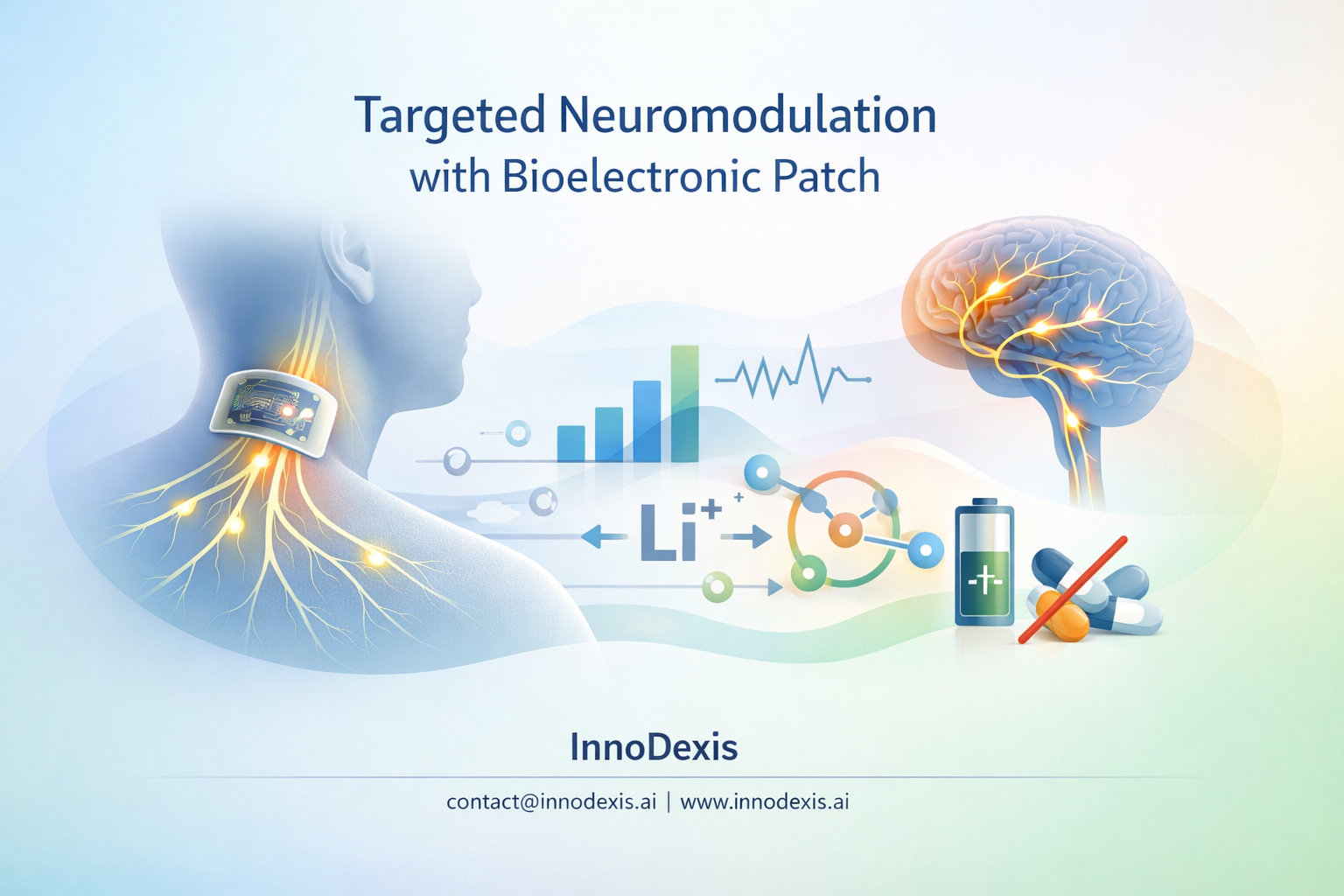
InnoDexis has published its latest Innovation Intelligence Report covering bioelectronic medicine and material-driven therapeutics, analyzing emerging approaches that integrate battery chemistry with neuromodulation technologies. The report reveals that researchers at the University of Chicago have developed a flexible bioelectronic patch using lithium-ion battery materials to directly control nerve activity. By delivering lithium ions locally and on demand through electrical signals, the system demonstrates a method of modulating neural function without systemic drug exposure, highlighting a potential shift toward precision, material-based therapeutic delivery systems.
Key Findings
Researchers at the University of Chicago have developed a bioelectronic patch that utilizes lithium-ion battery chemistry to modulate nerve activity. The system is based on lithium iron phosphate, a material commonly used in battery cathodes, repurposed here for controlled ion delivery in a biological setting.
The patch is designed as a flexible device capable of interfacing directly with targeted nerves. Instead of administering a pharmaceutical compound systemically, the device releases lithium ions locally at the site of interest, enabling direct interaction with neural tissue.
Ion delivery is controlled through electrical signals, allowing the timing and dosage of lithium release to be precisely regulated. This on-demand mechanism enables dynamic modulation of nerve activity, in contrast to traditional drug delivery methods that rely on fixed dosing schedules.
Experimental validation in animal models demonstrated that the system can successfully reduce nerve activity. This indicates that localized lithium ion delivery can achieve functional neuromodulation effects without requiring systemic administration.
A key advantage of the approach is the avoidance of systemic toxicity associated with oral lithium treatments. By restricting lithium exposure to targeted areas, the method reduces the risk of adverse effects on organs such as the kidneys and liver, which are commonly associated with long-term lithium use.
Strategic Insight and Trend Analysis
The development of a lithium-ion-based bioelectronic patch reflects a broader shift in therapeutic design toward precision and localization. Traditional pharmacological approaches typically involve systemic drug delivery, where active compounds circulate throughout the body and interact with multiple biological systems. This often results in unintended side effects and limited control over spatial targeting.
The University of Chicago research introduces a different paradigm in which materials themselves function as therapeutic agents. By leveraging the ion transport properties of battery materials, the system enables localized modulation of biological processes at the level of individual nerves.
The use of electrical signals to control ion release further integrates principles from electronics and materials science into medical treatment. This convergence of disciplines is characteristic of bioelectronic medicine, where devices are designed to interact directly with physiological systems using electrical and chemical signals.
The transition from systemic pharmacology to localized, on-demand ion delivery represents a structural change in how therapies may be administered. Rather than delivering drugs that act broadly across the body, future treatments may focus on precise intervention at specific biological sites, with the ability to adjust or reverse effects in real time.
This approach also suggests that materials traditionally associated with energy storage could have broader applications in healthcare. The ability to repurpose battery chemistry for therapeutic use indicates a potential expansion of material science into clinical domains beyond its conventional boundaries.
Global and Industry Implications
For corporates and R&D teams in healthcare and medical devices, the findings indicate new opportunities at the intersection of materials science and therapeutics. Bioelectronic systems that enable localized treatment may complement or replace certain drug-based approaches, particularly in neuromodulation applications.
For investors and capital allocators, the emergence of material-based therapies represents a potential expansion of the bioelectronics and medtech landscape. Technologies that combine device engineering with therapeutic functionality may create new categories within precision medicine.
For policymakers and national innovation bodies, the development of such systems highlights the importance of interdisciplinary research frameworks that integrate materials science, electronics, and biomedical engineering. Regulatory pathways may also need to evolve to address hybrid technologies that do not fit traditional drug or device classifications.
InnoDexis Statement
“The integration of battery materials into bioelectronic systems demonstrates how ion transport mechanisms can be repurposed for localized therapeutic intervention, signaling a shift toward material-driven precision medicine,” noted InnoDexis in its latest intelligence report.
Conclusion
The development of a lithium-ion-based bioelectronic patch capable of modulating nerve activity introduces a new perspective on how therapies can be delivered. By enabling localized, on-demand ion release, the system moves beyond traditional pharmacology toward precision intervention at the site of action. As research continues to explore the intersection of materials science and medicine, such approaches may contribute to the evolution of targeted, reversible, and more controlled treatment strategies. The complete Bioelectronic Medicine Innovation Intelligence Report is available to InnoDexis subscribers and enterprise clients.
About InnoDexis
InnoDexis is a global Innovation Intelligence platform that tracks, analyzes, and interprets breakthrough innovations, prototypes, and emerging technologies across industries and countries. Its intelligence helps corporates, investors, and policymakers understand the true structure and direction of global innovation. Learn more at innodexis.ai.