Bacterial Blight-Resistant African Rice From HHU and IRD Pyramids 4 Resistance Genes in 3 Elite Varieties Without Genome Editing
Heinrich Heine University Düsseldorf and IRD used marker-assisted breeding to combine four resistance genes in NERICA-4, FARO-44 and KombokaP, preparing broad-spectrum bacterial blight resistance for East African field trials.
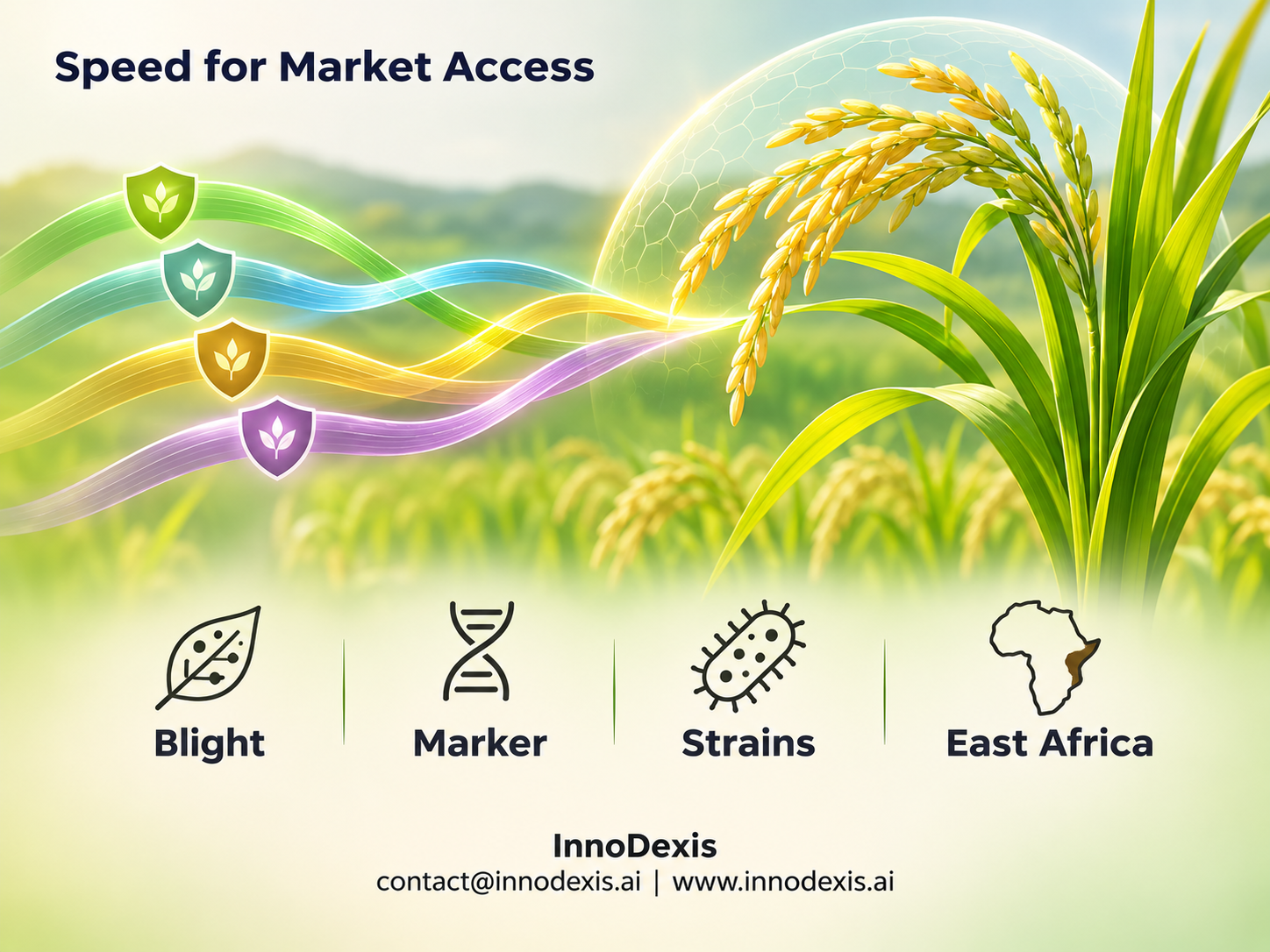
InnoDexis has published its latest Innovation Intelligence Report covering disease-resistant rice breeding, analyzing one innovation from Germany, in collaboration with French researchers, published on 30 October 2026. The report reveals that Heinrich Heine University Düsseldorf and the French National Research Institute for Sustainable Development used marker-assisted breeding to combine four resistance genes in three elite African rice varieties, delivering broad-spectrum resistance to bacterial leaf blight without genome editing and preparing the lines for field trials in East Africa, where genome-editing approval frameworks are not yet available.
Key Findings
Four resistance genes were pyramided into three elite African rice varieties: NERICA-4, FARO-44 and KombokaP. The work used marker-assisted breeding to target bacterial leaf blight, caused by Xanthomonas oryzae pv. oryzae (Xoo), and it provides a framework for conferring polygenic disease resistance on local crop varieties.
The resulting lines show broad-spectrum resistance to Xoo strains from Tanzania, Madagascar, selected Asian origins and West Africa. Combining several genes gives multi-strain protection compared with single-gene resistance and lowers the technical risk of rapid pathogen breakdown. The strain collection assembled by the French institute from the start of the outbreak to the present underpins this testing.
No genome editing was used. East African genome-editing approval frameworks are not yet available, so marker-assisted breeding serves as a regulatory-compliant alternative that allows immediate field integration and bypasses the regulatory delays linked to editing. The approach is non-genome-edited, multi-gene resistance pyramiding.
The lines are ready for field trials, and commercial readiness is rated medium. Field trials, national registration and distribution to local farmers are expected to take 1 to 3 years, and regional breeders can cross the lines naturally with local rice varieties.
The trade-off is speed. Wolf B. Frommer notes that marker-assisted breeding is very time-consuming, while genome editing can respond to regional needs far faster. The team chose the slower route so that the lines can reach farmers quickly under current regulation.
Strategic Insight and Trend Analysis
The dominant trend in this research is regulation shaping which breeding technology reaches farmers first. Genome editing offers a faster development cycle, but its regulatory restrictions in East Africa limit immediate deployment. By choosing marker-assisted breeding, the team trades development speed for immediate market access in jurisdictions where frameworks for gene-edited organisms are strict or absent.
The significance is food security. Demand is rising for climate- and pathogen-resilient food crops in sub-Saharan Africa, and invasive Asian Xoo strains threaten staple rice. Pyramiding four genes into widely used African varieties aims to defeat those strains and protect crop yield without deploying genetically modified plants, which makes the approach a template that could be adapted to other staple crops facing bacterial leaf diseases.
The evidence also has clear limits. Pathogen mutation could eventually break down pyramided resistance over prolonged use, and adoption may be slow or delayed by variety registration. Regulation differs across East African countries, long-term field trials and seed multiplication need funding, and farmers can only benefit if localized seed multiplication and breeding distribution networks exist.
The next phase is therefore less about laboratory proof than delivery: registering the lines as formal plant varieties, cross-breeding them with additional local varieties, and testing field performance under variable East African conditions. Harmonized African Union policy standards for novel breeding technologies are the main opportunity beyond the lines themselves.
Global and Industry Implications
For corporates and R&D teams, the work points to commercial licensing or open dissemination of resilient seed stocks to regional African agricultural suppliers. Seed production is the identified industry, and the pyramiding approach may be adapted to other staple crops facing bacterial leaf diseases. Localized seed multiplication and distribution networks are the capability these organizations will need. Eliza Loo notes that the study gives East African rice breeders robust resistance to bacterial blight in three local varieties for field trials.
For investors and capital allocators, insufficient funding for long-term field trials and seed multiplication is the named financial risk, and the expected 1 to 3 year path to registration and distribution defines the horizon. Adoption speed among local farmers and delays in variety registration are the market risks to weigh.
For policymakers and national innovation bodies, the lines require national plant variety registration in target East African countries before commercial dissemination. Regulatory fragmentation across nations is a risk, and harmonization of genome-editing policies across the African Union is a stated opportunity. Partnerships with local agricultural extension services and regional breeders will determine how quickly resistant seed reaches farmers.
InnoDexis Statement
“Regulation is shaping which breeding technology reaches farmers first: pyramiding four resistance genes by marker-assisted breeding offers East African rice growers durable protection, while policy harmonization will determine how quickly faster methods follow,” noted InnoDexis in its latest intelligence report.
Conclusion
The next milestones to watch are field trials of the resistant lines in target East African locations, their registration as formal plant varieties, and cross-breeding with additional local varieties. Field performance under variable environmental conditions will show whether the pyramided resistance holds, and harmonization of genome-editing policies across the African Union will influence how quickly newer methods follow. InnoDexis will continue to track agricultural biotechnology, crop resilience and food security innovation as this field develops. The complete Disease-Resistant African Rice Innovation Intelligence Report is available to InnoDexis subscribers and enterprise clients.
About InnoDexis
InnoDexis is a real-time innovation intelligence platform connecting scientific discovery to commercial opportunity. Powered by InnoGraph, its proprietary innovation knowledge graph, the platform maps technologies across the entire lifecycle, from early-stage research (TRL 1) to market deployment (TRL 9), connecting researchers, institutions, startups, companies, products and emerging opportunities.
Covering 40+ specialised industry segments and 360 technology areas, InnoDexis delivers innovation tracking, research discovery, product and startup intelligence, investment insights, and AI-powered reports. Its mission is to bridge the gap between scientific discovery and real-world impact.
InnoDexis — From Lab to Market: Real-Time Innovation Intelligence.