Awake Deep Brain Stimulation Mapping Repositions 15% of 137 Leads in Mayo Clinic Essential Tremor Study, With 88% of Adjustments Missed by Imaging
Mayo Clinic researchers found that real-time neurophysiological recording and patient feedback during awake surgery changed final lead placement in 15% of 137 leads, and that 88% of those adjustments could not have been identified through imaging alone.
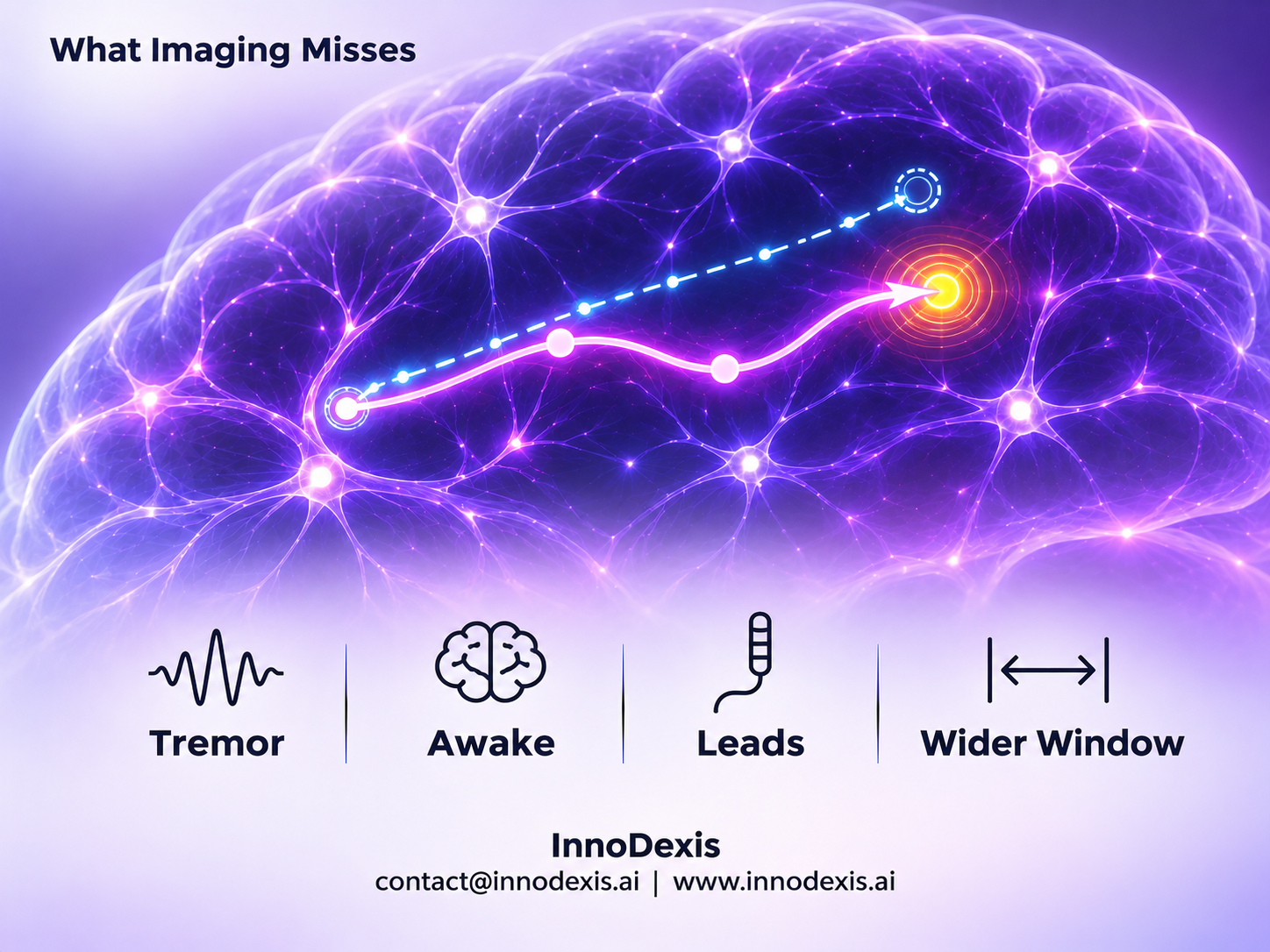
InnoDexis has published its latest Innovation Intelligence Report covering awake brain mapping for deep brain stimulation, analyzing one innovation from the United States, published on 10 November 2026. The report reveals that a Mayo Clinic retrospective study of 137 deep brain stimulation leads implanted during awake surgery for essential tremor found that intraoperative neurophysiological recordings and patient feedback meaningfully repositioned 15% of leads, and that 88% of those adjustments could not have been identified through preoperative imaging alone, with better tremor control, fewer side effects and wider therapeutic windows.
Key Findings
Intraoperative neurophysiological recordings and patient feedback altered final electrode positioning in 15% of the 137 leads evaluated. The result shows that awake testing changes the outcome for a measurable share of patients, which is what allows lead placement to be personalized to individual functional neuroanatomy.
Of those lead adjustments, 88% could not have been identified through preoperative imaging alone. The study quantifies the gap between imaging-planned targets and functional electrophysiological targets, and it provides empirical justification for awake protocols that aim to optimize individual therapeutic outcomes.
Awake surgery is linked to better tremor control, fewer side effects and wider therapeutic windows compared with asleep, imaging-guided procedures. A wider window gives greater flexibility during future programming and improves long-term treatment management, which makes the benefit practical as well as technical.
The method is an interactive process that combines real-time neurophysiological recording and stimulation testing with immediate patient feedback. Clinicians can adjust lead placement when the recordings or testing reveal suboptimal positioning, whereas asleep DBS relies exclusively on structural imaging.
The evidence has clear limits. The study is retrospective, awake procedures run longer than asleep DBS, and there are no preoperative markers to identify which patients need awake adjustments. Procedure duration and patient burden during awake surgery remain the main efficiency hurdles. These constraints define what the next generation of tools must solve.
Strategic Insight and Trend Analysis
The dominant trend in this research is the case for functional data alongside anatomical imaging in deep brain stimulation. The study challenges the trend toward exclusively asleep, imaging-based procedures by showing that real-time recording and patient feedback identify lead positions that imaging misses in 88% of the adjustments made. That figure defines the limit of imaging alone and moves the discussion from whether awake testing helps to how it can be delivered efficiently.
The significance is practical. Awake testing is already implemented in specialized clinical settings, and the technique is rated high for commercial readiness because it is used in clinical practice during surgical DBS procedures. Refined biomarker-driven workflows are still under active research and development, and the researchers state that the next step is to gather this information more efficiently, shortening the procedure while preserving the information that supports better decisions for each patient.
Two forces pull the other way. Clinical preference may shift toward asleep DBS because of patient comfort and surgical efficiency, and advances in high-resolution MRI could lead surgeons to rely solely on imaging despite the functional discrepancies the study documents. Patient exhaustion or discomfort during lengthy awake procedures, and variability in patient responses during intraoperative testing, add to the risk.
The strategic question is therefore whether automated neural biomarker measurement and faster intraoperative testing can close the efficiency gap before preference for asleep procedures hardens.
Global and Industry Implications
For corporates and R&D teams, the data points to a clear product need. Medical device developers should focus on rapid, automated intraoperative mapping and neural biomarker tracking systems that reduce awake DBS surgery duration while preserving functional mapping advantages. Integration of surgical software and intraoperative monitoring tools to streamline data collection is the stated technical requirement, along with multi-channel parallel recording and stimulation algorithms.
For investors and capital allocators, the evidence is a retrospective study of 137 leads, and no funding or partnership data is available. The stated opportunities are automation of neural biomarker measurement and expansion of awake testing protocols to other DBS indications such as Parkinson’s disease. The main threat is a clinical shift toward asleep DBS, while no regulatory approval requirement is apparent.
For policymakers and national innovation bodies, the study gives empirical support for awake DBS protocols as a route to more individualized treatment. The constraints are surgical duration, procedure complexity and patient burden, so support for research that shortens awake procedures without losing functional information addresses the main barrier to wider use.
InnoDexis Statement
“Functional recording during awake surgery exposes lead-placement decisions that anatomical imaging cannot make, so the strategic question for deep brain stimulation is how to capture that information without lengthening the procedure,” noted InnoDexis in its latest intelligence report.
Conclusion
The next milestones to watch are tools that evaluate multiple measures of brain activity simultaneously, integration of automated neural biomarker detection into DBS targeting, and testing of new patient tasks, stimulation approaches and targeting strategies to shorten procedure times. Whether preoperative markers can identify which patients need awake adjustments is the other open question, along with expansion beyond essential tremor. InnoDexis will continue to track neuromodulation, bioelectronics and surgical optimization as this field develops. The complete Awake Brain Mapping for Deep Brain Stimulation Innovation Intelligence Report is available to InnoDexis subscribers and enterprise clients.
About InnoDexis
InnoDexis is a real-time innovation intelligence platform connecting scientific discovery to commercial opportunity. Powered by InnoGraph, its proprietary innovation knowledge graph, the platform maps technologies across the entire lifecycle, from early-stage research (TRL 1) to market deployment (TRL 9), connecting researchers, institutions, startups, companies, products and emerging opportunities.
Covering 40+ specialised industry segments and 360 technology areas, InnoDexis delivers innovation tracking, research discovery, product and startup intelligence, investment insights, and AI-powered reports. Its mission is to bridge the gap between scientific discovery and real-world impact.
InnoDexis — From Lab to Market: Real-Time Innovation Intelligence.