Autonomous Underwater Vehicle Rated to 11,000 Meters Weighs 250 kg as WHOI and NASA JPL Announce Deep Venture Operational Readiness
WHOI and NASA's Jet Propulsion Laboratory announced operational readiness for Deep Venture, a modular 250-kilogram autonomous vehicle rated to 11,000 meters that has so far descended approximately 6,000 meters near Bermuda.
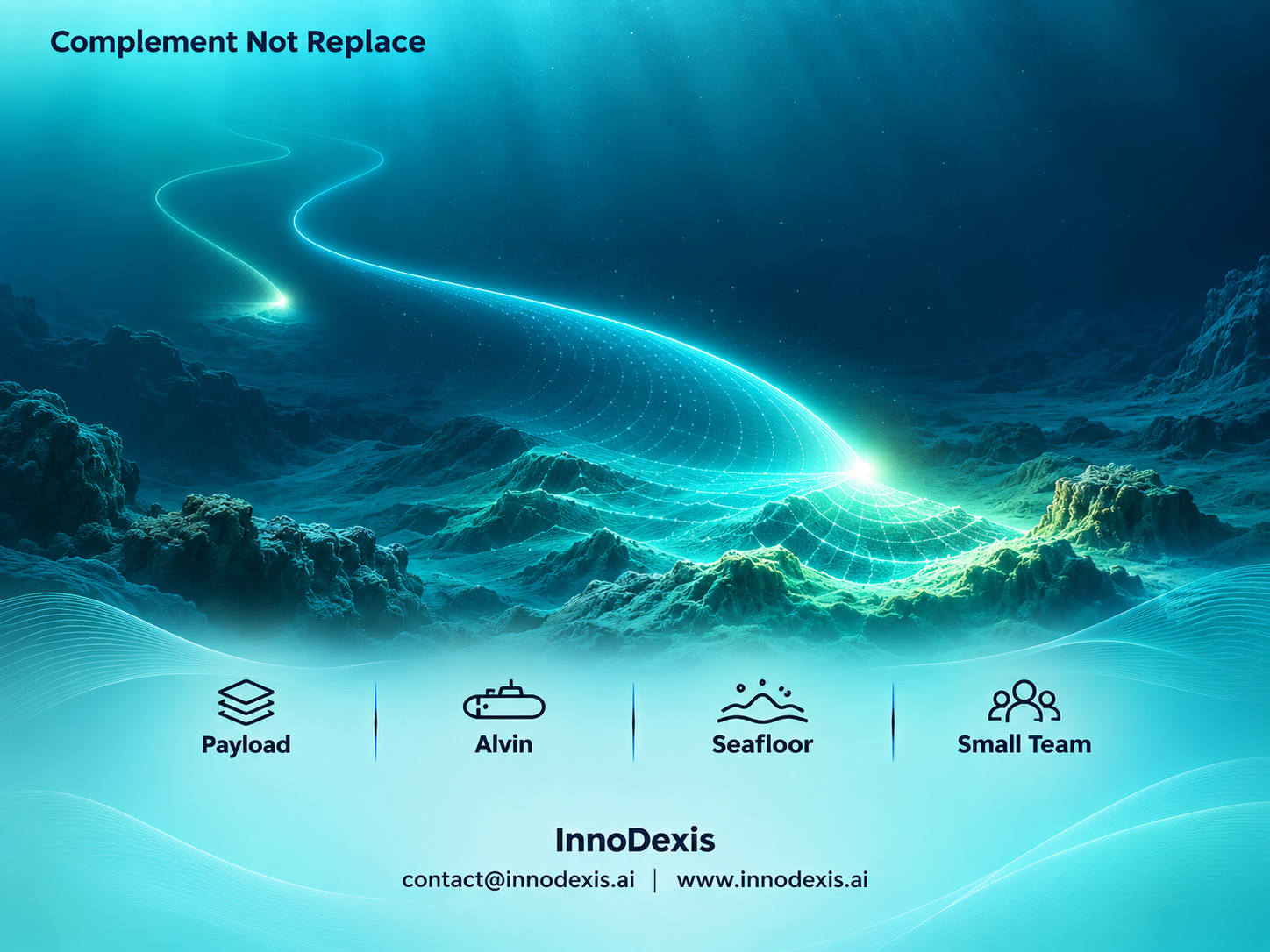
InnoDexis has published its latest Innovation Intelligence Report covering deep-sea autonomous robotics, analyzing one innovation from the United States, published on 20 November 2026. The report reveals that the Woods Hole Oceanographic Institution (WHOI) and NASA's Jet Propulsion Laboratory developed Deep Venture, a lightweight, modular autonomous underwater vehicle rated to the full ocean depth of 11,000 meters at a weight of 250 kilograms, and announced its operational readiness after a descent of approximately 6,000 meters near Bermuda in June 2026 as a companion to the human-occupied vehicle Alvin.
Key Findings
Deep Venture is rated to withstand pressure at full ocean depth, down to 11,000 meters (about 6.83 miles). Its deepest trial so far was a descent of approximately 6,000 meters near Bermuda in June 2026, after 13 autonomous dives as deep as 5,000 meters in the Gulf of Alaska in 2024, so the full rating has not yet been shown in the trials listed.
The vehicle weighs 250 kilograms and measures 72 inches long, 60 wide and 56 high. It can be deployed by a small team from a wide range of vessels without specialized support and operates untethered and autonomously after deployment, which reduces the deployment overhead normally tied to deep-sea work.
A modular science payload bay carries chemical and biological sensors, high-resolution imaging and equipment for seafloor landing and sample collection. Researchers can reconfigure the vehicle for different missions with minimal changes, and photogrammetry supports 3-D reconstruction of the seafloor.
Deep Venture is designed to complement human-occupied vehicles such as Alvin rather than replace them. It can survey an area in advance to inform dive planning, and it operated as a companion to Alvin during the June 2026 Bermuda expedition.
WHOI and NASA JPL announced operational readiness on 20 November 2026. Commercial readiness is rated medium to high, the platform is moving into internal scaling and wider scientific deployment, and WHOI plans to build additional units in the coming years.
Strategic Insight and Trend Analysis
The dominant trend in this research is a move from custom-built, single-mission deep-sea vehicles toward a compact, modular and reconfigurable platform. Existing deep-ocean exploration relies on tethered remotely operated vehicles or large, capital-intensive autonomous vehicles constrained by vessel compatibility. Deep Venture is presented as a flexible, lower-cost alternative, deployable by small teams from standard vessels and untethered once in the water.
The significance is that the platform changes how deep-sea surveys can be organised. Pre-dive mapping by an autonomous vehicle could replace or shorten expensive exploratory dives of human-occupied vehicles, and building multiple units would allow several vehicles to survey simultaneously with different payloads. This fits two stated market trends: growing demand for marine ecosystem data and monitoring of exclusive economic zone resources, and a shift toward multi-vehicle autonomous collaborative robotics in unstructured environments.
The limits are specific. Operating duration is shorter than for tethered power supplies, and pressure-resistant materials add manufacturing complexity and cost, which restricts production largely to institutional funding. Operational risks include vehicle or payload loss during untethered operation, communication loss and structural fatigue under repeated pressure cycling at hadal depths.
The same architecture is also named as a technology transfer route to planetary exploration, including missions to icy moons with subsurface oceans, which links marine institutes and space agencies around autonomous navigation in harsh environments. Anna Michel of the National Deep Submergence Laboratory notes that the deep ocean remains one of the least explored places in the global ocean.
Global and Industry Implications
For corporates and R&D teams, the record points to commercial offshore survey and seabed surveying, and to space agencies seeking autonomous robotics for extreme environments, as direct application areas. Lower deployment overhead, with small teams and standard vessels, is the stated advantage for these users. Producing small fleets without custom redesigns will require specialized pressure-tolerant housing materials and modular sensor integration processes.
For investors and capital allocators, the record describes modular deep-ocean robotics as an alternative to rigid single-mission vehicles. The evidence shown is institutional: no commercial funding is listed, and further units depend on government grants and research institute budgets. High manufacturing costs for deep-ocean materials and budget constraints in marine research funding are named as the main financial risks.
For policymakers and national innovation bodies, a foundation of knowledge about the deep ocean supports decisions on exploration, resource use and environmental stewardship. Evolving international maritime regulations on autonomous vehicle navigation in international waters are a regulatory risk, although no regulatory approval is apparent for standard oceanographic research.
InnoDexis Statement
"Deep Venture moves full-ocean-depth exploration from vessel-dependent, single-mission vehicles toward a compact modular platform, and the next test is proving the 11,000-meter rating at depth while additional units are funded and built," noted InnoDexis in its latest intelligence report.
Conclusion
The next milestones to watch are dives approaching the 11,000-meter rating, construction of additional Deep Venture units at WHOI, and simultaneous multi-vehicle surveys with different scientific payloads. Optimising long-duration autonomous navigation without communication at depth, and the transfer of the architecture to planetary exploration, will show how far the platform extends beyond oceanography. InnoDexis will continue to track autonomous underwater robotics, modular sensing payloads and extreme-environment robotics as this field develops. The complete Autonomous Deep-Ocean Robotics Innovation Intelligence Report is available to InnoDexis subscribers and enterprise clients.
About InnoDexis
InnoDexis is a real-time innovation intelligence platform connecting scientific discovery to commercial opportunity. Powered by InnoGraph, its proprietary innovation knowledge graph, the platform maps technologies across the entire lifecycle, from early-stage research (TRL 1) to market deployment (TRL 9), connecting researchers, institutions, startups, companies, products and emerging opportunities.
Covering 40+ specialised industry segments and 360 technology areas, InnoDexis delivers innovation tracking, research discovery, product and startup intelligence, investment insights, and AI-powered reports. Its mission is to bridge the gap between scientific discovery and real-world impact.
InnoDexis — From Lab to Market: Real-Time Innovation Intelligence.