Autonomous Laboratory Operations Advance as Robotic Systems Enable 24/7 Testing Workflows
Integration of industrial robotics into laboratory systems signals a shift from human-paced experimentation to continuous, machine-driven research environments.
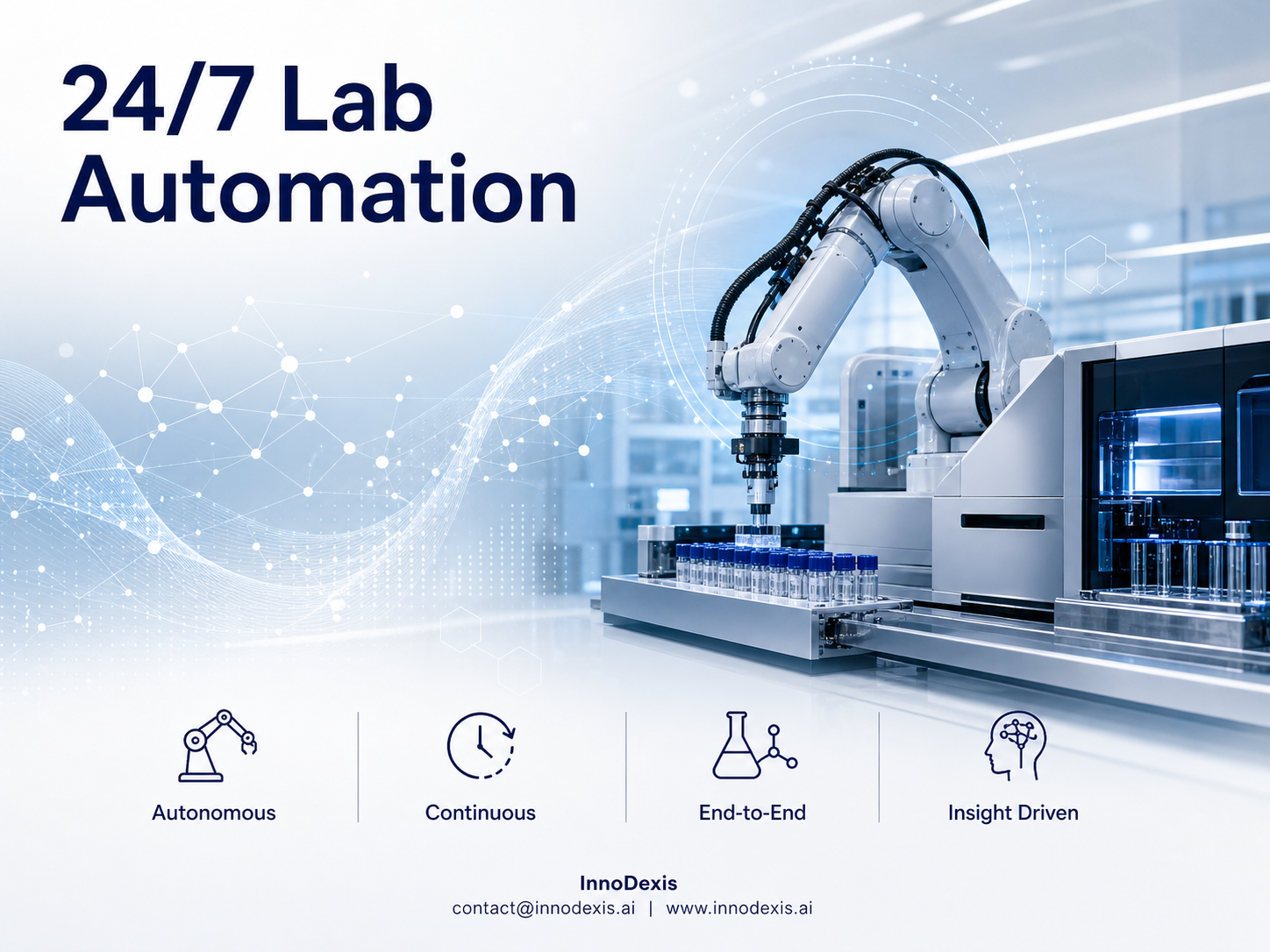
InnoDexis has published its latest Innovation Intelligence Report covering laboratory automation and robotics, analyzing emerging deployments of autonomous systems in scientific workflows. The report reveals that integration of robotic platforms such as KR AGILUS into analytical instruments is enabling continuous, 24/7 laboratory operations. With end-to-end automation spanning sample handling, testing, and reporting, the findings indicate a structural shift in how laboratories are designed, operated, and scaled.
Key Findings
Robotic integration within laboratory instrumentation is enabling continuous operational models. The deployment of KR AGILUS within testing systems developed by Anton Paar demonstrates how robotics can be embedded directly into analytical workflows rather than functioning as standalone automation units.
Automated laboratory systems are achieving sustained throughput levels. Documented implementations indicate continuous 24/7 operation with approximately 60 samples processed daily, reflecting a transition from batch-based experimentation toward uninterrupted processing cycles.
Manual intervention across laboratory workflows is being reduced. Up to 14 individual process steps—including sample handling, preparation, and post-analysis tasks—are being eliminated through integrated robotic execution, reducing variability associated with human-dependent procedures.
End-to-end workflow automation is becoming operationally viable. Systems now encompass the full experimental sequence, including handling, testing, cleaning, sorting, and reporting. This level of integration indicates a movement toward fully autonomous laboratory environments rather than partial automation.
Laboratory roles are evolving alongside system capabilities. With robotic systems managing execution, the role of scientists is shifting away from operational tasks toward analytical interpretation and decision-making, reflecting a redefinition of human involvement in experimental processes.
Strategic Insight and Trend Analysis
The integration of robotics into laboratory systems represents a transition from discrete automation to system-level redesign. Rather than incrementally improving individual steps, current implementations indicate that entire laboratory workflows are being restructured around continuous, machine-driven operation. This reflects a broader trend toward autonomous research environments in which experimentation is no longer constrained by human working hours or manual throughput limitations.
The shift toward continuous operation introduces new performance benchmarks for laboratories. Metrics such as throughput, consistency, and reproducibility become central to evaluating experimental systems, as automated processes reduce variability associated with manual handling. This standardization of experimentation suggests that data quality may become a primary differentiator in research and industrial settings.
The reduction of manual process steps also indicates a transition toward reproducible experimental pipelines. By embedding robotics within analytical instruments, laboratories are moving closer to fully controlled environments where each stage of experimentation is executed with minimal deviation. This may enable more reliable scaling of experiments across locations and use cases.
At a structural level, the role of human expertise is being repositioned. Scientists are increasingly focused on interpreting results, designing experiments, and making strategic decisions, while execution is delegated to automated systems. This separation of execution and analysis reflects a broader evolution in how scientific work is organized.
Global and Industry Implications
For corporates and R&D teams, autonomous laboratory systems indicate an opportunity to increase throughput and standardize experimental processes without proportional increases in workforce size. Integration of robotics may become a key factor in scaling research and development operations.
For investors and capital allocators, the emergence of embedded robotic laboratory systems highlights a shift toward infrastructure-driven innovation in scientific workflows. Opportunities may arise in companies developing integrated automation platforms that combine hardware, software, and analytical capabilities.
For policymakers and national innovation bodies, the adoption of autonomous laboratory systems suggests a need to support infrastructure development and workforce transition. As roles evolve from execution to analysis, training and policy frameworks may need to adapt to changing skill requirements.
InnoDexis Statement
“The emergence of continuous, autonomous laboratory systems indicates a structural shift in scientific workflows, where execution is standardized through robotics and competitive advantage increasingly depends on data quality and analytical interpretation,” noted InnoDexis in its latest intelligence report.
Conclusion
The deployment of robotic systems such as KR AGILUS within laboratory environments signals a transition toward continuous, autonomous experimentation. As laboratories move from human-paced to machine-driven operations, the focus is shifting toward throughput, consistency, and data reliability. The evolution of scientist roles and the integration of end-to-end workflows suggest that laboratory innovation will increasingly be defined by system design rather than individual instruments. The complete Laboratory Automation Innovation Intelligence Report is available to InnoDexis subscribers and enterprise clients.
About InnoDexis
InnoDexis is a global Innovation Intelligence platform that tracks, analyzes, and interprets breakthrough innovations, prototypes, and emerging technologies across industries and countries. Its intelligence helps corporates, investors, and policymakers understand the true structure and direction of global innovation. Learn more at innodexis.ai.